
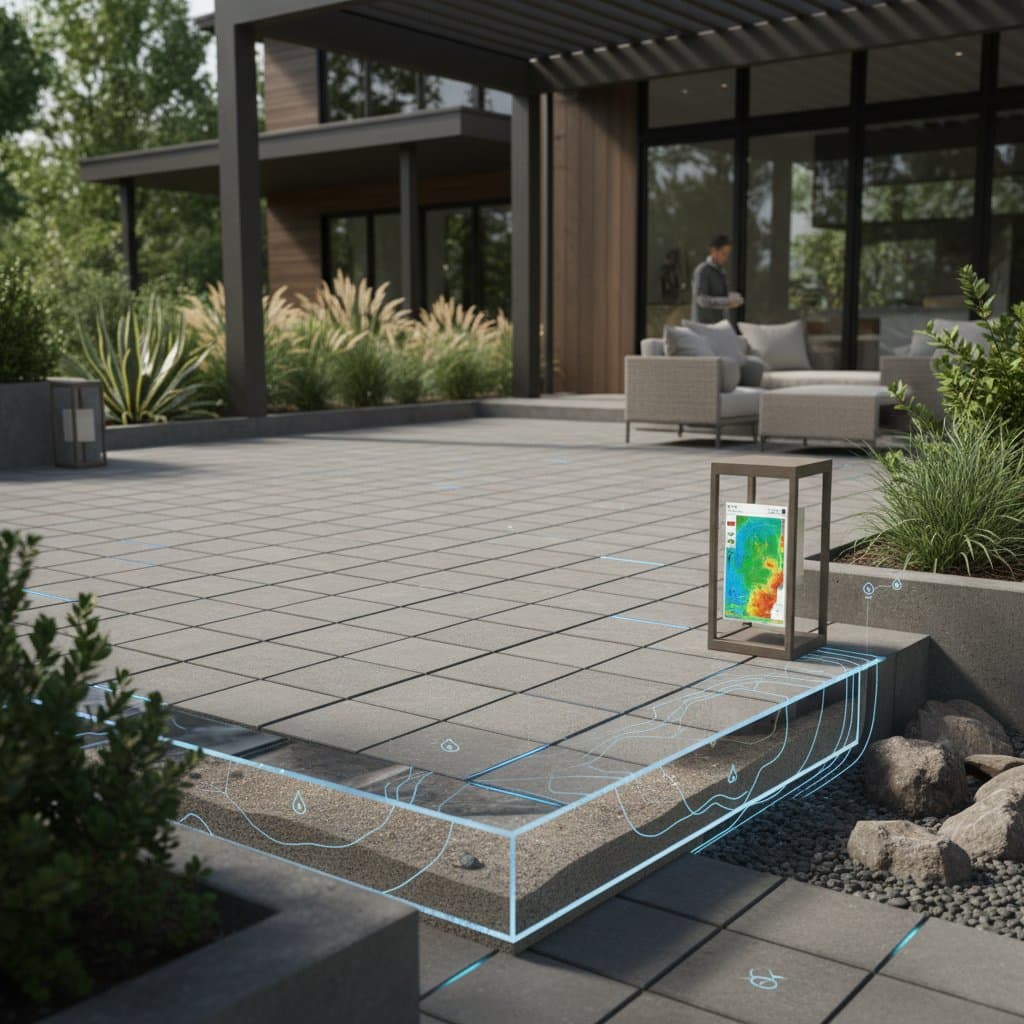
Smart Pavers: Detecting Hidden Water Issues Early
Overview
Smart pavers equipped with Internet of Things (IoT) sensors monitor water flow and soil moisture levels. These innovations transform traditional landscaping into proactive systems that alert homeowners and property managers to potential drainage problems. By integrating technology with hardscape elements, smart pavers extend surface longevity and minimize water waste, provided the underlying site preparation supports their function.
The primary challenges involve sensor integration, reliable data connectivity, and ongoing calibration. Without addressing these, the technology risks providing incomplete insights. Focus on foundational drainage before adopting advanced monitoring to achieve optimal results.
Initial Site Assessment
Examine your property after rainfall to understand water behavior. Persistent puddles lasting over 24 hours indicate inadequate drainage. Inspect slopes, gutters, and downspouts for proper alignment, ensuring water directs away from structures.
Conduct these straightforward evaluations to inform decisions about smart paver installation:
- Runoff patterns: Trace water paths post-rain to identify collection points or infiltration zones.
- Joint conditions: Search for weeds or white efflorescence, indicators of moisture retention.
- Soil evaluation: Insert a screwdriver into adjacent ground; soft or adhesive soil suggests poor percolation.
- Current systems: Review readings from existing irrigation sensors and correlate them with visual and tactile observations.
- Interior indicators: Detect musty smells or discoloration near basement walls or slab perimeters, signaling subsurface water intrusion.
These steps reveal whether technology will enhance or merely document existing issues.
Warning Signs of Water Management Failures
Certain observations demand immediate attention, as they highlight unmanaged water risks. Smart pavers excel at detection but require corrected site conditions to prevent recurrence.
Key indicators include:
- Water pooling against foundations or patio edges.
- Uneven settling or uplift in paved surfaces.
- Mineral crusts forming along joints.
- Growth of mold or algae on shaded areas.
- Moisture within electrical conduits or low-voltage fixtures.
- Clogged drains following brief showers.
- Shifted or fractured edging, pointing to unstable bases.
Address these through grading adjustments or drainage enhancements before sensor deployment.
Corrective Measures and Estimated Expenses
Prioritize site corrections over technological additions. Regrading compact patio zones costs approximately three to six dollars per square foot. Installing channel drains or permeable edges adds eight to fifteen dollars per linear foot.
For properly drained sites, integrate sensors during paver placement. Costs vary by system complexity:
- Moisture sensors embedded in pavers: Two to five dollars per unit for entry-level options.
- Full smart paver installations with hubs: Fifteen to twenty-five dollars per square foot, including labor.
- Monitoring subscriptions via cloud platforms: One hundred to three hundred dollars annually for home-scale setups.
- Infrastructure for power and data: Five hundred to one thousand five hundred dollars for wiring or solar integrations in average projects.
Standalone sensors offer limited utility without a cohesive network for data aggregation and notifications. Select systems with defined maintenance guidelines, as environmental factors like debris accumulation, temperature fluctuations, and usage can impair sensor performance beyond initial projections.
Evaluating Repairs Against Full Replacement
Assess aging patios or pathways to determine the best approach.
- Intact base with surface damage: Lift, reset, and embed sensors while reusing compatible stones.
- Compromised base causing movement: Opt for complete replacement, as sensors do not stabilize shifting substrates.
- Slopes below one percent: Adjust grading prior to reinstallation; sensors will verify but not resolve pooling.
- Automation components: Service or adjust current irrigation and drainage sensors before considering upgrades, unless precision issues persist post-maintenance.
Stable, permeable bases maximize smart paver effectiveness. Consult drainage specialists or engineers to confirm percolation and slopes prior to proceeding.
Assembling the Project Team
Initiate with a comprehensive site review by professionals versed in both landscaping and structural elements. Landscape architects or civil engineers map water routes and assess infiltration capacities, pinpointing sensor placement opportunities.
Engage hardscape contractors early for estimates on excavation, base preparation, and cabling. Coordinate IoT experts for network setup, sensor tuning, and interface development. Integrated teams streamline small residential efforts, provided roles remain clearly defined.
Concurrent specialist involvement accelerates progress. Inquire about their water management strategies beyond surface aesthetics. Appointing a project overseer incurs ten to twenty percent additional expense but mitigates costly revisions.
Essential Upgrade Priorities
Target interventions that yield tangible outcomes:
- Grading and drainage improvements: Investments here safeguard the entire property.
- Permeable substrates: Layers of open-graded aggregate minimize runoff and protect embedded components.
- Data acquisition via IoT: Implement after physical foundations ensure reliable inputs.
- Irrigation system linkages: Moisture metrics inform controllers, curbing excess usage.
- Utility pathways: Incorporate lighting and power during initial trenching to prevent future disruptions.
Defer cosmetic changes or redundant digital interfaces until functional elements perform consistently.
Budgeting and Installation Sequence
Phased execution balances expenses and ensures longevity:
- Resolve water ingress and establish slopes: Verify directional flow from buildings.
- Construct robust bases: Layer and compact aggregates while testing permeability.
- Embed utilities and sensors: Use burial-rated conduits for protection.
- Place pavers and seal joints: Select materials accommodating sensor connections.
- Activate networks and validate: Confirm data accuracy pre-sealing.
- Integrate automations: Proceed only with verified sensor outputs.
- Tune and archive baselines: Document initial conditions for ongoing reference.
Omit tuning at your peril; it prevents erroneous notifications. Structured timelines maintain accountability and eliminate redundant excavations.
Ongoing Care and Sensor Tuning
Regular upkeep sustains smart paver performance. Accumulated debris or deposits can skew readings by blocking sensor exposure. Perform annual cleanings and joint inspections.
Tune sensors seasonally or following significant precipitation that alters soil profiles. Integrate battery or solar replacements into standard yard routines.
Schedule software enhancements deliberately to preserve calibration settings. Maintain physical records of metrics and interventions alongside digital logs for dependable verification.
Potential Challenges and Returns
Overreliance on technology without site corrections poses the greatest hazard. Smart pavers document issues but demand proactive resolutions for grading or upkeep deficiencies.
Benefits accrue through damage prevention and resource efficiency. Analytics refine watering routines, prolong pavements, and conserve water. Returns build gradually, emphasizing reliability over rapid gains.
Professional Perspectives
A landscape engineer from a coastal area observes, "Most failures we see come from skipping the boring steps. They install sensors before controlling runoff, then blame the tech when readings stay high."
An estate project supervisor notes, "We trench once, lay conduit, drainage, and sensor lines together. That way, the owner gets clean data and fewer callbacks."
These accounts underscore the importance of integrated planning.
Enduring Advantages
Established smart paver arrays integrate into property operations. They monitor compaction, identify leaks, and evaluate post-storm drainage.
On expansive sites, combining with weather inputs can reduce consumption by up to one-third. Residential applications provide timely alerts, flagging clogs or shifts before surface harm emerges.
Sustaining System Performance
Monitor after heavy rains, clearing joint obstructions. Verify network indicators and address seal failures promptly to protect wiring.
Retain installer contacts for updates and tuning assistance. Log all maintenance for future reference.
Smart pavers function as vital water management tools. Paired with precise grading, resilient bases, and diligent care, they evolve static surfaces into responsive networks, delivering dependable landscapes with minimal intervention.