
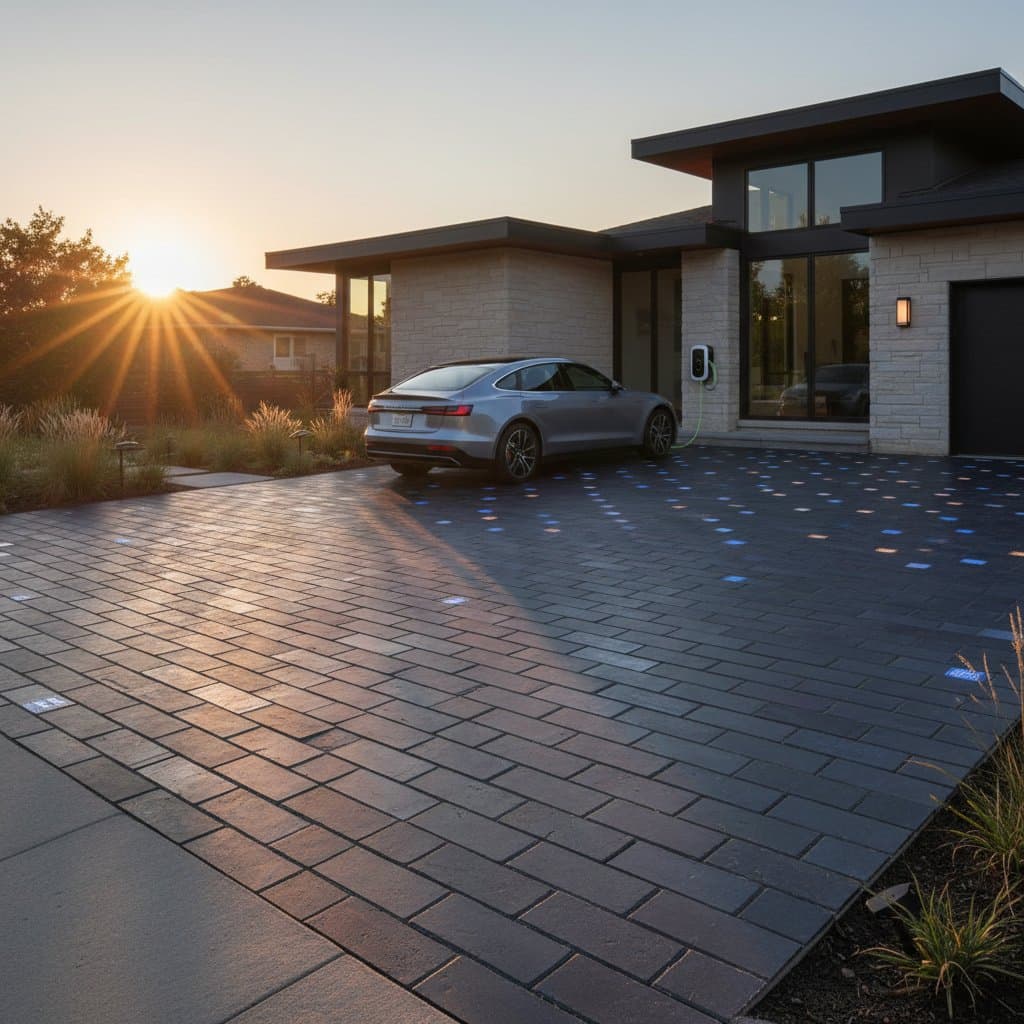
Solar Pavers: Driveways That Generate and Illuminate Your Home
Solar pavers consist of hardscape blocks embedded with photovoltaic cells. These blocks resemble conventional concrete or stone pavers, yet they capture sunlight and convert it into usable electricity. Homeowners can direct this energy toward outdoor lighting, battery storage, or integration with the home electrical system. For those seeking renewable energy solutions without rooftop installations, solar pavers enable driveways and pathways to function as productive energy-generating surfaces.
Advantages and Disadvantages
Advantages
- Produce renewable energy on existing paved areas.
- Integrate seamlessly into traditional paver designs with sleek, contemporary finishes.
- Decrease dependence on utility power for applications such as outdoor illumination or electric vehicle charging.
- Allow combination with non-solar pavers to manage expenses and customize arrangements.
- Contribute to environmental objectives through innovative design elements.
Disadvantages
- Involve greater initial expenses compared to ordinary concrete or brick options.
- Offer fewer style and color varieties than conventional pavers.
- Exhibit reduced efficiency relative to rooftop solar arrays, influenced by potential shading and accumulated debris.
- Demand precise wiring and waterproof connections beneath the surface.
- Present more intricate repair processes if wiring or solar modules malfunction.
Pricing Considerations
Solar paver materials generally cost between 18 and 35 dollars per square foot, varying by energy capacity and surface treatment. Professional installation, encompassing wiring, control systems, and foundational preparation, elevates the total to 30 through 60 dollars per square foot.
Several elements influence these variations:
- Power specifications: Modules with elevated wattage command premium prices.
- Surface characteristics: Textured or custom finishes increase expenses.
- Electrical configuration: Extended wiring paths or intricate patterns raise labor demands.
- Site conditions: Confined or inclined areas necessitate additional preparation time.
- System enhancements: Incorporation of battery units or intelligent controls amplifies overall investment.
Projects targeting modest driveway segments for lighting purposes incur lower costs, whereas comprehensive setups with energy storage demand higher budgets.
Durability and Upkeep
Solar pavers typically endure 20 to 25 years of service. While the encasing concrete or resin may persist longer, the embedded photovoltaic components gradually diminish in performance. Upkeep remains straightforward yet requires regularity:
- Remove dirt, oil stains, and foliage to optimize sunlight absorption.
- Clean with a gentle detergent solution and water several times annually.
- Examine joints for weed growth or subsidence that could impair water runoff.
- Monitor wiring enclosures and connections for signs of water penetration.
- Substitute impaired units without delay to preserve system integrity.
Consistent cleaning proves essential. A mere layer of dust can diminish energy production by multiple percentage points.
Essential Specifications to Evaluate
Prior to purchasing solar pavers, verify the following attributes:
- Wattage generation per unit and projected aggregate system capacity.
- Load-bearing compressive strength adequate for vehicular traffic.
- Slip-resistant properties for secure footing during inclement weather.
- Ingress protection rating against water and particulate ingress.
- Operational temperature range compatible with local weather patterns.
- Connection mechanisms and suitability for low-voltage applications.
Request certification documents attesting to adherence with electrical safety norms and suitability for exterior environments.
Site Preparation Essentials
Effective solar driveway projects commence with thorough subsurface groundwork. This process mirrors standard paver installation yet incorporates strategic conduit placement for electrical routing.
Critical assessments:
- Assess gradient to direct drainage clear of buildings.
- Evaluate soil firmness and achieve required compaction levels.
- Map underground conduit pathways prior to any digging.
- Steer clear of root systems or shaded regions that hinder output.
- Locate and mark subsurface utilities to prevent disruptions.
Secure necessary electrical permits from local authorities if mandated in your jurisdiction.
Installation Process
- Design the layout. Delineate the boundaries and pattern, incorporating solar and conventional pavers as needed.
- Excavate the site. Clear earth to accommodate base material, bedding course, and paver depth.
- Establish the foundation. Layer and compact crushed aggregate for firm underpinning.
- Position conduits. Install low-voltage tubing and access points beneath the uppermost base layer.
- Level the bedding. Distribute and smooth sand or fine gravel evenly.
- Place the pavers. Align from a fixed edge, maintaining uniform spacing.
- Link the electrical components. Attach according to manufacturer guidelines, ensuring all seals are intact.
- Apply perimeter restraints. Fasten borders to inhibit movement.
- Seal the joints. Introduce polymeric sand into crevices and vibrate to settle.
- Validate functionality. Measure electrical output prior to concluding.
Engage a certified electrician for all wiring tasks. Improper handling of even low-voltage setups risks malfunctions or safety issues.
Design Configurations and Choices
Solar pavers accommodate diverse installation approaches:
- Complete surfacing: All blocks contribute to energy production, ideal for unobstructed, sunlit expanses.
- Hybrid arrangements: Solar elements create grids or linear accents amid standard pavers.
- Targeted sections: Limit generation to zones like garage approaches or entry paths.
- Illuminated perimeters: Employ solar blocks to energize embedded LED strips along edges.
Blending solar and traditional pavers optimizes both budget and visual harmony. Numerous owners opt to emphasize select areas rather than outfitting the full driveway.
Self-Installation Versus Professional Services
Individuals with prior paver-handling expertise may manage minor ornamental zones independently. Tasks such as site grading, base stabilization, and joint finishing align with routine procedures.
Engage specialists for:
- Surfaces supporting vehicle weight.
- Electrical integration with home systems.
- Adjustments to drainage or elevation.
- Advanced features like energy storage or automated monitoring.
Electrical finalization demands a licensed professional. Self-attempts may breach regulations and invalidate guarantees.
Typical Issues and Resolutions
Issue: Diminished or absent energy generation.
Reason: Surface contamination, compromised cells, or disrupted links.
Solution: Thoroughly clean the blocks, measure voltage sequentially, and swap defective components.
Issue: Moisture within connection housings.
Reason: Inadequate sealing or fractured casings.
Solution: Evaporate excess water, apply fresh seals, and install new gaskets.
Issue: Irregular elevation or displacement.
Reason: Inadequate foundational density or border failures.
Solution: Adjust the impacted section and realign seams.
Issue: Non-functional LED fixtures.
Reason: Defective controllers or wiring faults.
Solution: Inspect protective fuses, conductors, or substitute the lighting assembly.
Location-Specific and Weather Considerations
Solar pavers perform optimally in regions with consistent solar irradiance. Yield decreases in overcast or high-latitude areas, though they adequately support modest loads like pathway illumination.
In areas prone to freezing and thawing:
- Select units engineered for thermal cycling resilience.
- Facilitate base drainage to avert uplift.
- Refrain from joint sealants that retain water.
For arid or marine environments:
- Choose UV-resistant exteriors and anti-corrosive fittings.
- Routinely rinse away salts or abrasives to safeguard coatings.
Regions with intermittent sunlight still yield advantages for auxiliary circuits, such as automated gates or security features.
Comparable Solutions
Should solar pavers appear prohibitive in cost or complexity, explore these alternatives:
- Elevated solar arrays on roofs or overhangs: Superior output with simplified care.
- Standalone solar lanterns or stakes: Effortless illumination absent subsurface cabling.
- Conventional pavers with pre-installed pathways: Facilitate future solar additions.
- Photovoltaic surface applications: Emerging coatings that energize existing concrete with minimal power.
Selections vary in visual impact, expenditure, and performance. Solar pavers deliver the most unobtrusive ground-based renewable integration, though other avenues exist for sustainable energy.
Sustaining System Performance
Preserve your solar driveway's efficacy through:
- Periodic rinsing using water and a non-abrasive brush.
- Quarterly reviews of seams and boundaries.
- Cautious snow clearance employing plastic implements to prevent cell abrasion.
- Tracking production via inverter displays or digital interfaces; declining readings indicate maintenance requirements.
- Prompt replacement of underperforming modules to safeguard adjacent elements.
Diligent care sustains efficiency and prolongs utility. Such surfaces not only enhance appearance but also provide reliable, unobtrusive power generation.
Advancing Your Project
For driveway renovations or replacements, solar pavers combine resilience with renewable output. Initiate with a professional assessment of solar exposure and connection feasibility. Evaluate manufacturers based on performance metrics, structural robustness, and assurance terms.