
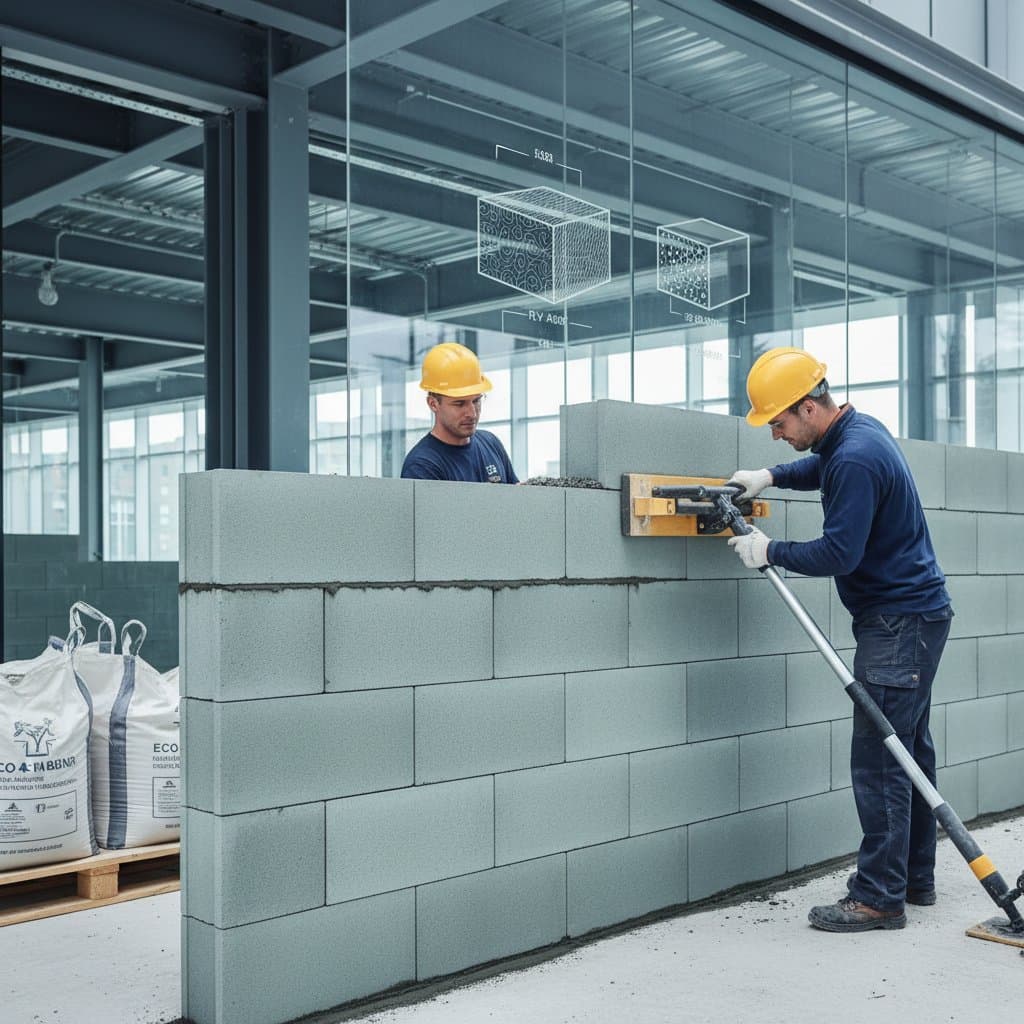
Quick Overview
Geopolymer blocks represent an innovative masonry option that delivers compressive strength up to three times that of conventional fired clay bricks. These blocks incorporate industrial by-products like fly ash or slag, which minimize the need for cement and reduce the embodied carbon footprint. Primary expenses arise from precise curing requirements, optimized mix formulations, and potential challenges with regional availability.
Essential Checks
Before incorporating geopolymer blocks into a renovation or new construction project, verify several fundamental aspects.
Examine the uniformity of color and texture throughout the batch. Variations in shade or fragile edges often indicate inadequate curing.
Strike several blocks lightly with a hammer or trowel handle. A resonant tone signifies solid material, whereas a muted sound suggests internal voids or weak bonding.
Assess dimensional accuracy by stacking three or four blocks without mortar. The alignment should remain stable without any wobbling.
Review the storage conditions on pallets for signs of dampness or efflorescence. The presence of white crystalline deposits points to suboptimal storage practices.
Request laboratory test results for compressive strength and water absorption rates. Reputable suppliers provide this documentation readily.
Warning Signs
- Inconsistent block dimensions or damaged corners.
- Surfaces that feel powdery or exhibit chalking.
- Absence of technical specifications from the supplier.
- Unrealistic assertions such as zero water absorption or complete immunity to cracking.
- Formulations dependent on unidentified additives rather than established materials like fly ash or slag.
- Local building authorities lacking familiarity with the product, which may prolong permitting processes.
Common Solutions and Estimated Expenses
Geopolymer blocks typically command a premium of 10 to 20 percent over clay bricks per unit in many areas. This difference frequently diminishes when accounting for reduced mortar consumption and accelerated assembly times due to their consistent dimensions and lighter weight, which lessen labor demands.
Should a shipment show signs of softness or brittleness, decline acceptance upon arrival. On-site corrections for curing deficiencies prove impossible.
Enhance joint integrity by selecting polymer-modified mortar compatible with the block's composition. Standard cement-based mortar risks compromising the connection.
Protective coatings remain optional in most cases. For harsh environmental exposure, apply a breathable silicate-based sealer at approximately 2 to 3 dollars per square foot.
Potential issues stem from installation teams or designers inexperienced with the material, who may approach it as ordinary brick. Incorrect mortar choices or curing techniques can result in rework and diminished performance.
Repair Strategies Versus Full Replacement
Walls
Address cracks narrower than 2 millimeters using low-viscosity polymer grout. Opt for replacement only if cracks exhibit vertical shifting or extensive delamination.
Mortar Joints
Repoint with an alkali-activated paste formulated for compatibility. Steer clear of mortar mixes heavy in cement, as they generate stress concentrations at interfaces.
Finishes
Select coatings that permit vapor transmission. Materials like acrylic paints or thick cement stucco can retain moisture, leading to surface spalling.
Foundations
Employ geopolymer blocks below grade solely if certified for such applications. Certain formulations lack suitability. In saturated soils, prefer concrete blocks or poured footings.
Retrofit Applications
When integrating into existing walls, ensure the original masonry withstands the elevated compressive strength. Fragile lime-based mortar may fail under the rigidity of geopolymer units.
Assembling the Right Team and Workflow
Engage a structural engineer versed in alternative binding agents from the outset. This expert evaluates load distribution and modifies foundation designs as necessary.
Consult an architect to affirm adherence to building codes, detail joint configurations, incorporate insulation, and manage vapor barriers.
Involve the general contractor early for accurate pricing and identification of procurement challenges. Disruptions in the supply chain pose significant delays.
Include the manufacturer's technical advisor in initial discussions. This individual offers insights on mix compatibilities and optimal joint thicknesses.
Coordinate trade involvement concurrently rather than sequentially. Masons new to geopolymer blocks benefit from reviewing mockup assemblies prior to commencing full-scale work.
Dedicated project management incurs an additional 10 to 20 percent in costs, yet ensures seamless collaboration among suppliers, engineers, and installers.
Key Priorities for Project Scope
Focus on applications where geopolymer blocks excel:
- Exterior walls designed to withstand moisture ingress and temperature fluctuations.
- Load-bearing interior partitions in areas requiring fire resistance.
- Substitutions for degraded brickwork emphasizing enhanced durability and lifespan.
Postpone non-essential implementations, such as ornamental garden walls or brief landscape features. The material's superior strength surpasses requirements there, rendering it uneconomical.
Retain intact existing brick structures whenever feasible. Reserve geopolymer blocks for scenarios where structural upgrades or environmental benefits warrant the investment.
Budgeting and Phased Implementation
Sequence tasks based on interdependencies and potential risks.
-
Validate supplier reliability and batch consistency prior to finalizing designs.
-
Level the foundation or slab precisely, as these blocks demand exact alignments.
-
Construct sample panels to test joint performance and aesthetic outcomes.
-
Advance to full wall erection following mockup approval.
-
Maintain vigilant moisture management near windows, doors, and roof edges. Install flashing and drip edges consistent with brick standards.
-
Apply finishes after the blocks attain maximum strength, typically following a designated curing phase.
Prioritize moisture mitigation throughout. Redirect downspouts from wall bases and prevent ground-level splash. Although geopolymer blocks exhibit superior water resistance compared to clay bricks, persistent wetting accelerates joint degradation.
Strength, Durability, and Performance Metrics
Quality geopolymer blocks exhibit compressive strengths ranging from 40 to 60 megapascals, approximately three times that of typical bricks. They retain integrity under elevated temperatures and corrosive conditions.
The thermal mass mirrors that of dense concrete, aiding in stable indoor climates.
Production relies on aluminosilicate reactions rather than Portland cement hydration, emitting minimal carbon dioxide and potentially halving the embodied carbon compared to traditional methods.
Water absorption generally falls below 10 percent by weight, mitigating freeze-thaw cycles. However, no masonry achieves absolute waterproofing. Joint integrity and effective drainage remain critical.
These blocks provide excellent sound attenuation and fire resistance, releasing no hazardous gases under combustion.
Ongoing Maintenance and Extended Service Life
Conduct periodic inspections of visible walls every few years, focusing on cracks or joint wear. Perform cleaning with gentle water pressure, avoiding acidic solutions.
For repainting, choose mineral or silicate paints that facilitate vapor escape.
Install mechanical fasteners without penetrating the block surface. Favor chemical anchors or sleeved through-bolts.
Observe for differential settlement at openings and corners. The material's rigidity may mask minor shifts until abrupt stress manifestations occur.
Steps to Successful Adoption
Visit a completed geopolymer block installation to evaluate joint aging and any efflorescence development.
Conduct a comprehensive cost analysis encompassing labor, mortar quantities, and curing oversight, beyond mere unit pricing.
Account for logistical hurdles if local sourcing proves scarce, including transport and storage safeguards.
Direct your mason to erect a modest test wall, subject it to rainfall over several weeks, and then scrutinize for discoloration or joint failures.
Retain comprehensive records, including mix compositions, curing protocols, and testing outcomes.
Geopolymer blocks yield substantial advantages in strength, water repellency, and environmental impact when managed with precision. They stand as a compelling substitute for conventional brick or concrete masonry in forward-thinking builds.