
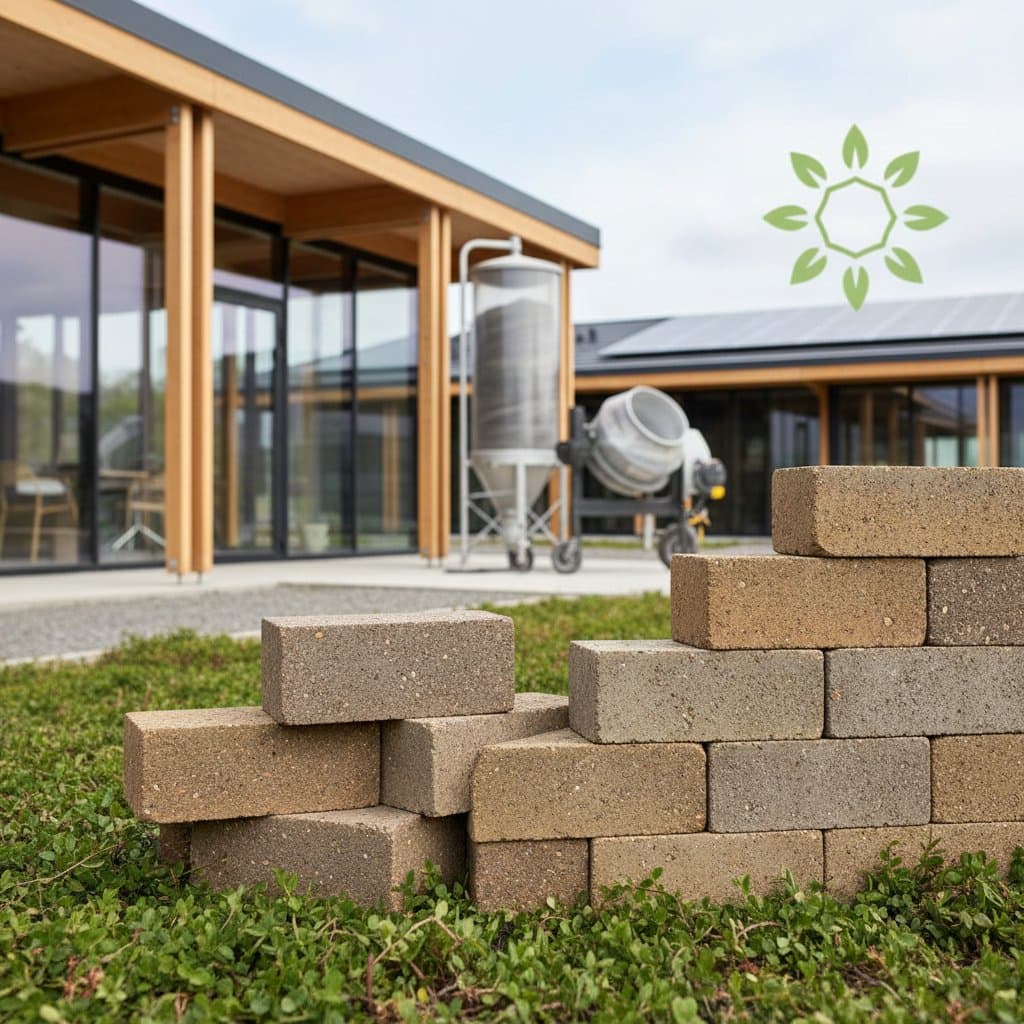
Understanding Geopolymer Bricks
Geopolymer bricks represent a breakthrough in sustainable masonry, eliminating the need for Portland cement. These zero-cement units bind industrial by-products, such as fly ash from coal plants or ground blast-furnace slag, with alkaline activators. A polymerization reaction creates a dense, rock-like matrix that matches or surpasses conventional concrete in compressive strength and longevity.
Producing traditional cement involves heating limestone, which releases substantial carbon dioxide. By bypassing this process, geopolymer bricks reduce emissions by up to 80 percent compared to standard options. They also divert waste from landfills, conserving natural resources and minimizing environmental impact.
At their core, these bricks form through a geopolymerization process, where aluminosilicate materials react to build a three-dimensional network. This yields a versatile product ideal for load-bearing walls, facades, and paving, all while maintaining low thermal conductivity for energy-efficient structures.
The Role of Zero-Cement Bricks in Sustainable Building
Adopting zero-cement bricks aligns with worldwide efforts to decarbonize construction, an industry responsible for nearly 40 percent of global emissions. Cement alternatives like geopolymers preserve performance while slashing the carbon footprint. Their lower embodied energy—from extraction to production—supports certifications such as LEED or BREEAM.
These bricks excel in harsh conditions, enduring temperatures up to 1,200 degrees Celsius and resisting sulfates or acids better than Portland-based materials. Reduced shrinkage during curing minimizes cracks, extending service life beyond 50 years in many cases. Installers appreciate the consistent sizing and finish, which streamline workflows and eliminate the need for paints or sealants.
Beyond performance, geopolymer bricks promote circular economy principles by valorizing by-products. Sourcing locally cuts transportation emissions, and their recyclability at end-of-life further enhances sustainability credentials.
Planning a Geopolymer Brick Project
Successful integration of geopolymer bricks starts with thorough planning. Determine if your project requires structural support or aesthetic elements, as these influence brick selection and layout. Engage a structural engineer early, especially for buildings over two stories, to verify compliance with building codes like ASTM C90 for masonry units.
Site Evaluation
Assess ground conditions to ensure stability. Test soil for bearing capacity, typically needing at least 1,500 pounds per square foot for residential foundations. Address poor drainage with gravel layers or French drains to prevent water accumulation, which could undermine the wall.
Quantity Calculations
Measure the total surface area by multiplying wall height in feet by length in feet. For a 10-foot-high by 20-foot-long wall, that equals 200 square feet. Divide by the brick's face area—often 0.17 square feet for standard sizes—and add 10 percent for breakage: order around 1,300 units.
Climate Considerations
Account for local weather during installation. In hot climates above 90 degrees Fahrenheit, mist bricks to control curing speed and avoid thermal cracking. Humid areas may require ventilation provisions to manage moisture vapor.
Selecting the Ideal Geopolymer Brick Type
Tailor your choice to project demands, balancing availability, performance, and budget. Each variant leverages specific by-products for unique advantages.
-
Fly Ash-Based Bricks
-
Advantages: High early strength up to 5,000 psi, fine texture for clean joints, and abundant supply from power plants.
-
Drawbacks: Quality varies with ash composition; potential supply disruptions from shifting energy policies.
-
Required Expertise: Intermediate; mix activators precisely to avoid weak bonds.
-
Upkeep: Minimal; rinse with water annually to remove dust.
-
Slag-Based Bricks
-
Advantages: Exceptional durability against abrasion and chemicals, ideal for marine or factory settings.
-
Drawbacks: Denser at 120 pounds per cubic foot, increasing transport costs.
-
Required Expertise: Intermediate to advanced; monitor curing for optimal density.
-
Upkeep: Low; inspect for efflorescence and clean with a soft brush.
-
Hybrid Geopolymer Bricks
-
Advantages: Blends fly ash and slag for tailored traits, like enhanced fire resistance or color variation.
-
Drawbacks: Requires lab testing for consistency in non-standard mixes.
-
Required Expertise: Advanced; best handled by certified producers.
-
Upkeep: Comparable to standards; seal porous hybrids if exposed to salts.
Opt for fly ash variants in cost-sensitive residential builds. Select slag for demanding commercial applications. Hybrids suit innovative designs where aesthetics meet functionality.
Essential Tools and Materials
Equip yourself with reliable gear to ensure precise work. Basic hand tools include a pointing trowel for mortar spreading, a 4-foot spirit level for straight runs, and a bolster chisel for adjustments.
Power options feature a 1/2-inch drill with paddle mixer for batches under 5 gallons, plus a wet saw with diamond blade for accurate cuts without chipping. Rent a vibrating plate compactor for sub-base preparation on larger sites.
Stock up on geopolymer bricks, a matching alkali-activated mortar (avoid Portland types to preserve low-carbon benefits), and coarse sand for joint filling. Purchase 10 to 15 percent surplus bricks to account for on-site variables like uneven cuts or defects.
Installing Geopolymer Bricks Step by Step
Follow these steps for a secure, professional result. Precision in early stages prevents costly corrections later.
-
Establish the Foundation. Excavate to frost depth, typically 36 inches in cold regions, and pour a concrete footing at least 8 inches thick. Compact gravel backfill to 95 percent density using a tamper.
-
Prepare Mortar Mix. Combine activator solution with dry geopolymer binder per supplier ratios, aiming for a peanut butter-like consistency. Mix small batches to use within 30 minutes.
-
Set the Initial Course. Butter brick ends with mortar, press into place, and align using a mason's line stretched between corner stakes. Maintain 3/8-inch joints for expansion.
-
Build Upward Layers. Offset each row by half a brick to interlock units. Apply 3/8-inch mortar beds, tapping bricks level with a rubber mallet.
-
Monitor Progress Regularly. Plumb walls every third course with a 6-foot level; adjust with shims if needed. Measure diagonals to confirm squareness.
-
Complete Joint Finishing. After 20 minutes, strike joints with a jointer tool for a concave profile that repels water. Brush excess mortar immediately.
-
Allow Curing Time. Cover with damp burlap for 48 hours in dry conditions to promote even hardening. Avoid loading for seven days.
Attention to detail here builds resilience against seismic or wind forces.
Maintaining and Enhancing Geopolymer Structures
Geopolymer walls demand minimal intervention for decades of service. Conduct yearly visual checks for joint erosion, repairing small cracks with compatible grout injected under pressure.
Clean facades using a low-pressure washer at 500 psi with biodegradable soap, avoiding abrasives that could etch the surface. In polluted areas, apply a breathable silane sealant every five years to guard against staining.
Integrate greenery like vertical gardens or trellises to amplify insulation and biodiversity. Pair with energy-efficient windows for passive solar gains, maximizing the bricks' thermal mass. These additions not only extend functionality but also showcase the material's role in resilient, low-impact design.