
Understanding Geopolymer Bricks
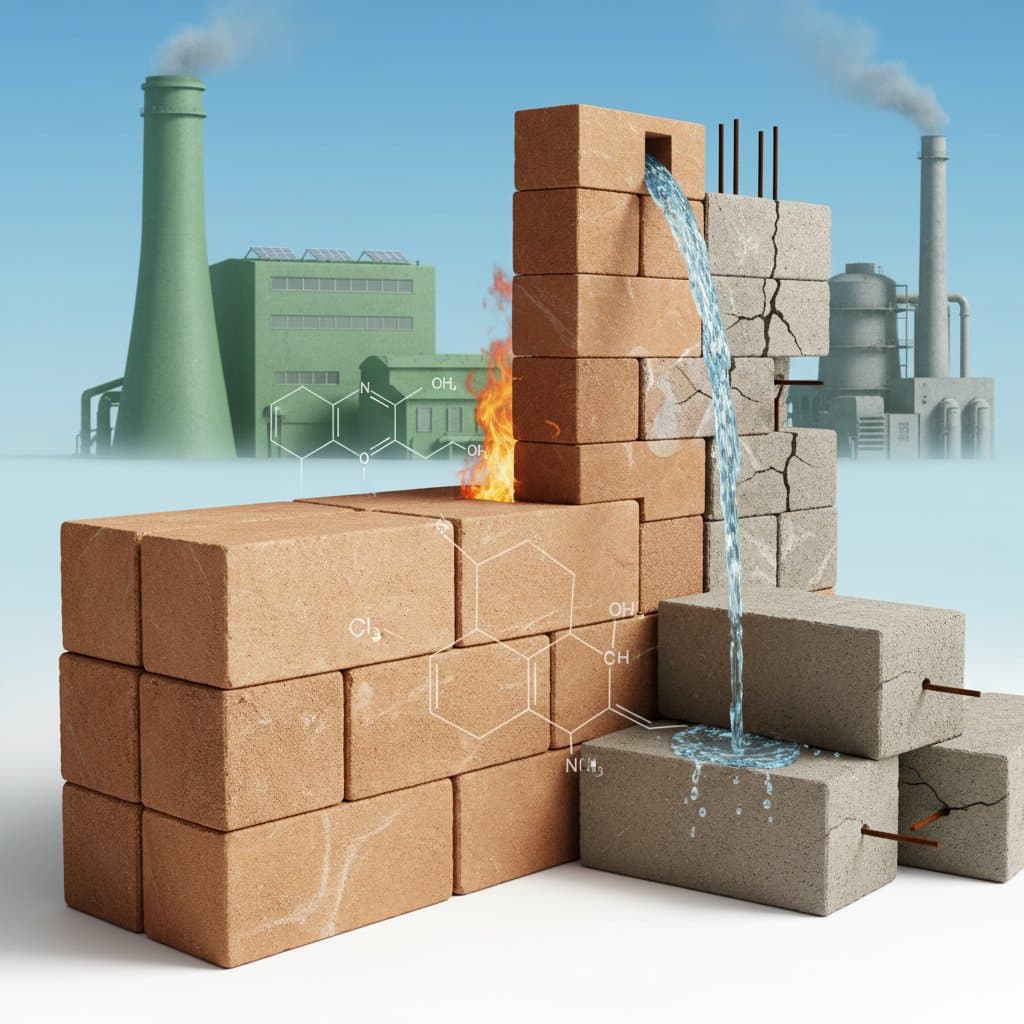
Geopolymer bricks represent a significant advancement in modern masonry, providing a cleaner, more robust, and sustainable option compared to traditional cement blocks. These bricks form through the combination of industrial by-products, such as fly ash or slag, with alkaline activators. This process triggers a chemical reaction that produces a durable, stone-like material without requiring high-temperature kilns. The outcome is a product with outstanding structural strength and a minimal environmental impact.
Traditional cement production emits substantial carbon dioxide and demands considerable energy. Geopolymer technology employs a room-temperature chemical bonding process that substantially lowers emissions. This approach preserves, and frequently enhances, the material's strength and longevity.
Why Geopolymer Matters
The underlying science of geopolymer materials alters the performance characteristics of masonry products. Unlike cement, which depends on heat-driven hydration, geopolymerization reorganizes silica and alumina molecules into a stable three-dimensional framework. This structure confers exceptional resistance to heat, water, and chemical exposure. Consequently, these bricks endure longer, retain greater strength, and demand less ongoing maintenance.
For builders and homeowners who prioritize sustainability alongside reliable performance, geopolymer bricks mark a pivotal innovation. They adapt seamlessly to large-scale commercial endeavors and modest residential applications, delivering uniform quality, precise dimensions, and minimized waste.
Transitioning from Cement to Geopolymer
Cement has served as the foundation of construction for decades, yet its environmental toll proves substantial. Producing one ton of cement releases approximately one ton of carbon dioxide. As awareness of emissions rises, experts and builders pursue alternatives that balance ecological benefits with dependable functionality. Geopolymer bricks fulfill this demand effectively.
Beyond their environmental merits, these bricks offer practical superiorities. They set rapidly, resist cracking, and withstand harsh conditions more effectively than standard cement blocks. In areas characterized by elevated humidity, salinity, or temperature fluctuations, geopolymer masonry preserves its form while traditional cement may deteriorate.
Comparing Strength and Performance
Laboratory tests reveal that geopolymer bricks frequently surpass cement-based counterparts in compressive strength. Their compact microstructure impedes moisture penetration, thereby curbing efflorescence and mold development. Fire resistance stands out as a key advantage. Cement loses integrity under prolonged high heat, whereas geopolymer materials maintain composure at elevated temperatures, often exceeding 1000 degrees Celsius.
Additionally, their reduced shrinkage minimizes gaps and promotes superior alignment in walls or pavements over time. This precision appeals to builders, as it curtails the need for corrections and prolongs the service life of completed structures.
Planning Your Geopolymer Brick Project
Prior to integrating a novel building material, assess its compatibility with your project's scale, financial constraints, and technical specifications.
Evaluating the Site
Examine the soil composition, drainage patterns, and terrain gradient. Firm, adequately drained soil bolsters geopolymer masonry in the same manner as conventional blockwork. Inadequate drainage compromises any foundation, so implement appropriate grading and implement moisture management strategies.
Key Environmental Considerations
Geopolymer bricks excel in water and chemical resistance, rendering them ideal for coastal environments, flood-risk areas, or regions with fluctuating climates. Their thermal endurance positions them as a prudent selection in wildfire-vulnerable locales, where they can withstand radiant heat without structural compromise.
Potential Challenges
Availability and expertise may vary by region. Contractors unfamiliar with geopolymer products could require instruction on mixing proportions and curing protocols. Consult manufacturer specifications for accurate activator dosages and safety protocols, including ventilation during mixing.
Ensuring Compliance
Building regulations increasingly accommodate geopolymer materials. Verify requirements with local building departments and homeowners' associations prior to commencement. When excavation is involved, contact utility services, such as dialing 811 in the United States, to locate buried lines.
Selecting Geopolymer Materials
The choice of geopolymer formulation influences aesthetics and functionality.
Fly Ash-Based Bricks
- Description: Produced from coal combustion residues blended with an alkaline solution.
- Advantages: High strength, reduced weight, superior thermal insulation properties.
- Disadvantages: Potential color inconsistencies stemming from source variations in ash.
- Cost: Typically economical.
- Required Expertise: Moderate.
Slag-Based Bricks
- Description: Sourced from steel production by-products, yielding compact, robust blocks.
- Advantages: Exceptional durability, minimal porosity, appropriate for load-bearing applications.
- Disadvantages: Marginally elevated cost and density.
- Cost: Higher than fly ash options.
- Required Expertise: Intermediate.
Hybrid Blends
- Description: Integrate various industrial residues to achieve optimized traits.
- Advantages: Tailorable strength, coloration, and surface texture.
- Disadvantages: Demands rigorous quality assurance.
- Cost: Moderate range.
- Required Expertise: Intermediate to advanced.
Recommendation: Acquire ten percent more bricks than estimated to account for cuts, breaks, or unforeseen losses.
Essential Tools and Materials
Standard masonry equipment suffices for constructing walls, pathways, or landscape elements.
Essential Hand Tools
- Brick trowel: Ensures even application of mortar or adhesive.
- Mason's hammer: Facilitates cutting and shaping of bricks.
- Level: Confirms vertical and horizontal accuracy.
- Jointing tool: Finishes mortar joints for a professional appearance.
Recommended Power Tools
- Wet saw equipped with a masonry blade: Delivers precise brick sections.
- Mixing drill: Achieves homogeneous geopolymer mixtures.
Equipment Rentals
- Plate compactor: Levels substrates for pavements effectively.
- Masonry mixer: Handles substantial volumes of binder efficiently.
For smaller projects, manual mixing in a sturdy container works adequately.
Safety essentials include gloves, protective eyewear, and a respirator for dealing with alkaline activators and powders.
Step-by-Step Guide to Wall Construction
- Prepare the Foundation. Compact and level the base thoroughly. Establish reference lines with string for alignment. A stable foundation averts differential settlement.
- Prepare the Binder. Adhere to manufacturer guidelines for activator proportions. Stir until the mixture is uniform and free of clumps.
- Install the Base Course. Spread a consistent binder layer, then position bricks adjacently. Verify levelness periodically during placement.
- Erect Subsequent Courses. Offset joints between layers to enhance stability. Preserve uniform gaps for binder application.
- Facilitate Curing. Geopolymer sets without supplemental moisture. Shield the structure from direct sun and disturbance for a minimum of 24 hours.
- Complete the Joints. Tool the seams once the binder firms up, creating smooth, weather-resistant finishes.
Quality assurance: After every three courses, inspect for plumb and level. Address deviations promptly to maintain structural integrity.
Extending the Benefits of Geopolymer Bricks
Applying Finishes
A refined surface improves both visual appeal and longevity. Sealants should apply only as recommended by the producer. Options like paint or stucco offer customization, although the inherent texture of geopolymer bricks often serves as a desirable exposed finish.
Ongoing Maintenance
These structures demand little attention. Conduct yearly inspections for fissures near edges or apertures. Clean surfaces with water and gentle detergent solutions. Steer clear of abrasive or acidic cleaners that could etch the material.
Creative Applications
Incorporate geopolymer bricks into retaining walls, border edging, outdoor cooking areas, or fire pits. Their resilience to heat and dampness supports diverse structural and ornamental roles.
Avoiding Pitfalls
- Deviating from specified activator ratios, which compromises adhesion.
- Neglecting alignment verifications, resulting in crooked assemblies.
- Excessive rinsing during cleaning, potentially causing discoloration.