
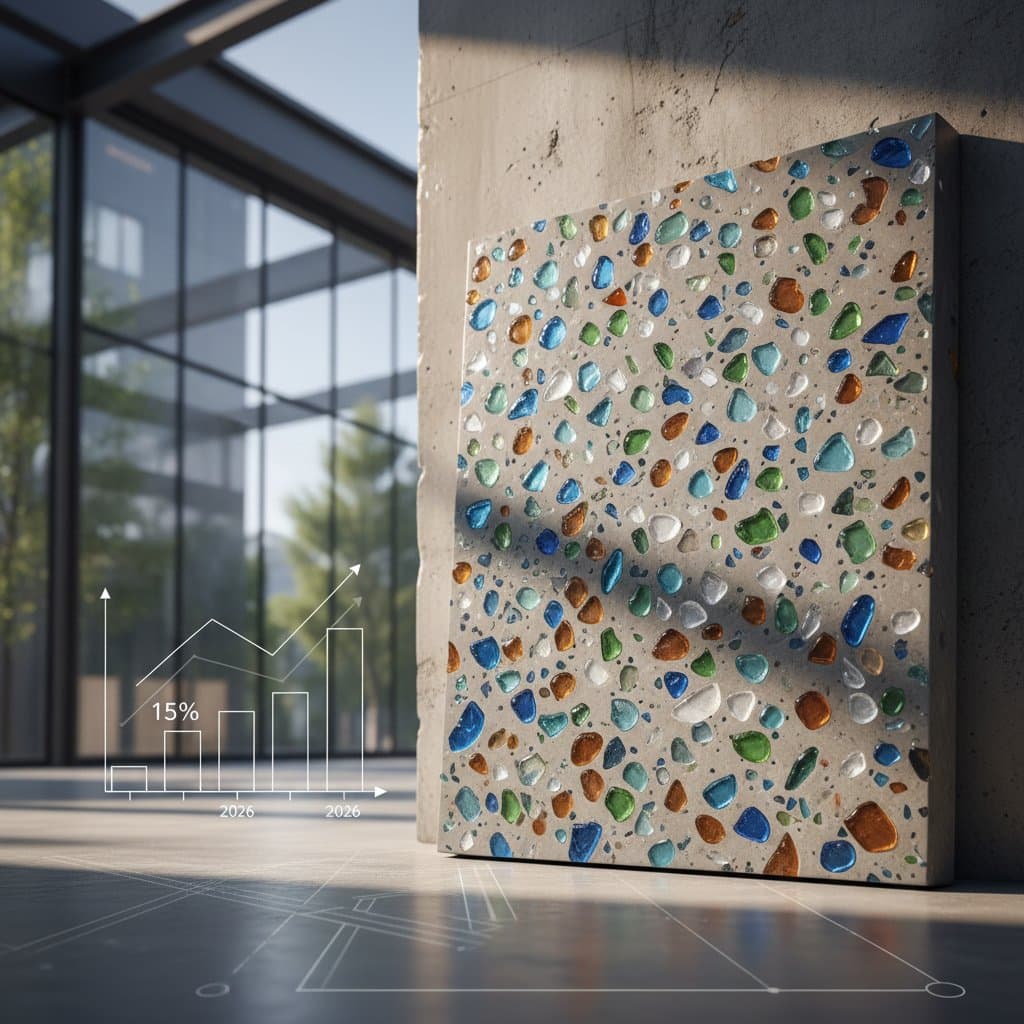
Why Recycled Glass Transforms Concrete in 2026
Concrete forms the backbone of contemporary construction, yet its production carries a heavy environmental burden. Cement manufacturing ranks among the top contributors to industrial carbon emissions. At the same time, vast quantities of glass waste accumulate in landfills annually. This intersection of challenges presents a compelling solution: recycled glass serves as a groundbreaking additive in concrete, delivering sustainability alongside enhanced performance. The following sections detail the mechanics of recycled glass concrete, its rising adoption, and essential considerations for integration into projects.
Key Takeaways
- Cost Efficiency: Recycled glass concrete generally costs 5 to 15 percent less than formulations with virgin sand or gravel. Breakdown includes approximately 60 percent for materials, 30 percent for labor, and 10 percent for equipment.
- Aggregate Replacement: Crushed or ground glass substitutes for 10 to 50 percent of standard fine or coarse aggregates, preserving structural integrity.
- Performance Metrics: Achieve compressive strengths from 4,000 to 6,000 PSI through meticulous mix design and curing processes.
- Curing Duration: Standard curing spans 7 to 28 days, influenced by environmental temperature and humidity levels.
- Environmental Impact: Incorporation of recycled glass decreases cement usage by as much as 20 percent, thereby reducing embodied carbon and diverting waste from landfills.
Planning and Material Selection
Integrating recycled glass requires careful upfront planning to optimize outcomes and meet regulatory demands.
Permits and Local Regulations
Certain regions impose standards on recycled materials for environmental or structural compliance. Consult local building authorities to verify approval for glass aggregates in load-bearing or structural components. Non-structural and decorative uses often encounter minimal barriers.
Sourcing Materials
Secure a reliable supply of high-quality recycled glass to maintain consistency. Select providers that supply pre-washed, screened, and color-sorted cullet. Impurities such as ceramics or metals may interfere with curing and compromise surface quality.
Budget Analysis
Expect costs for a cubic yard of recycled glass concrete to range from 90 to 120 dollars, varying by location and glass proportion. Materials account for about 60 percent of expenses, labor 30 percent, and equipment 10 percent. Primary savings arise from diminished cement requirements and reduced transport of traditional aggregates.
Execution: Mixing and Placing Recycled Glass Concrete
Successful implementation hinges on precise techniques during mixing, placement, and finishing.
Step 1: Accurate Measurement and Batching
Weigh all components rather than relying on volume for uniform results. Initiate with a substitution rate of 15 to 20 percent for traditional aggregates, then refine based on trial performance tests.
Step 2: Thorough Mixing
Employ a drum or pan mixer to distribute particles evenly. Limit mixing duration to prevent abrasion of glass surfaces, which could elevate air content and affect density.
Step 3: Placement and Consolidation
Transfer the mixture into forms and apply gentle vibration to remove voids. Over-vibration risks settling of glass particles, leading to inconsistent coloration.
Step 4: Surface Finishing
In decorative scenarios, reveal glass aggregates through light grinding or polishing after initial setting. For structural or routine flatwork, apply standard troweling or broom finishing.
Step 5: Effective Curing
Preserve moisture levels for a minimum of 7 days to foster strength development. Prolong curing to 28 days for full pozzolanic activity, resulting in denser and more resilient concrete.
Addressing Common Issues
Challenges may arise during production and curing; proactive measures ensure quality.
- Cracking: Rapid moisture loss often triggers fissures. Mitigate by applying curing compounds or enclosing with plastic sheeting post-finishing.
- Discoloration: Inconsistent glass distribution or contaminants produce uneven hues. Counter this with purified aggregates and uniform mixing protocols.
- Insufficient Strength: Targets below expected PSI indicate issues with ratios or curing. Recheck water-to-cement proportions and extend curing as needed.
DIY Versus Professional Installation
For professional services, confirm the following credentials:
- Active licensing and comprehensive insurance coverage.
- Proven expertise in handling recycled aggregates.
- Client references and examples of prior installations.
- Detailed warranty addressing curing processes and final finish.
Homeowners attempting DIY projects should prioritize safety gear, precise measurements, and small-scale testing to familiarize with the material's behavior.
Advancing Sustainable Construction Practices
Recycled glass reimagines concrete as a resource that converts waste into durable, attractive, and eco-friendly elements. Builders and designers benefit from its versatility in applications from patios to polished flooring. Embrace this approach to realize tangible reductions in costs and environmental footprint while elevating project aesthetics and longevity.