
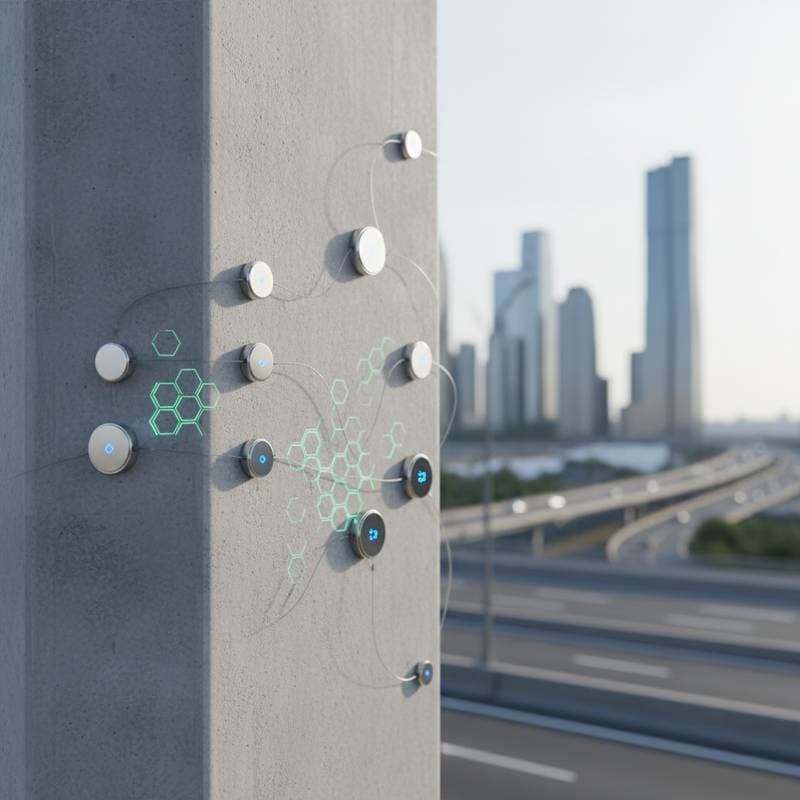
Smart Sensors Detect Concrete Stress Before Cracks Form
Concrete structures endure significant loads over time, yet they remain vulnerable to environmental factors. Subtle shifts from ground movement, moisture infiltration, or thermal expansion generate internal stress that eventually results in cracks. These cracks allow water and deicing salts to penetrate, accelerating corrosion in reinforcing steel and compromising overall integrity. Smart sensors address this vulnerability by providing engineers and maintenance professionals with advance notice of potential issues.
These devices monitor internal conditions continuously, transmitting data on strain, temperature, and humidity levels. Engineers use this information to forecast crack formation and implement preventive measures. As a result, property owners avoid expensive emergency repairs and maintain structural reliability.
How Smart Concrete Sensors Function
Smart concrete sensors incorporate embedded microchips or fiber-optic cables to capture precise measurements within the material. Strain sensors detect minute deformations as the concrete expands or contracts under load. Temperature and humidity sensors track environmental influences that impact curing and long-term durability.
The sensors transmit data via wireless signals to a central dashboard or cloud-based system. Advanced algorithms process this information to identify anomalies, such as sudden strain increases or moisture spikes. Upon detection, the system generates alerts, enabling teams to inspect and reinforce affected areas proactively.
This setup functions as a vigilant monitoring network, offering insights into the concrete's evolving condition without invasive inspections.
Advantages and Drawbacks
Advantages
- Early identification of stress patterns averts progressive damage and minimizes operational disruptions.
- Ongoing surveillance provides comprehensive performance data across the structure's lifecycle.
- Targeted interventions reduce overall maintenance expenses by addressing issues at their onset.
- Precise load assessment enhances occupant and user safety.
- Data-driven decisions eliminate reliance on subjective evaluations by inspectors.
Drawbacks
- Initial investment in sensors and supporting infrastructure presents a significant expense.
- Dependence on wireless signals can pose challenges in areas with poor connectivity.
- Sensor longevity varies, influenced by battery performance and environmental exposure.
- Effective data handling requires specialized software and staff training.
Installation and Operating Costs
Individual sensor units typically range from $50 to $300, based on their sensitivity and features. For a modest foundation, a handful of units suffices, whereas extensive applications like bridges demand dozens or hundreds. Complete systems, including installation and integration, generally cost $3 to $10 per square foot of covered surface.
Expenses increase with demands for high-frequency data collection, extended transmission distances, or compatibility with legacy systems. Over time, these investments yield returns through deferred repairs and prolonged service intervals.
Durability and Upkeep
Quality smart sensors endure 10 to 20 years, aligning with standard inspection cycles for concrete elements. Protective enclosures shield electronics from corrosion and ingress of contaminants. Wireless models require periodic battery assessments to sustain functionality.
To maintain accuracy:
- Review data logs monthly to spot deviations from norms.
- Clean connection points and antennas to prevent signal degradation.
- Recalibrate units if discrepancies arise in measurements.
Key Specifications to Evaluate
Select sensors that align with project needs by verifying:
- Type: Options include strain gauges for deformation, hygrometers for humidity, or thermocouples for heat.
- Range: Ensure coverage matches anticipated environmental extremes.
- Precision: Target readings accurate to within microstrains for reliable structural analysis.
- Transmission distance: Confirm adequate reach for the site's layout.
- Energy supply: Choose between battery-powered, hardwired, or solar-harvesting designs.
- Protection level: Prioritize IP-rated enclosures suitable for submersion in concrete.
Site Assessment and Preparation
Identify high-risk zones, such as expansion joints, support columns, and edge perimeters, where stress concentrates. Determine sensor density according to the concrete's dimensions and load distribution. Evaluate access for utilities and data relays during the planning phase.
Coordinate with the concrete supplier to ensure mix consistency, as sensors integrate during the placement process. Document exact positions in construction records for reference in future modifications or inspections.
Step-by-Step Installation Guide
Installation demands careful execution to preserve sensor integrity:
- Design the sensor array and designate placement points on reinforcement.
- Secure sensors to rebar frameworks or formwork surfaces.
- Test connections and wireless configurations prior to concrete delivery.
- Pour concrete methodically, vibrating to eliminate voids around sensors.
- Monitor initial data outputs as the material sets.
- Integrate with the central monitoring interface and establish reference baselines.
Position sensors away from potential settlement areas, and protect cabling from abrasion during handling.
System Configurations
Two primary approaches suit different scenarios:
- Embedded designs integrate directly into fresh concrete, providing lifelong internal monitoring for new builds or rehabilitations.
- Surface-attached units adhere to cured surfaces, capturing external vibrations and strains ideal for retrofitting aging infrastructure like overpasses or retaining walls.
Hybrid systems blend both for layered oversight, maximizing data granularity.
Professional Installation Versus Self-Setup
For minor projects, such as garage slabs, competent individuals can deploy basic kits by aligning sensors pre-pour and linking to mobile applications. This approach suits low-stakes applications with straightforward data needs.
Engage specialists for complex scenarios:
- Load-bearing elements in commercial settings.
- Synchronization with facility management platforms.
- Advanced calibration and analytical support.
Professional oversight prevents errors that could invalidate sensor outputs, justifying the added expenditure.
Troubleshooting Common Issues
Intermittent signal disruptions often stem from electromagnetic interference or depleted power sources. Relocate hubs away from metallic obstacles and swap batteries promptly.
Inaccurate data may arise from misalignment or encapsulation defects. Reset calibrations against known standards or isolate faulty units for replacement.
For embedded sensors, nearby fissures can introduce conductive moisture. Apply resin sealants to breaches and track signal continuity.
Routine log reviews pinpoint problems early, safeguarding system performance.
Considerations for Regional Conditions
In freeze-prone areas, select sensors engineered for cyclic thermal stresses to maintain enclosure seals. Coastal environments demand corrosion-resistant materials, such as titanium casings or polymer-insulated wiring.
Arid, high-heat zones require components tolerant of elevated temperatures, with shielded exteriors for any exposed elements. Adverse weather can impair radio signals, so deploy redundant mesh topologies for resilience.
Cost-Effective Alternatives
Budget constraints may favor simpler tools:
- Adhesive strain indicators for short-term assessments.
- Infrared imaging to map thermal anomalies indicative of subsurface flaws.
- Ultrasonic detectors that capture early fracture acoustics.
While these provide snapshots, they fall short of the persistent, embedded intelligence offered by full sensor arrays.
Implementing Sensors for Lasting Concrete Performance
Smart sensors elevate concrete from inert mass to a communicative asset, exposing hidden dynamics well ahead of visible deterioration. Building managers gain foresight for proactive upkeep, streamlining budgets and timelines.
Consult structural experts during design or upgrade phases to incorporate sensor-compatible materials and protocols. This strategic integration fortifies foundations against time and elements, ensuring enduring stability for residential, commercial, and civic projects.