
Quick Overview
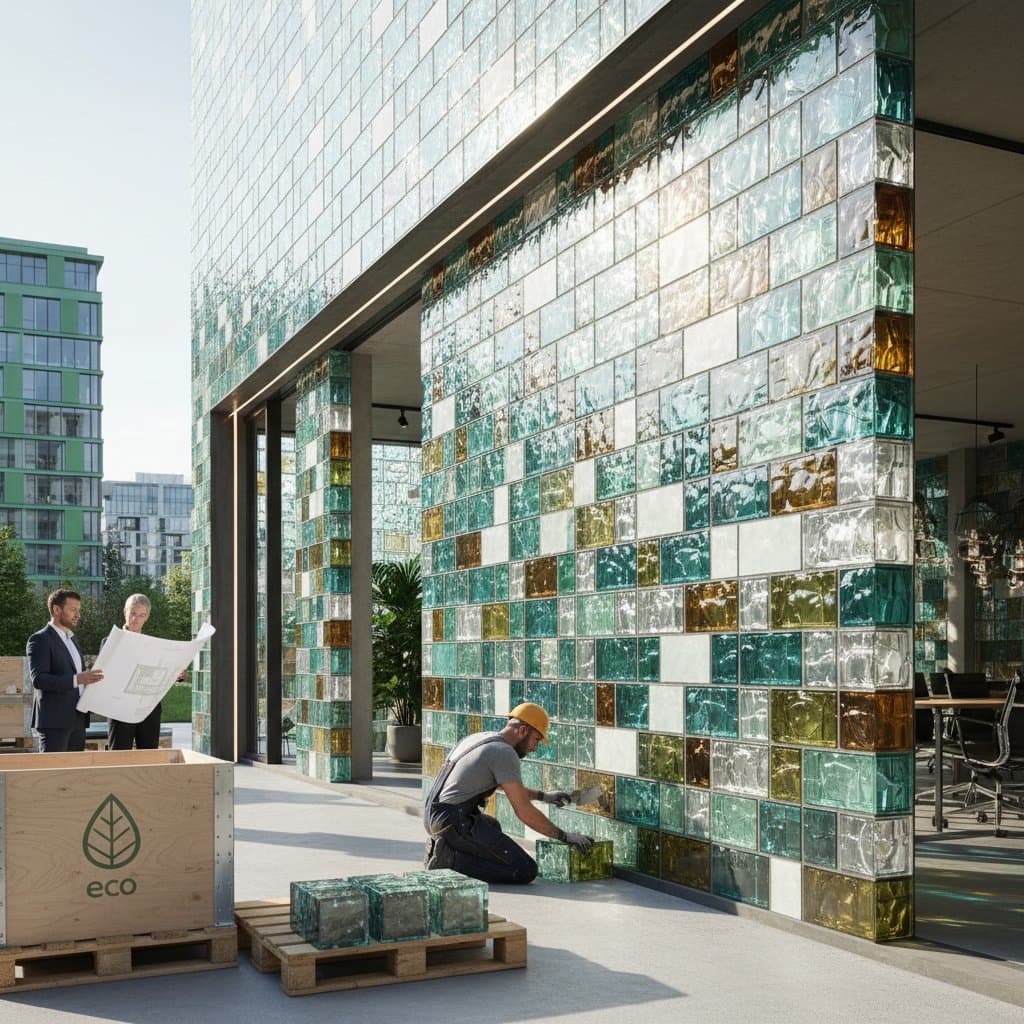
Recycled glass blocks emerge as a robust, low-carbon substitute for traditional bricks and concrete masonry units. The main challenges involve selecting verified suppliers and accounting for the installation expertise required to handle the material's unique properties. Expenses depend on regional sourcing, shipping logistics, and access to laborers experienced in its specific manipulation techniques.
Essential Quality Checks
Evaluate the recycled glass block's response to stress and environmental exposure through targeted field tests. These assessments provide critical insights into performance:
- Surface finish and color consistency. Inferior fusion results in hazy surfaces or irregular patches.
- Edge and corner integrity. Fragile or fractured areas indicate inadequate annealing processes.
- Acoustic test. Tap the block with a metal tool; a clear ring signifies solidity, while a muffled sound suggests internal defects.
- Water interaction. Apply water to a sample; excessive darkening or absorption reveals high porosity and reduced longevity.
- Heat regulation. Compare samples exposed to sunlight and shade; superior blocks maintain gradual temperature changes rather than extreme fluctuations.
Observe light transmission as well. High-quality blocks scatter sunlight uniformly to avoid intense glare, enhancing usability in interior spaces. Substandard units produce distracting hotspots that hinder design applications.
Warning Signs of Issues
Monitor for these indicators of potential problems:
- Fractures or separation at joints following brief exposure to weather elements.
- Inconsistent coloration or linear discolorations from variable raw glass inputs.
- Prominent impurities or bubbles observable on the surface.
- Significant powdering during manipulation, pointing to insufficient binding agents.
- Hesitation from suppliers to provide data on compressive strength or freeze-thaw resistance.
- Incompatible mortar causing discoloration or weak bonding.
Identifying these early prevents escalation to major structural or visual shortcomings. Prompt action minimizes labor costs and material waste.
Common Remedies and Estimated Expenses
Recycled glass block assemblies differ in design, from dense compressed forms to cavity-filled modules joined with specialized mortars.
- Sealing surfaces and reapplying grout. Costs range from three to six dollars per square foot. Pursue this only if the core block structure remains intact.
- Reconstructing affected wall sections. Expect ten to fifteen dollars per square foot, influenced by design intricacy. Apply when damage extends past joint lines.
- Complete substitution with fresh blocks. Budget fifteen to twenty-five dollars per square foot, encompassing removal and waste handling.
- Addressing underlying moisture problems. Incorporate an additional five to eight dollars per square foot for enhanced drainage or barrier installations.
Steer clear of inexpensive surface treatments that mask underlying water penetration. Such solutions often degrade quickly, necessitating comprehensive interventions. Effective repairs typically involve excising compromised mortar and refining water diversion at connections.
Strategies for Repair or Replacement
Around Windows and Openings
Preserve existing frames if they maintain alignment and stability. Employ recycled glass blocks for filling or decorative elements, avoiding their use as primary egress solutions unless certified appropriately.
At Roof Interfaces
Examine sealant details where glass block walls connect to roofing. Intervene with replacement solely for extensive fissures or evident water paths. Lesser infiltrations benefit from renewed sealing and supplementary barriers.
On Foundation Levels
Avoid placing recycled glass walls directly atop moist or uninsulated bases. Introduce a vapor barrier beforehand. For signs of upward moisture migration, prioritize drainage enhancements over wall reconstruction.
In Interior Divisions
These blocks excel as luminous partitions. Renew sections only if supporting frames shift or bonding deteriorates. Address joint weaknesses initially, as disruptions often originate at boundaries.
Follow this principle: opt for repairs when the blocks exhibit stability and integrity. Reserve replacement for confirmed structural or water-related compromises.
Assembling the Right Team and Workflow
Involve a building inspector versed in non-traditional masonry from the outset. This expert identifies curing deficiencies or heat transfer issues prior to assembly. Collaborate with an architect to assess light dynamics and privacy levels against the glass facade.
Select a general contractor experienced in comparable installations, such as terrazzo, due to variations in spacing and setting timelines compared to conventional masonry. For locations prone to severe freezing, thawing, or saline conditions, seek input from a materials engineer on formulation adjustments and dimensional allowances.
Coordinated team involvement typically increases project expenses by ten to twenty percent. However, this oversight averts budget excesses. Most shortcomings arise from overlooked drying periods or uneven joint dimensions, rather than inherent material flaws.
Planning Priorities for Projects
Establish these focal points when incorporating recycled glass blocks into renovations or new constructions:
- Prioritize moisture mitigation. Implement drainage systems, barriers, and sealants ahead of surface treatments.
- Confirm load-bearing capacity. These blocks exceed the weight of many facade options; validate supports accordingly.
- Enhance thermal and airtight qualities. Certain configurations include insulating inserts or layered designs for better energy efficiency.
- Highlight architectural features. Position blocks in areas like transoms, highlights, or wet zones where illumination adds value.
- Postpone marginal modifications. Refrain from wholesale exterior updates unless current materials show distress; returns seldom justify the investment.
Targeted improvements, such as perimeter sealing, yield quicker benefits in comfort than extensive visual alterations.
Budgeting and Installation Sequence
Sequence activities meticulously to optimize efficiency. Initiate with perimeter drainage and base preparation, verifying outward gradients and incorporating drainage channels. Secure structural supports next.
Lay the blocks subsequently, aligning levels and ensuring complete mortar engagement. Post-curing, install protective coatings and edge details. Complete interior finishes last.
This approach in areas like kitchens or exteriors prevents redundant efforts. Route utilities such as pipes or cables prior to block placement to avoid subsequent disruptions that could lead to fractures or stains.
Incorporating into Historic Structures
Aged residences accommodate recycled glass blocks seamlessly. Substitute them for deteriorated lower-level openings while preserving ledge profiles. They outperform timber in resisting decay and pests.
For verandas or enclosures, low glass block barriers introduce natural light minus airflow issues. Verify adhesion between legacy lime mortars and contemporary polymer blends via trial assemblies. This discloses bonding reliability or separation risks. Maintain proportional mixes where feasible to prevent rigidity mismatches that induce splits at junctions.
Upkeep and Expected Durability
Routine maintenance for recycled glass block installations remains minimal. Clean annually or biannually using pH-neutral solutions. Refrain from harsh scrubbers that damage finishes.
Conduct joint examinations each year, focusing on elevated or boundary areas for hairline fissures. Address internal moisture via absent drainage or sealant breakdowns by refilling with matching compounds. Apply durable, light-resistant sealants at frame or metal contacts.
Properly executed installations rival the lifespan of traditional clay products. Their reused composition lowers disposal impacts and production energy demands. Sustained performance relies on excluding water and managing expansions.
Implementing Recycled Glass Blocks Successfully
The adoption of recycled glass blocks marks a substantive evolution in eco-conscious architecture, blending reduced environmental footprint with compelling aesthetics. Achievement rests on rigorous assembly practices, water exclusion strategies, and prudent financial planning.
Prospective users benefit from starting modestly. Examine an in-situ example locally and perform the outlined evaluations. Consult practitioners with direct product experience beyond vendor pitches.
Optimal outcomes balance precision with restraint. These blocks excel in intersections of illumination, seclusion, and resilience, conserving resources and heritage across generations while diverting refuse from disposal sites.