
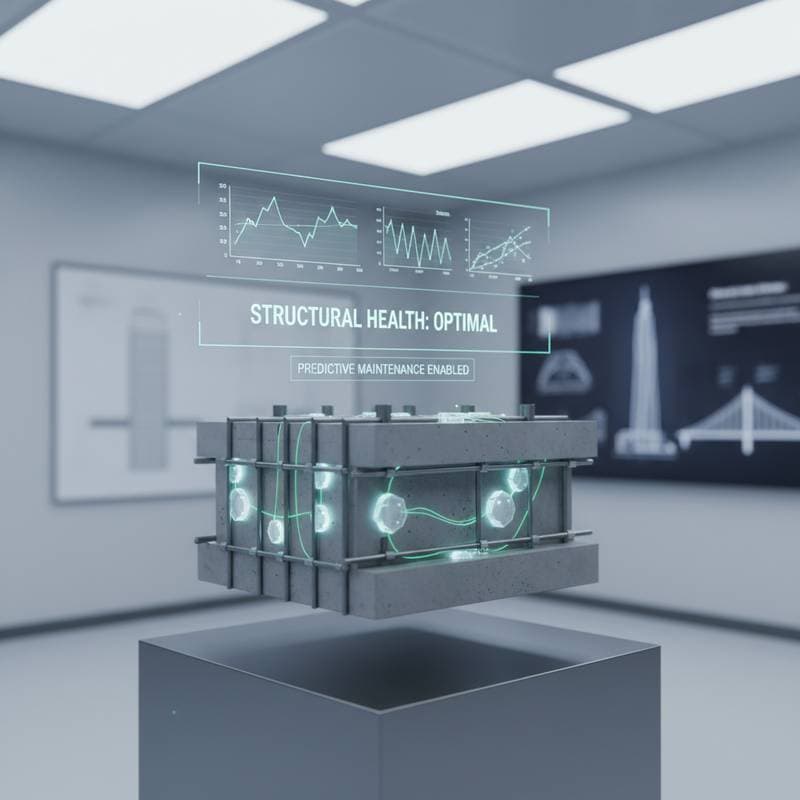
Smart Concrete: Enabling Self-Monitoring for Enhanced Structural Safety
Smart concrete revolutionizes structural safety for builders, engineers, and property owners. This innovative material embeds sensors directly into concrete mixes to enable ongoing assessment of internal stress, temperature, moisture, and strain. The primary objective is to develop buildings, bridges, and infrastructure that detect their own conditions and signal emerging issues prior to any failure. This guide explains the mechanics of smart concrete, associated costs, installation methods, and contributions to safety and durability in contemporary construction projects.
Key Takeaways
- Cost breakdown: Installations of smart concrete generally cost 15 to 25 percent more than those of traditional concrete, with materials comprising 60 percent, sensor systems 25 percent, and labor plus calibration 15 percent.
- Sensor placement: Position sensors at intervals of 3 to 6 feet along essential load-bearing paths or joints to achieve comprehensive data collection.
- Data collection rate: Systems capture information every few seconds and relay it via wired or wireless networks for immediate evaluation.
- Expected lifespan: Well-maintained smart concrete setups endure 20 to 40 years, influenced by environmental factors and sensor robustness.
- Selection criteria: Consider sensor varieties, data handling platforms, and integration with current monitoring setups when deciding.
The Fundamentals of Smart Concrete and Its Applications
Smart concrete merges sensing capabilities into the core material, permitting measurement of internal states that remain hidden until visible signs of damage like cracks, corrosion, or settling appear. Embedded sensors, frequently utilizing fiber optics or piezoelectric elements, identify subtle shifts in strain or temperature and relay this information to a centralized control unit.
Two principal types exist:
- Self-sensing concrete: The mixture gains conductivity through additives such as carbon nanotubes or steel fibers, registering strain variations as changes in electrical resistance.
- Embedded-sensor configurations: Individual sensors integrate during the concrete pour, linking via cables or wireless components to external data recorders.
These approaches support structural health monitoring, which tracks performance throughout a structure's life. Collected data assists engineers in recognizing stress patterns, spotting initial damage, and guiding maintenance choices to avert expensive or hazardous breakdowns.
Essential Planning Considerations Prior to Installation
Evaluate critical elements before incorporating smart concrete into a project:
- Scope and intricacy of the project: The added expense may not suit small residential slabs, but bridges, tunnels, and high-rise foundations gain substantial value from sensor inclusion.
- Adherence to regulations: Building codes in many areas demand records of sensor positions, calibration protocols, and data retention practices.
- Site-specific environment: Extreme temperatures and high moisture levels dictate choices in sensor models and protective enclosures.
- Strategy for data oversight: Specify ownership and management of data, storage procedures, and alert triggers for predefined limits.
Obtain permits if the system employs wireless transmission or connects to public networks. Consult local regulatory bodies in advance to ensure compliance.
Required Materials and Equipment
Successful integration of smart concrete demands the following items:
- Concrete mixture: Opt for a premium blend with uniform slump and aggregate dimensions to support precise sensor performance.
- Sensors: Select fiber optic, piezoelectric, or resistive types aligned with specific monitoring requirements.
- Data acquisition device: Gathers, retains, and sends sensor outputs for detailed review.
- Power supply: Options range from wired links to battery units, based on sensor specifications.
- Protective tubing: Safeguards cables and nodes against harm during the pouring phase.
- Calibration instruments: Confirm sensor accuracy before concrete sets.
- Personal protective gear: Include gloves, safety glasses, and sturdy boots for managing materials and electrical components.
Detailed Installation Procedure
1. Site Preparation and Sensor Positioning
Examine the structural blueprint to pinpoint vital stress zones, including beam-column connections, mid-span areas, or foundation edges. Indicate sensor spots on formwork with chalk lines or markers. Adhere to even spacing as outlined in the project plans.
2. Sensor and Conduit Placement
Attach sensors to rebar using secure fasteners like zip ties or thin wire. Align sensors properly and route leads through protective tubing. Position cables at minimum one-inch clearance from outer surfaces to shield against finishing operations.
3. Wiring Connections and Initial Testing
Link all sensors to the data acquisition unit prior to pouring and conduct baseline measurements. This verification confirms operational status and proper calibration for each unit. Document initial values for post-curing comparisons.
4. Concrete Placement and Compaction
Pour concrete with care to preserve sensor stability. Employ internal vibrators to eliminate voids while avoiding cable disruption. Ensure uniform distribution and prevent metal tools from contacting sensor wiring.
5. Curing Oversight and Data Validation
Track temperature and strain metrics throughout curing to validate sensor operation. Curing typically spans 7 to 14 days, varying with mixture composition and weather conditions. Analyze ongoing data against baselines to identify any irregularities.
Ensuring Quality Through Inspection
Implement thorough physical and digital checks for smart concrete systems. Confirm integrity of sensor leads and enclosures manually. Examine data patterns electronically for deviations signaling faults or stress concentrations.
Conduct annual calibration verifications per industry guidelines. For major projects, configure automatic notifications when strain or temperature surpasses established thresholds. This ongoing cycle bolsters sustained dependability.
Addressing Typical Installation and Operational Issues
- Signal interruption: Often results from cable damage or moisture penetration; examine tubing seals and substitute affected parts.
- Data inconsistency: Suggests calibration discrepancies; cross-check with manual strain assessments and adjust accordingly.
- Sensor malfunction: Swap out inactive units during routine upkeep, favoring designs with easy-access connections.
- Signal interference: Wireless setups near powerful electrical sources may encounter disruptions; apply shielded wiring or adjust transmission frequencies.
Sustaining Performance Over Time
Regular upkeep preserves the efficacy of smart concrete systems. During yearly structural evaluations, inspect sensor casings and seal integrity. Clear data interfaces and confirm reliable power delivery. Address defective components swiftly to uphold system wholeness.
Cloud platforms often provide visual interfaces for long-term trend analysis. Leverage these to detect progressive wear, thermal expansions, or water ingress. Shift toward proactive strategies that lower expenses and elevate safety standards.
Advancing Construction Through Intelligent Monitoring
Smart concrete marks a significant step forward in structural health assessment, delivering persistent insights that strengthen safety, longevity, and operational efficiency. Merging established building methods with cutting-edge sensors yields profound understanding of structural behavior across years. For overseers of extensive infrastructure or commercial assets, this investment prolongs usability, minimizes inspection outlays, and instills greater assurance in performance.