
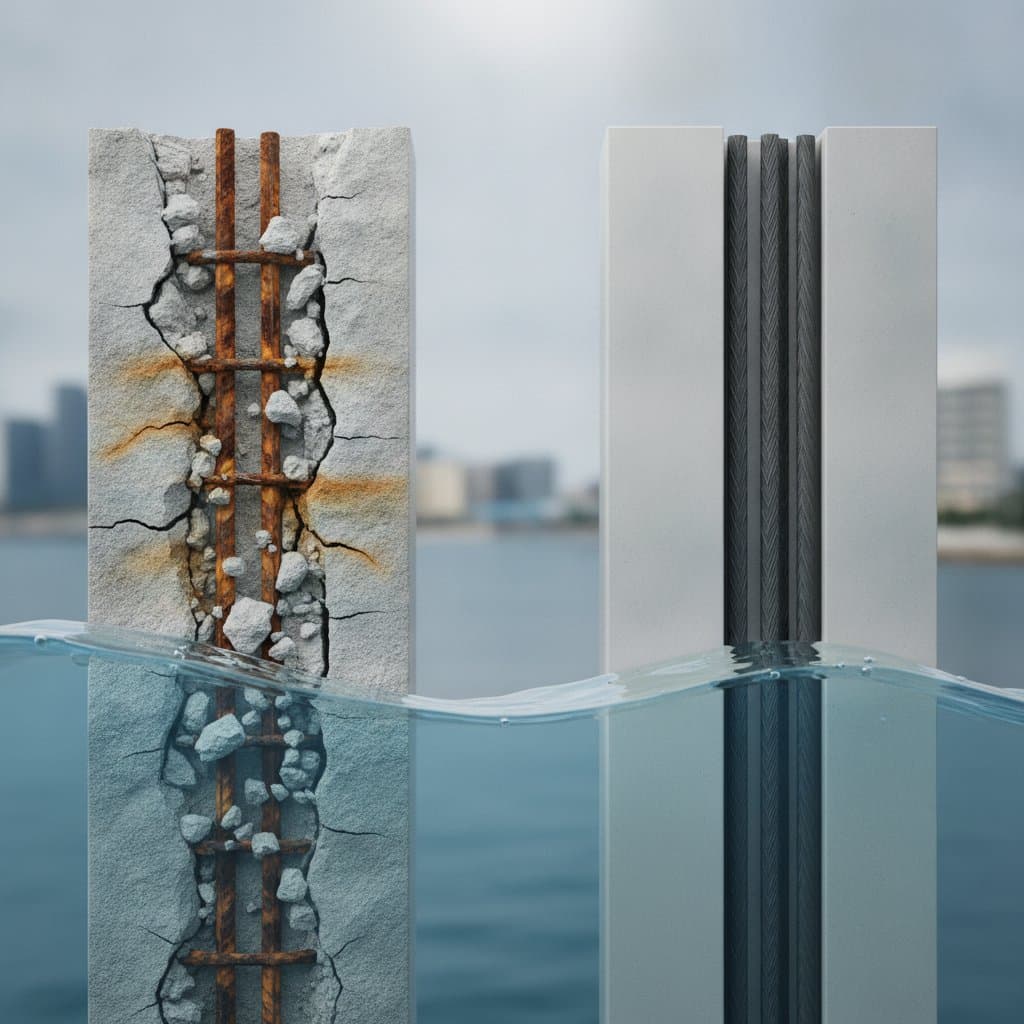
Basalt Rebar Beats Steel in Saltwater Foundations
Saltwater foundations face a persistent threat. Chloride ions can penetrate concrete, reach embedded steel, and trigger corrosion that expands the reinforcement until the surrounding concrete cracks and fails. Basalt rebar provides a corrosion resistant alternative for coastal construction, especially where foundations, seawalls, piers, retaining walls, and marine structures remain exposed to salt spray or brackish groundwater. This guide explains how basalt rebar works, where it fits, how to specify it, and when professional engineering is required.
Key takeaways
- Basalt rebar typically costs 10 to 40 percent more than standard steel reinforcement, while installation labor can remain similar and lifecycle repair costs can fall substantially.
- Provide concrete cover according to local code, commonly 2 to 3 inches for cast against soil and 1.5 to 2 inches for exterior exposure, unless the engineer specifies more.
- Basalt reinforcement does not rust, but it requires compatible design, proper bends, adequate lap lengths, and concrete with a suitable water to cement ratio.
- Plan for several days to several weeks for design, permitting, excavation, placement, inspection, and concrete curing, depending on foundation size and site conditions.
- Use a licensed structural engineer for load bearing foundations, flood zone work, seawalls, piles, and any project governed by special coastal or marine requirements.
Why saltwater damages steel reinforced concrete
Concrete protects steel through its naturally alkaline chemistry. That protection declines when chlorides from seawater, salt spray, deicing salts, or contaminated soil travel through pores and cracks. Once chloride concentration reaches the steel, corrosion begins.
Rust occupies more volume than the original steel. The expansion creates internal pressure, which produces cracks parallel to the reinforcement. Cracks allow additional moisture and salt to enter, accelerating deterioration. Spalling can expose the steel directly, reducing the reinforcement area and weakening the structure.
Coastal foundations face several exposure conditions. Direct contact with seawater or tidal water creates constant chloride exposure. Salt laden wind and spray reach inland structures. High groundwater near the shoreline carries dissolved salts. Poorly drained soils with dissolved chlorides create ongoing risk. Repeated wetting and drying cycles accelerate chloride penetration. Floodwater contamination after storm events introduces new chloride sources.
Increasing concrete cover helps, but cover alone does not eliminate corrosion risk. Dense concrete, careful crack control, proper drainage, and corrosion resistant reinforcement work together. Basalt rebar addresses the reinforcement itself.
What basalt rebar is and how it works
Basalt rebar, also called basalt fiber reinforced polymer rebar or BFRP, consists of continuous basalt fibers embedded in a polymer resin. Manufacturers produce the fibers by melting volcanic basalt rock and drawing it into strands. The finished reinforcement has a ribbed or textured surface that bonds with concrete.
Unlike steel, basalt rebar contains no iron. It cannot rust or form expansive corrosion products when exposed to chloride rich moisture. This quality makes it suitable for corrosion resistant foundations and other structures where repairs would be difficult or disruptive.
Basalt rebar has different structural behavior from steel. It has high tensile strength, commonly around 100,000 to 150,000 PSI, depending on the product. It weighs roughly one quarter as much as steel of comparable reinforcement capacity. It does not yield gradually before failure. BFRP behaves elastically until rupture. Its elastic modulus is lower than steel, so reinforced concrete may require more reinforcement to control cracking and deflection. It has low thermal and electrical conductivity. It cannot be bent on site unless the manufacturer supplies approved bent shapes.
These differences require an engineered design. Substituting basalt bars for steel using the same diameter and spacing is not automatically acceptable.
Comparing basalt rebar with steel
Basalt rebar
Best applications: Coastal foundations, marine slabs, seawalls, bridge components, retaining walls, parking structures, and areas with stray electrical currents.
Advantages:
- Does not corrode in saltwater exposure
- Reduces handling effort because of its light weight
- Offers high tensile strength
- Resists electrical conductivity
- Can reduce long term repairs in inaccessible locations
Limitations:
- Usually costs more at purchase
- Cannot be field bent like conventional steel
- Requires different design calculations
- Loses strength at elevated temperatures
- Can be damaged by improper cutting, impact, or excessive heat
Steel rebar
Best applications: General reinforced concrete, conventional foundations, heavily loaded structural members, and projects with established local supply chains.
Advantages:
- Widely available in standard sizes
- Familiar to contractors and inspectors
- Provides ductility and visible yielding before failure
- Can be bent and fabricated readily
- Often costs less initially
Limitations:
- Corrodes when chloride protection fails
- Adds considerable weight to handling and transport
- Requires adequate cover and concrete quality
- May require coatings, sealers, or cathodic protection in severe exposure
- Repairs can involve demolition and structural replacement
For a dry inland footing, steel may remain the practical choice. For a coastal foundation with difficult access, high chloride exposure, or an expected service life measured in many decades, basalt can offer stronger lifecycle value.
Planning a basalt reinforced foundation
Start with a site assessment. Identify the soil type, groundwater elevation, flood zone, tidal influence, slope stability, and local frost depth. Sandy coastal soils drain quickly but can wash out or shift during flooding. Clay soils hold water and can transmit chlorides to the foundation. Fill soils require special testing because their bearing capacity and settlement behavior may be inconsistent.
Check local requirements before ordering materials. Building departments may require a structural drawing sealed by a licensed engineer, geotechnical recommendations, flood resistant design details, inspection before concrete placement, product documentation for the selected basalt rebar, and confirmation that the reinforcement meets an accepted standard.
BFRP design commonly references ACI 440.11, the American Concrete Institute code for structural concrete reinforced with fiber reinforced polymer bars. Product documentation should identify tensile strength, elastic modulus, surface treatment, glass transition temperature, durability testing, and approved splice or anchorage details.
Cost planning
National installed foundation costs vary widely with excavation, access, formwork, concrete volume, reinforcement density, soil conditions, and local labor. A typical reinforced concrete foundation project may allocate approximately 35 to 50 percent for concrete, reinforcement, and other materials, 30 to 45 percent for labor, 10 to 20 percent for excavation, equipment, delivery, and site preparation, and 5 to 15 percent for engineering, permits, testing, and inspections.
Basalt rebar often adds 10 to 40 percent to reinforcement material costs compared with uncoated steel. The total project increase may be lower because reinforcement commonly represents a limited portion of the complete foundation budget. Obtain at least three written quotes, and compare bar sizes, spacing, couplers, delivery, cutting, and engineering support rather than comparing only price per linear foot.
Materials, equipment, and safety
Materials
- Basalt rebar: Select a certified product with structural properties suited to the exposure and design.
- Concrete: Use the specified compressive strength, often 4,000 to 5,000 PSI for demanding exterior exposure.
- Rebar supports: Use noncorrosive chairs or supports that maintain the specified cover.
- Tie material: Use polymer, nylon, or approved nonmetallic ties compatible with the reinforcement.
- Waterproofing materials: Apply membranes, sealants, or drainage systems specified for below grade exposure.
- Concrete curing materials: Use curing blankets, sheet coverings, or curing compound approved for the concrete system.
Equipment and protective gear
- Measuring tools and cover gauges
- Approved abrasive saw or manufacturer approved cutter
- Formwork tools and bracing
- Concrete vibrator
- Safety glasses, gloves, hearing protection, and dust protection
- Hard hat, steel toe footwear, and high visibility clothing
- Fall protection near excavations or elevated forms
Do not drag basalt bars across rough ground, crush them under equipment, or expose them to open flame. Follow the manufacturer's cutting instructions and inspect every bar before placement.
Step by step installation process
1. Prepare and inspect the site
Clear vegetation, debris, unsuitable fill, and standing water. Excavate to the dimensions shown on the approved plans. Keep trench walls stable, and use shoring or safe sloped sides where required.
Compact the subgrade according to the geotechnical specification. Place granular drainage material, a vapor barrier, or mud slab where the design calls for one. Never pour on soft, saturated, or disturbed soil without correction.
2. Build accurate forms
Set forms to the foundation dimensions and brace them against concrete pressure. Check line, level, square, and elevation. Coastal sites often require careful elevation control to meet floodplain requirements and maintain drainage away from the structure.
Seal gaps that could allow cement paste to escape. Install sleeves and embedded items before reinforcement placement, confirming that penetrations do not cut or displace critical bars.
3. Place supports and basalt reinforcement
Set noncorrosive chairs at spacing that prevents sagging during concrete placement. Maintain the specified concrete cover on every face. Do not rest bars directly on soil, vapor barriers, or formwork.
Cut bars cleanly with the approved tool. Install straight lengths, stirrups, and prefabricated bends according to the structural drawings. Use specified lap lengths or mechanical connections. BFRP lap requirements can exceed steel requirements, so never estimate them from ordinary steel practice.
Tie intersections securely, but avoid crushing or nicking the bars. Keep reinforcement clean and free of oil, mud, and loose resin.
4. Complete pre pour inspection
Check bar diameter, spacing, orientation, overlap, supports, cover, openings, and embedded hardware. Photograph the reinforcement before concrete placement for the project record.
Arrange the required inspection before the pour. Correct deficiencies at this stage. Moving reinforcement after concrete placement cannot restore inadequate cover or missing bars.
5. Place, consolidate, and cure concrete
Use the specified concrete mix and verify delivery tickets. Do not add uncontrolled water at the site. Place concrete steadily to avoid segregation and excessive pressure on forms.
Consolidate with a vibrator, keeping the head away from direct contact with basalt bars and forms. Overvibration can move reinforcement or separate the mix. Strike and finish the surface as specified, then begin curing promptly.
Maintain moisture and temperature conditions according to the concrete specification. Structural concrete commonly gains much of its design strength during the first 7 to 28 days, but the engineer controls when loads, backfill, or construction traffic are permitted.
Quality control and troubleshooting
Bars move during the pour
Insufficient chairs, weak ties, or careless hose placement often cause movement. Stop placement, reposition the reinforcement, and add supports before continuing. Recheck cover with a gauge.
Concrete honeycombing appears
Inadequate consolidation, poor mix design, or form leakage can create honeycombing. Stop placement, improve vibration technique, and adjust mix consistency. Fill voids with approved repair materials after form removal.
Cover is inadequate
Measure cover at multiple locations during placement. Add additional chairs or reposition bars to achieve specified cover. Document corrections for inspection records.
Temperature concerns
Basalt rebar loses strength at elevated temperatures. Protect reinforcement from welding operations, open flames, and hot equipment. Maintain concrete placement temperatures within specified limits.
Making the right coastal foundation decision
The choice between basalt and steel reinforcement depends on exposure conditions, access constraints, and service life requirements. Coastal projects with high chloride exposure benefit from basalt rebar's corrosion resistance. Projects with difficult future access justify the material premium through reduced maintenance costs. Standard inland applications may favor steel due to lower initial costs and established supply chains.
Evaluate each project based on specific site conditions rather than material preference alone. Consider soil chemistry, groundwater quality, flood frequency, and maintenance access when making material selections. Work with engineers experienced in both materials to develop appropriate designs for your coastal foundation requirements.