
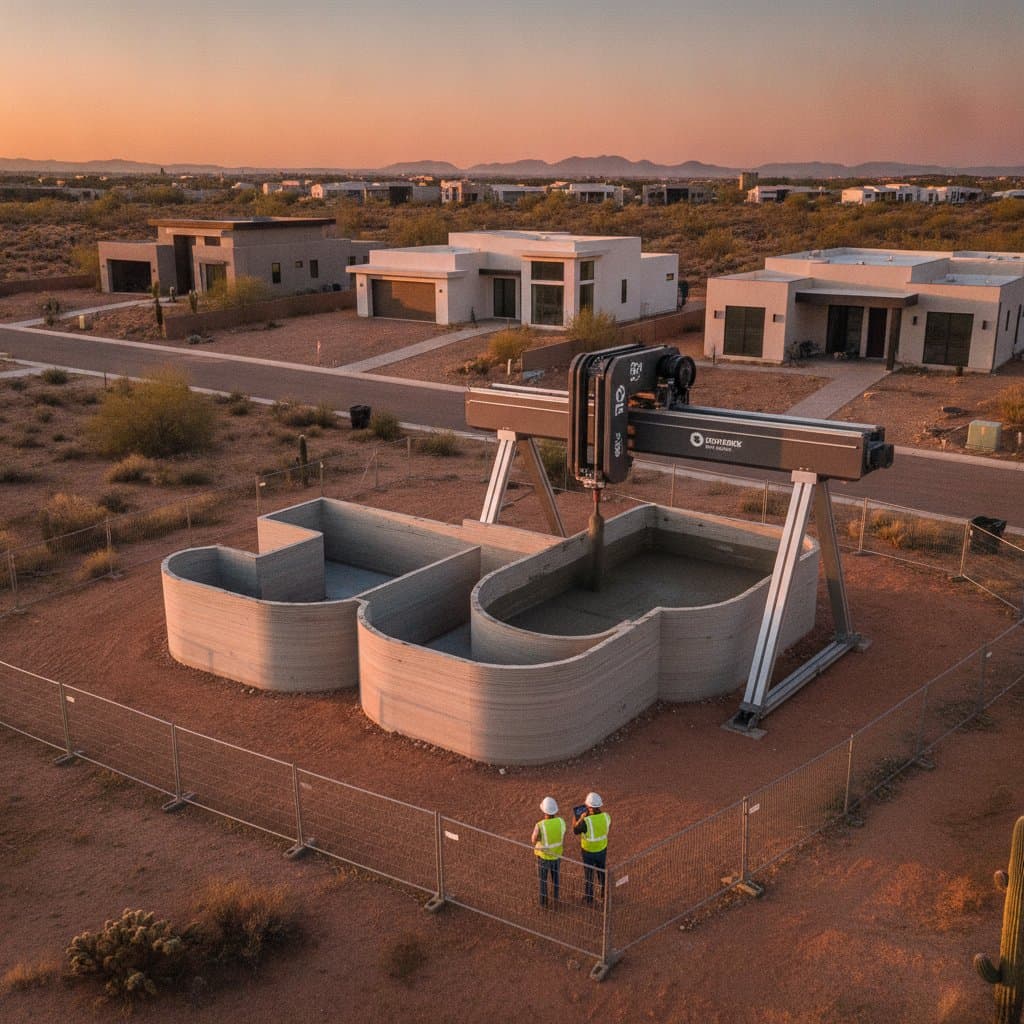
3D Printed Concrete Foundations Deliver Speed and Precision
Traditional foundation construction often requires multiple days or weeks for forming, pouring, and curing. Robotic 3D printing systems now complete full concrete foundations in roughly 48 hours. The automated process follows a digital model to deposit specialized concrete mixes layer by layer.
Core Process
A gantry or robotic arm printer extrudes pumpable concrete in continuous beads. These layers create footings, stem walls, and utility pathways according to the approved plan. After printing, the material cures to structural strength suitable for framing or modular placement.
Key Advantages
- Construction time drops to about two days for most residential slabs.
- Computer control improves dimensional accuracy and reduces material overuse.
- Labor requirements decrease because the printer manages forming and placement.
- Recycled aggregates in approved mixes lower cement demand.
- Curved layouts and variable wall thicknesses require no extra tooling.
Current Limitations
Printer acquisition or rental costs remain high for many contractors. Few crews hold certification for operation and mix calibration. Local building departments may request additional engineering review before permitting. Only certain concrete formulations extrude reliably without segregation. Site conditions must allow stable printer tracks and continuous material supply.
Cost Ranges
Material expenses average 5 to 10 dollars per square foot. Total installed cost, including setup and programming, typically ranges from 15 to 25 dollars per square foot. Complex geometry or restricted access increases these figures, while repeated prints on similar sites reduce per unit expense.
Expected Service Life
Printed foundations achieve design lives of 75 years or longer when mix designs meet compressive strength targets. The resulting surface density improves resistance to moisture penetration. Owners should inspect perimeter drainage annually and seal any visible joints.
Required Specifications
- Minimum compressive strength of 3,000 psi for single story residential use.
- Pumpable mix verified for layer bonding and extrusion consistency.
- Dimensional tolerance within one quarter inch across the entire footprint.
- Curing behavior that supports stacked layers without cold joints.
Site Preparation
Compact and level the subgrade. Install temporary drainage as needed. Confirm printer reach and power access before mobilization. Contact the building department early to determine whether an engineer stamp or test reports will be required.
Installation Sequence
- Verify layout and elevations with survey equipment.
- Assemble and calibrate the printer gantry or tracks.
- Load approved mix into the pump hopper.
- Execute the print according to the digital model.
- Place conduits and sleeves during active printing.
- Finish top surfaces and set anchor bolts while material remains workable.
- Protect the print during initial cure before backfill or loading.
Design and Climate Adaptations
Monolithic slabs, stem walls, and frost protected shallow foundations are all printable. In freeze thaw regions, specify air entrained mixes. Hot weather projects benefit from retarders that maintain workability between layers. Wet sites require added perimeter drainage and waterproofing membranes.
Practical Recommendations
Order at least ten percent extra material for startup and testing. Keep spare nozzles available to limit downtime. Monitor ambient conditions throughout the print. Schedule inspection prior to backfill. Coordinate anchor bolt locations with framing crews in advance.
Ongoing Maintenance
Backfill with well draining soil compacted in lifts. Clear gutters and downspouts regularly. Monitor for settlement after major storms. Mark any cracks and observe movement before scheduling repairs. The finished foundation performs comparably to conventional concrete while offering tighter tolerances and reduced form lines.