
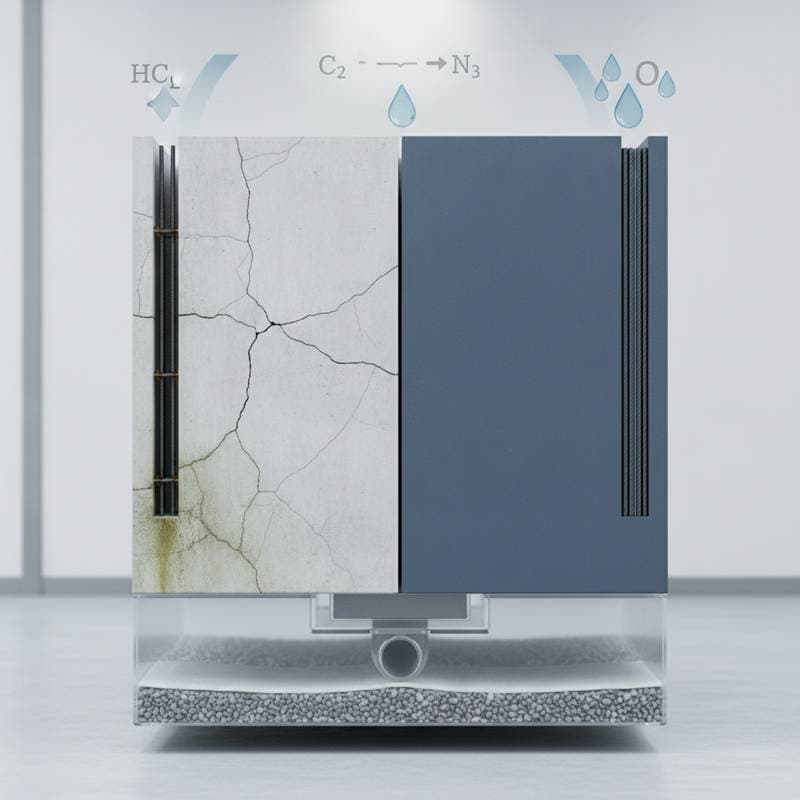
Overview
Geopolymer foundations rely on industrial byproducts activated by alkaline solutions rather than Portland cement. They resist moisture, chemical attack, and cracking more effectively than conventional concrete when mixed and cured correctly. Poor mix control remains the primary risk, as it can produce weak bonds or uneven curing. Key cost factors include material sourcing, quality checks, and contractor expertise.
Field Inspection Steps
Homeowners can apply straightforward checks to assess a geopolymer foundation. These steps mirror proven methods used with traditional concrete.
- Confirm that foundation walls appear straight and free of bulges or bows from a distance.
- Examine surfaces for smooth, dense texture and uniform color. Patchy areas or crumbly edges often indicate incomplete curing.
- Verify that the ground slopes away from the foundation perimeter to direct water outward.
- Inspect control joints and expansion joints for secure seals. Openings large enough for a coin allow moisture entry.
- Note basement air quality. Dry conditions and neutral odors suggest proper performance, while ongoing dampness signals drainage problems.
Warning Signs
Certain visible issues point to potential repair expenses or premature failure.
- Powdery residue on walls signals alkali leaching.
- Scaling or flaking at corners frequently results from inadequate temperature control during curing.
- Rust stains may indicate corrosion of embedded steel due to trapped moisture.
- Cracks that widen at the top suggest settlement or insufficient base compaction.
- Reluctance by the contractor to share batch records, mix proportions, or test data.
- Foundation samples that react strongly to mild acid, which points to cement contamination.
Repair Options and Estimated Costs
Repairs for geopolymer systems vary by issue.
- Surface scaling requires grinding followed by a compatible geopolymer slurry at roughly 5 to 10 dollars per square foot.
- Cracks respond to injection with geopolymer resin or microfine grout at 15 to 25 dollars per linear foot. Epoxy fillers often conceal problems without lasting results.
- Moisture entry calls for improved grading and drainage first. French drains or exterior waterproofing typically cost 30 to 60 dollars per linear foot.
- Structural movement may require underpinning or helical piers at 200 to 400 dollars per linear foot.
- Chemical attack needs removal of damaged sections and reapplication of a geopolymer overlay at 8 to 15 dollars per square foot depending on depth.
Owners should address water management and load paths before pursuing cosmetic improvements. Stability and dryness must be confirmed prior to refinishing.
Decision Framework for Repair or Replacement
Foundations require initial checks of drainage and load capacity. Geopolymer materials tolerate moisture better than Portland cement, yet they fail under sustained water pressure. Replacement becomes necessary only when the base or subgrade is compromised or movement exceeds acceptable limits.
Overlays on slabs frequently extend service life. Replacement is warranted solely when the base has heaved or settled unevenly.
Walls benefit from crack injection and patching because the material bonds chemically to itself. Full replacement serves as a final option.
Breathable coatings formulated for alkali-activated materials perform best for waterproofing. Asphaltic membranes should be avoided because they trap moisture.
Project Team and Execution
Begin with an inspector familiar with both Portland cement and geopolymer systems to detect defects and verify material authenticity. Engage an engineer early to confirm load paths and footing dimensions. Select a contractor with documented geopolymer experience and references from completed projects. Specialists become essential for contaminated soils, high groundwater, or prior movement.
Professional oversight typically adds 10 to 20 percent to project costs but prevents sequencing and curing errors. Interview the inspector, engineer, and contractor in the same week to align methods.
Execution Priorities
Focus first on water and temperature control during curing. Energy upgrades and finishes can follow later.
- Confirm site drainage and downspout placement.
- Validate mix design through laboratory testing when feasible.
- Schedule pours to minimize cold joints and uneven curing.
- Install control joints and reinforcement correctly.
- Verify compressive strength before applying loads.
Decorative treatments should wait until the foundation demonstrates stability through a full seasonal cycle. Sound existing surfaces can remain because geopolymer bonds strongly and maintains color without fading.
Work Sequence and Budget
Complete tasks in order of dependency.
- Establish water control through grading, swales, and drainage systems.
- Compact the subgrade uniformly to prevent future cracking.
- Adhere to manufacturer ratios for activators and aggregates.
- Maintain consistent moisture during curing to achieve full strength.
- Apply loads only after strength verification.
- Add finishes and insulation after structural and moisture checks.
A new geopolymer foundation typically costs 10 to 15 percent more than standard concrete. Reduced maintenance over decades offsets the initial difference.
Ongoing Care
Geopolymer foundations require minimal routine attention once installed.
- Clear gutters and extend downspouts regularly.
- Check control joints annually for sealant condition.
- Mark new cracks with a pencil line to monitor movement.
- Preserve proper grade slope to avoid ponding near the base.
- Limit de-icing salts near the foundation edge.
Preparation, moisture management, and controlled curing determine long-term performance. Geopolymer foundations, when executed properly, provide extended service life under chemical, thermal, and moisture stress while lowering lifetime repair expenses.