
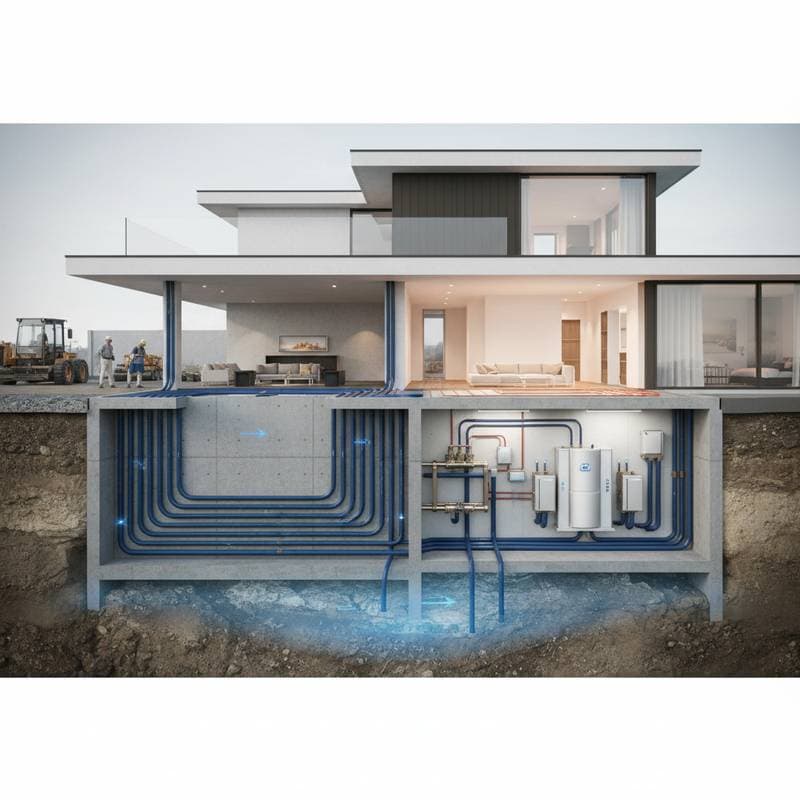
Cut HVAC Bills 60% with Geothermal Foundation Loops
Geothermal foundation loops represent an innovative ground-source heating and cooling solution integrated directly into a home's foundation. These systems leverage the earth's consistent subsurface temperature to transfer heat efficiently, reducing reliance on traditional outdoor air exchanges. Properly implemented, they lower heating and cooling expenses by approximately 60% relative to conventional furnace and air conditioner setups.
How It Works
Geothermal systems employ a heat pump to facilitate heat exchange with the ground rather than ambient air. The foundation loop consists of durable plastic pipes installed within or adjacent to concrete footings, slabs, or grade beams. A circulating fluid, typically water or antifreeze, flows through these pipes to absorb ground heat in winter and deliver it indoors via the heat pump, or to reject indoor heat into the soil during summer.
This integration utilizes the foundation as the primary thermal reservoir, merging structural elements with energy systems during construction. The approach minimizes additional excavation and preserves yard space. Homeowners benefit from a silent, efficient operation that maintains even indoor temperatures throughout the seasons.
Pros and Cons
Pros
- Substantial energy savings. Expect reductions in heating and cooling costs of 50% or greater after installation.
- Space-efficient integration. The system occupies no extra land beyond the foundation footprint, eliminating the need for separate trenches or boreholes.
- Enhanced durability. Pipes remain shielded from ultraviolet exposure, extreme weather, and physical impacts.
- Superior temperature control. Indoor climates stay consistent, avoiding the fluctuations common in air-based systems.
- Extended service life. The underground loops endure for 50 years or longer with proper installation.
Cons
- Elevated initial investment. Upfront expenses exceed those of standard HVAC equipment.
- Requirement for advance integration. Installation occurs during new construction or significant renovations, not as an afterthought.
- Challenges in servicing. Accessing embedded pipes demands extensive disruption to concrete and soil.
- Retrofit limitations. Compatibility varies with existing foundation designs.
- Site-specific performance. Efficiency depends on soil thermal properties and groundwater presence; suboptimal conditions may hinder results.
Costs
A complete geothermal foundation system typically costs $25 to $45 per square foot of conditioned space, encompassing the heat pump, piping network, and controls. For an average single-family home, the total investment ranges from $30,000 to $60,000.
Piping materials alone account for $1 to $3 per linear foot, but labor for precise placement during foundation pouring significantly influences the overall price. Factors increasing costs include challenging soil compositions like dense rock, deeper foundation requirements, restricted equipment access, or intricate building layouts.
Early collaboration with structural engineers streamlines the process, reducing expenses by incorporating loops into the primary pour rather than a standalone phase.
Lifespan and Maintenance
Installed piping withstands 50 years or more under ideal conditions. The indoor heat pump unit generally operates reliably for 20 to 25 years prior to substantial upgrades.
Annual tasks involve monitoring loop pressure and inspecting electrical components. Replace air filters quarterly and flush the fluid circuit every five to ten years, adjusting based on local water quality. Condensate drains require periodic cleaning to prevent backups.
The enclosed design limits ongoing interventions, promoting low-effort ownership.
Key Specifications to Verify
Select components that meet rigorous standards for reliability:
- Pipe material: High-density polyethylene (HDPE) certified for geothermal applications.
- Pipe diameter: 1-inch for most homes; scale up for commercial demands.
- Heat pump performance: Target a Coefficient of Performance (COP) exceeding 4 for heating and an Energy Efficiency Ratio (EER) over 20 for cooling.
- Circulating fluid: Propylene glycol-based antifreeze with added corrosion protection.
- Pressure tolerance: At least 160 psi.
- Thermal suitability: Rated for regional freeze-thaw cycles.
Engage installers proficient in fusion welding and pressure testing to guarantee integrity.
Planning and Site Preparation
Soil and Foundation Assessment
Optimal performance demands soils with strong heat conduction, such as clay-rich or loamy sands that retain moisture. Avoid dry, gravelly, or rocky substrates that impede transfer. Layout varies by foundation style:
- Slab-on-grade foundations: Embed pipes within or immediately below the concrete.
- Basement configurations: Position loops along perimeter footings or in grade beams.
- Pier or crawlspace setups: Incorporate vertical extensions near support piers.
Evaluate equipment access, local frost depths, and manifold placement. Always mark underground utilities prior to any ground disturbance.
Managing Drainage and Frost Protection
Effective site drainage prevents water accumulation that could lead to heaving or diminished insulation. Incorporate perimeter drains where necessary and use non-abrasive backfill. Position pipes below the frost line to safeguard against freezing.
Installation Process
Follow these steps for seamless integration:
- Conduct load calculations. A certified designer determines pipe length based on building demands and soil characteristics.
- Prepare forms and trenches. Install protective sleeves through footings for pipe routing.
- Lay the piping network. Position HDPE lines parallel to forms or slab edges at uniform intervals.
- Secure joints. Apply electrofusion or heat fusion for watertight bonds.
- Perform integrity tests. Pressurize with water to identify leaks before encasement.
- Execute the pour. Anchor pipes firmly to avoid displacement during concrete placement.
- Route connections. Extend supply and return lines to the indoor manifold.
- Backfill with care. Use soft, rock-free material to prevent pipe damage.
- Mount the heat pump. Integrate with existing ducts or hydronic systems.
- Commission the system. Introduce antifreeze, eliminate air pockets, and calibrate flows.
Loop Configurations
Tailor the design to site constraints:
- Serpentine patterns: Ideal under slabs for hydronic heating.
- Perimeter arrays: Suited to basements and frost-resistant builds.
- Vertical extensions: Effective for space-limited pier foundations.
Align choices with soil profiles, structure geometry, and capacity needs. Embedded slab loops enhance radiant applications, while perimeter options pair well with air handlers.
DIY Considerations
Feasible Owner Tasks
Homeowners may manage ancillary elements like conduit installation, trench backfilling with suitable material, or manifold setup for radiant floors.
Professional Requirements
Delegate core work involving concrete reinforcement, welding, testing, code compliance, and sizing to experts. Coordination across trades ensures optimal results and preserves warranties.
Geothermal loops demand specialized skills beyond routine projects.
Troubleshooting Common Issues
Fluid leaks in loops: Stem from faulty welds or construction impacts; identify via pressure drops and repair by isolating and rejoining sections.
Pressure deficiencies: Address minor leaks or air entrapment through refilling and venting procedures.
Inefficient performance: Verify pump function, filter status, and circulation before investigating refrigerant levels.
Excess moisture: Apply insulation to interior lines and maintain drain systems.
Early detection during commissioning minimizes long-term disruptions.
Climate-Specific Adaptations
In colder regions, loops below frost levels access stable warmth; edge insulation on slabs curbs losses. Warmer areas gain from soil's cooler baseline for efficient chilling. Coastal sites necessitate corrosion-proof materials amid saline influences, while arid locales may require extended piping for adequate conduction.
Adhere to regional codes for fluids and documentation.
Viable Alternatives
When foundation integration proves unfeasible:
- Horizontal field loops: Trenched nearby for retrofits, though yard space is essential.
- Deep vertical bores: Compact but costly, reaching 100 to 300 feet.
- Water body loops: Feasible near ponds with regulatory approval.
- Air-source alternatives: Simpler and cheaper for milder zones, albeit less effective.
Hybrid designs supplement smaller loops with auxiliary heating for peak demands.
Realized Benefits in Efficiency and Comfort
These systems deliver four to five units of heat per unit of electricity, halving overall HVAC consumption. Ground-sourced stability obviates compressor noise and erratic cycles, fostering uniform warmth or coolness year-round.
Cumulative savings recoup investments over time, accelerated by incentives. The enduring loop infrastructure yields sustained value.
Ensuring Compliance and Safety
Ground all electrical setups per code. Employ certified piping and fluids exclusively. Test pressures pre-pour and shield lines from rebar hazards. Seal wall penetrations against radon and water ingress.
Obtain permits for expansive installations and schedule inspections.
Sustaining System Performance
Document layouts and test data for reference. Arrange biennial professional reviews to assess flows and charges, preserving efficiency.