
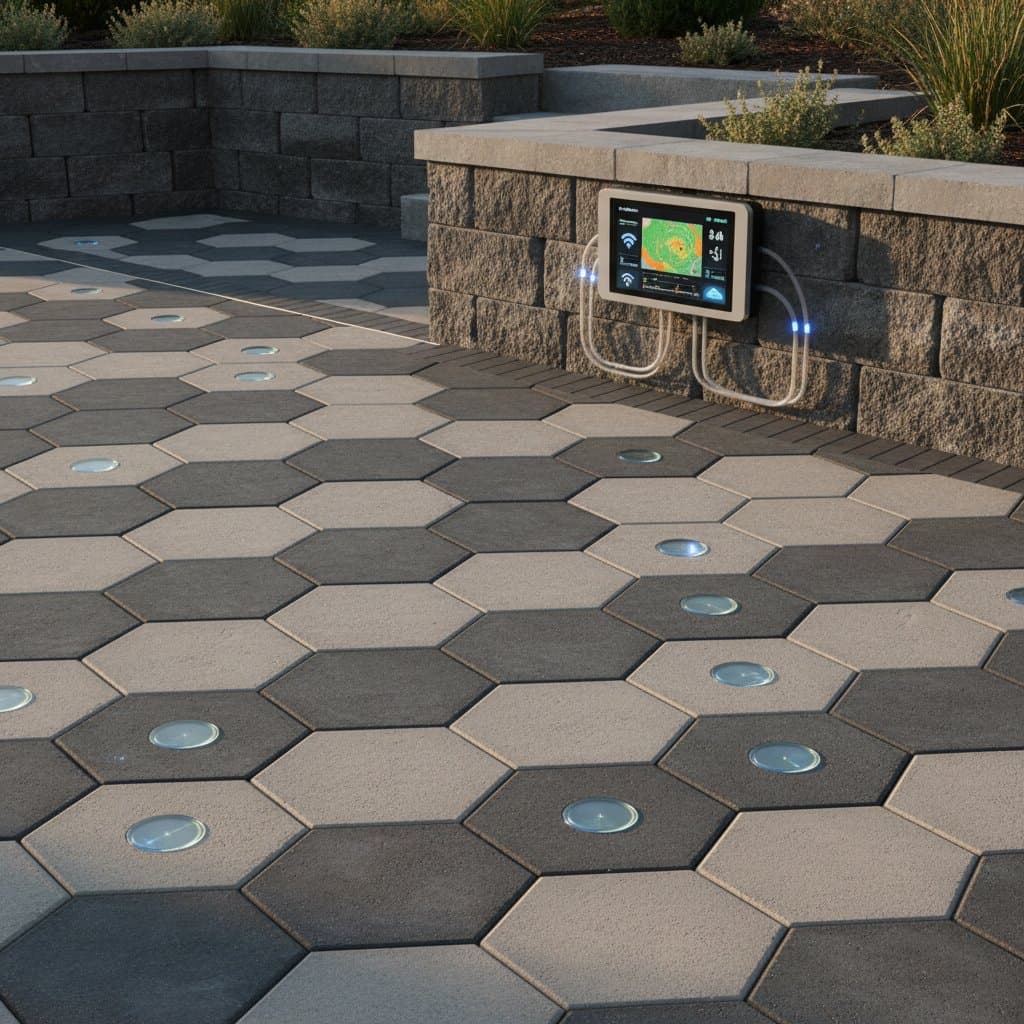
IoT Pavers: Detecting Soil Shifts for Stronger Walls
IoT pavers consist of paving or retaining wall blocks equipped with embedded sensors that measure soil movement, structural loads, temperature, and moisture levels. These units deliver real-time data on performance, enabling corrections for minor shifts before they lead to cracks or instability. Homeowners gain access to advanced monitoring capabilities that surpass traditional visual assessments in hardscape and wall installations.
Pros and Cons
Pros
- Identifies soil movement at an early stage, prior to visible damage
- Mitigates risks of expensive failures in walls or patios
- Enhances precision in designs for subsequent construction projects
- Supports remote oversight via connected apps and devices
- Eliminates uncertainty in evaluating drainage and soil compaction
Cons
- Involves elevated initial costs per unit
- Depends on reliable network connectivity or a compatible hub
- Sensor durability may not match the longevity of the paver material
- Availability of replacement components varies by region
- Introduces added complexity for straightforward, low-stakes installations
Costs
IoT-enabled paver materials generally range from $8 to $20 per square foot, influenced by sensor sophistication and enclosure durability. Conventional pavers without sensors cost $3 to $7 per square foot. Full installation of a smart system typically spans $18 to $35 per square foot.
Key factors driving expenses include sensor quantity, wireless transmission distance, data storage subscriptions, and compatibility with current control setups. For a modest patio requiring basic oversight, a limited number of strategically positioned smart units suffices. Retaining walls, however, demand a more comprehensive arrangement to achieve thorough monitoring.
Lifespan and Maintenance
The paver structure itself endures 25 to 50 years, comparable to standard materials. Embedded sensors operate for 8 to 15 years, contingent on power source type and protective sealing. Options often include replaceable batteries or low-voltage cabling.
Review sensor data monthly to spot anomalies like sudden fluctuations or signal interruptions. Maintain the surface by cleaning with a mild detergent and water solution. Refrain from directing high-pressure water streams at sensor access points. Resealing becomes necessary only in environments with excessive moisture or salt exposure.
Specs to Check
Prior to selecting IoT pavers, evaluate these essential specifications:
- Ingress protection rating of IP65 or better to withstand water and dust
- Operating temperature range suited to local weather conditions
- Wireless communication standard, such as Wi-Fi, LoRa, or Zigbee
- Battery capacity or power consumption aligned with projected lifespan
- Calibration precision for moisture and load measurements
- Integration with preferred monitoring software or platforms
Purchase an additional 10 percent of units to account for potential breakage and custom cuts during installation.
Planning and Prep
Begin with a thorough evaluation of site drainage and soil conditions. Sensors provide optimal benefits when supported by a properly prepared foundation and backfill. Determine frost line depth, terrain slope, and patterns of water flow.
Design the sensor placement strategy carefully. In retaining walls, position units along the base layer and at mid-level heights. For patios or driveways, distribute them uniformly across primary load-bearing areas. Incorporate conduits or pathways if the system relies on wired connections.
Contact utility locator services ahead of any digging. Confirm that routes for wiring trenches avoid underground utilities. In areas prone to wetness, establish drainage routes with gravel layers and perforated piping.
Installation Overview
- Outline and designate monitoring zones on the site.
- Dig to the specified depth accommodating base material, bedding sand, and paver thickness.
- Compact the base in successive layers using crushed stone or gravel, verifying drainage slope.
- Level the bedding layer evenly across the prepared area.
- Lay IoT pavers from a fixed straight edge, maintaining consistent joint widths.
- Link or synchronize sensors prior to final compaction to test signal reliability.
- Secure perimeter restraints to lock units in place.
- Fill joints with polymeric sand or fine aggregate, followed by gentle compaction.
- Initialize the monitoring system and capture initial readings after cleaning and drying the surface.
Patterns and Options
IoT pavers appear in familiar configurations, including squares, rectangles, and cobblestone styles. Retaining wall variants feature block designs with concealed sensor compartments.
Opt for stack bond or running bond arrangements in straightforward applications. Herringbone or basket weave patterns promote superior load sharing on driveways. Sensor performance remains independent of layout, though patterns aid in mapping data to specific locations.
DIY vs Pro
Experienced individuals can manage a compact patio or pathway installation with basic IoT pavers, utilizing standard masonry equipment alongside a mobile device for configuration.
Engage professionals for scenarios involving:
- Retaining walls holding over 3 feet of soil
- Clay-heavy or inadequately draining ground
- Designs incorporating electrical or network wiring
- Configurations with numerous sensors needing calibration and system linkage
Experts ensure proper base compaction and fine-tune foundations to minimize erroneous data.
Common Failures and Fixes
Data loss or dropouts: Inspect battery levels and signal range. Reinitialize sensor pairings as required.
False moisture alerts: Confirm absence of pooled water adjacent to sensor openings. Validate adequate site drainage gradient.
Inconsistent readings among units: Verify uniform base density. Isolated under-compacted areas can skew load measurements.
Cracked surface: Extract and replace the affected paver with care. Reattach or seal the sensor enclosure upon reinstallation.
Regional and Climate Notes
In regions with freeze-thaw cycles, select pavers certified for such conditions and ensure sensors meet IP67 sealing standards. Arid, high-heat areas require emphasis on ultraviolet protection and heat endurance. Coastal installations call for corrosion-proof connectors and enclosures resistant to salt-laden air.
Inadequate drainage hastens soil shifts and sensor degradation, so prioritize pathways for water to drain from beneath and behind the structure.
Alternatives
For those hesitant about full IoT paver adoption, consider standalone ground moisture probes or tilt indicators installed behind walls. These solutions prove more affordable yet necessitate independent setup. Fiber optic strain-monitoring tape offers continuous length-based detection, ideal for expansive retaining systems though uncommon in residential settings.
Pro Tips for Success
- Initiate with a pilot setup, placing smart units at critical stress zones before expanding.
- Document initial data post-compaction and following the initial substantial rainfall.
- Analyze readings over multiple seasons to map soil dynamics.
- Update sensor firmware regularly to sustain measurement reliability.
- Provide data logs to engineers or contractors during routine checks to inform ongoing improvements.
Achieving Lasting Results
IoT pavers elevate inert masonry into responsive infrastructure that reveals subsurface conditions. Homeowners benefit from reduced unexpected issues, extended structural integrity, and informed strategies for upkeep. Success hinges on a solid foundation, precise sensor deployment, and consistent data review.