
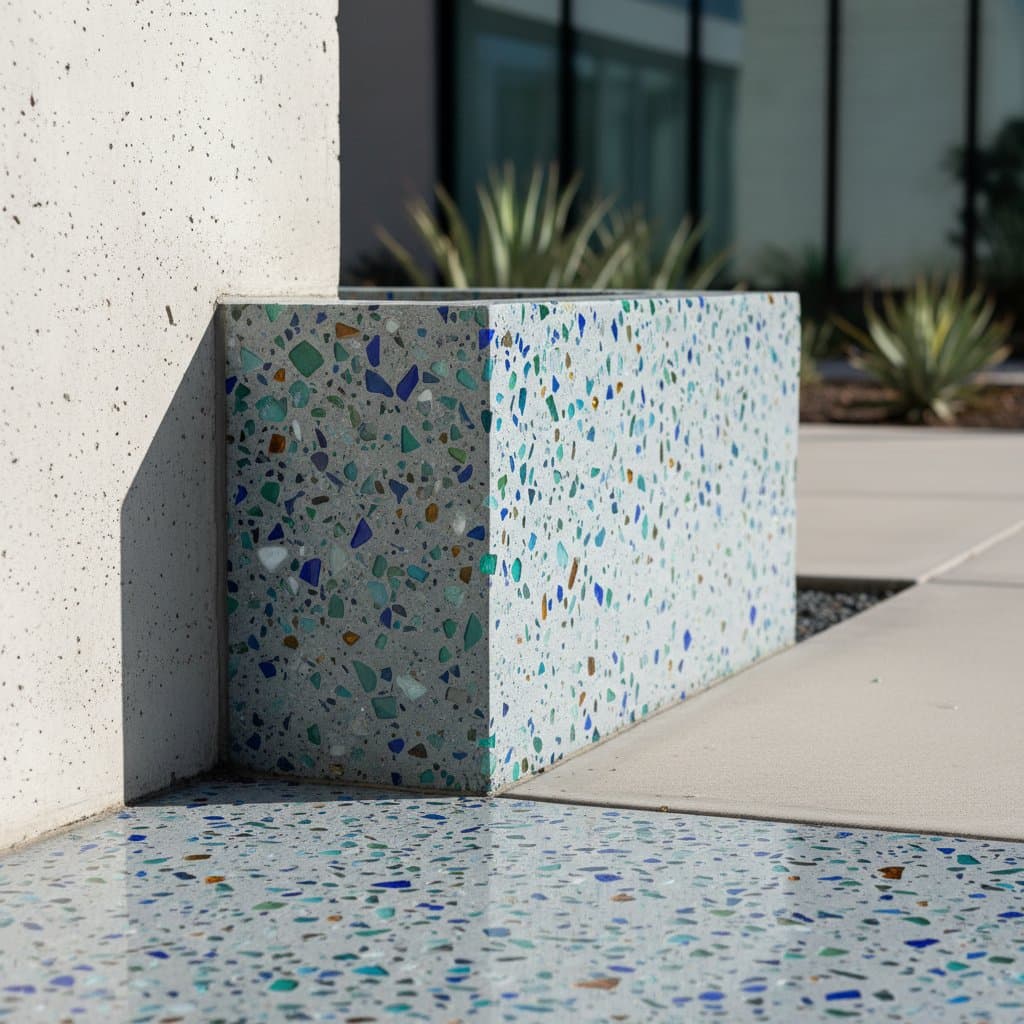
Team and Process
Successful projects with recycled glass concrete require precise sequencing and strong collaboration among key experts. Involve these professionals from the outset to ensure alignment and efficiency.
- Inspector or engineer: Evaluate the substrate's load-bearing capacity, reinforcement needs, and moisture levels to prevent structural issues.
- Architect or designer: Specify the desired color palette, aggregate exposure, and finish texture. Request early prototypes to align expectations and avoid costly adjustments.
- Concrete contractor: Select one with proven expertise in decorative aggregate polishing. Review local project references to confirm reliability.
- Supplier: Lock in a source for uniform recycled glass particle size and color prior to final bids. Mid-project supplier changes often result in noticeable inconsistencies.
- Sealer specialist: Critical for areas with heavy foot traffic or exposure to water. Opt for sealers that provide stain resistance while preserving the surface's natural appearance.
Conduct parallel evaluations of these team members to shorten timelines and minimize revisions. Engaging a professional project manager typically increases costs by 10 to 20 percent, yet it safeguards against delays and budget excesses in complex coordination scenarios.
Scope Priorities
Focus investments on elements that enhance both performance and visual appeal while supporting long-term durability.
- High-impact upgrades:
- Apply robust surface sealing to block moisture penetration.
- Install air barriers beneath slabs to reduce vapor transmission.
- Establish proper drainage slopes around outdoor installations.
- Source recycled glass locally to lower transportation expenses and emissions.
- Lower-priority modifications to postpone:
- Elaborate color mosaics that extend labor by double.
- Glass incorporation exceeding 25 percent, which compromises structural integrity.
- Decorative applications in basements or below-grade areas prone to dampness.
Retain existing load-bearing concrete where possible. Reserve recycled glass enhancements for surfaces where aesthetic and environmental advantages outweigh added expenses.
Budget and Sequencing
Prioritize foundational stability over decorative flair, as a solid base underpins all subsequent layers.
- Manage water effectively: Address site grading and drainage systems before any finishing work begins.
- Reinforce the structure: Seal cracks and joints, and incorporate control joints as required to manage expansion.
- Prepare the surface: Thoroughly clean, etch, and assess adhesion strength prior to applying overlays or embedding aggregates.
- Install the recycled glass mixture: Adhere strictly to predetermined batch proportions, maintaining minimal water addition for optimal consistency.
- Cure and refine: Allow complete curing before polishing commences. Progress from coarse to fine grits to achieve uniform glass revelation.
- Seal and safeguard: Distribute two layers of sealer, then restrict access until full hardening occurs.
- Ongoing care: Employ only neutral pH cleaners for washing, steering clear of acids or abrasive materials.
Omit any phase or accelerate curing at the risk of structural compromise. Each step builds directly on the previous one for reliable outcomes.
Performance and Payback
When implemented with precision, recycled glass concrete yields tangible gains in environmental stewardship and financial efficiency.
- Resource conservation: Redirects discarded glass from landfills and diminishes reliance on virgin sand extraction.
- Thermal advantages: The reflective properties of glass reduce solar heat gain on exposed exterior surfaces.
- Enhanced resilience: Well-integrated glass particles improve resistance to wear and tear.
- Aesthetic distinction: Every installation yields a one-of-a-kind pattern, surpassing the uniformity of conventional aggregates.
Returns materialize through extended service life and decreased carbon footprint. The initial premium typically offsets within five to seven years via reduced upkeep demands and superior endurance.
Common Field Mistakes
Experienced teams still encounter pitfalls unique to recycled glass applications.
- Excessive water in the mix: This dilutes adhesion and causes glass particles to migrate to the top layer.
- Omitting test panels: Results in mismatched hues or irregular aggregate depths.
- Flawed polishing progression: Produces visible swirls and uneven light reflection.
- Neglecting edge treatments: Unprotected borders allow glass to dislodge over time.
- Incompatible sealer choices: Certain chemical reactions with glass surfaces lead to faded tones.
Rigorous on-site protocols prevent rework and disputes. As one seasoned concrete specialist noted, “You cannot fix polish mistakes after the sealer goes on.”
Long-Term Maintenance
Treat recycled glass concrete akin to high-end terrazzo or honed stone for sustained vibrancy.
- Regularly sweep or vacuum to remove abrasive debris.
- Use pH-neutral soaps for cleaning, avoiding acidic or citrus-based products.
- Refresh sealer applications every two to three years based on usage intensity.
- Monitor edges for water seepage and address joint resealing immediately.
- Prevent impacts from heavy metallic items that could fracture glass margins.
Consistent routines preserve the finish's luster and extend its functional lifespan.
Sustainability and Local Sourcing
Achieve genuine eco-benefits by scrutinizing the recycled glass origin and processing methods. Partner with suppliers that employ low-energy techniques for cleaning and sizing the material. Common sources include clear, green, and amber glass bottles, while mirrors or ceramics demand specialized processing.
Local procurement minimizes shipping-related emissions, a frequent oversight in sustainable material choices. For load-bearing applications, confirm the glass's chemical inertness. Alkali-rich varieties can interact adversely with cement; incorporate pozzolanic agents like fly ash or slag to mitigate this. The incremental expense pales against potential deterioration costs.
Comparing Finishes
Recycled glass concrete holds its own against alternatives like terrazzo, epoxy-bound stone, and exposed natural aggregates, each with distinct pros and cons.
- Terrazzo: Delivers a sleek, polished look but demands high labor and upfront investment.
- Epoxy stone: Accelerates installation yet falters in outdoor durability and recyclability.
- Exposed aggregate concrete: Widely available and straightforward, though it misses the iridescence and waste-diversion perks of glass.
This option strikes a balance: reasonable pricing, robust performance, and compelling green attributes, free from the vulnerabilities of synthetic binders.
Making It Happen
Initiate with a modest trial zone, such as a countertop segment or garden path section, to gauge local glass compatibility with your formulation and protective coatings. Document exact proportions, curing durations, and polishing techniques. Circulate these findings with your contractor and supplier to inform full-scale execution.
Vigilantly exclude moisture, adhere to sealing schedules, and observe gradual wear patterns. Homeowners who regard recycled glass concrete as an integral structural and decorative element secure decades of reliable, low-maintenance performance.