
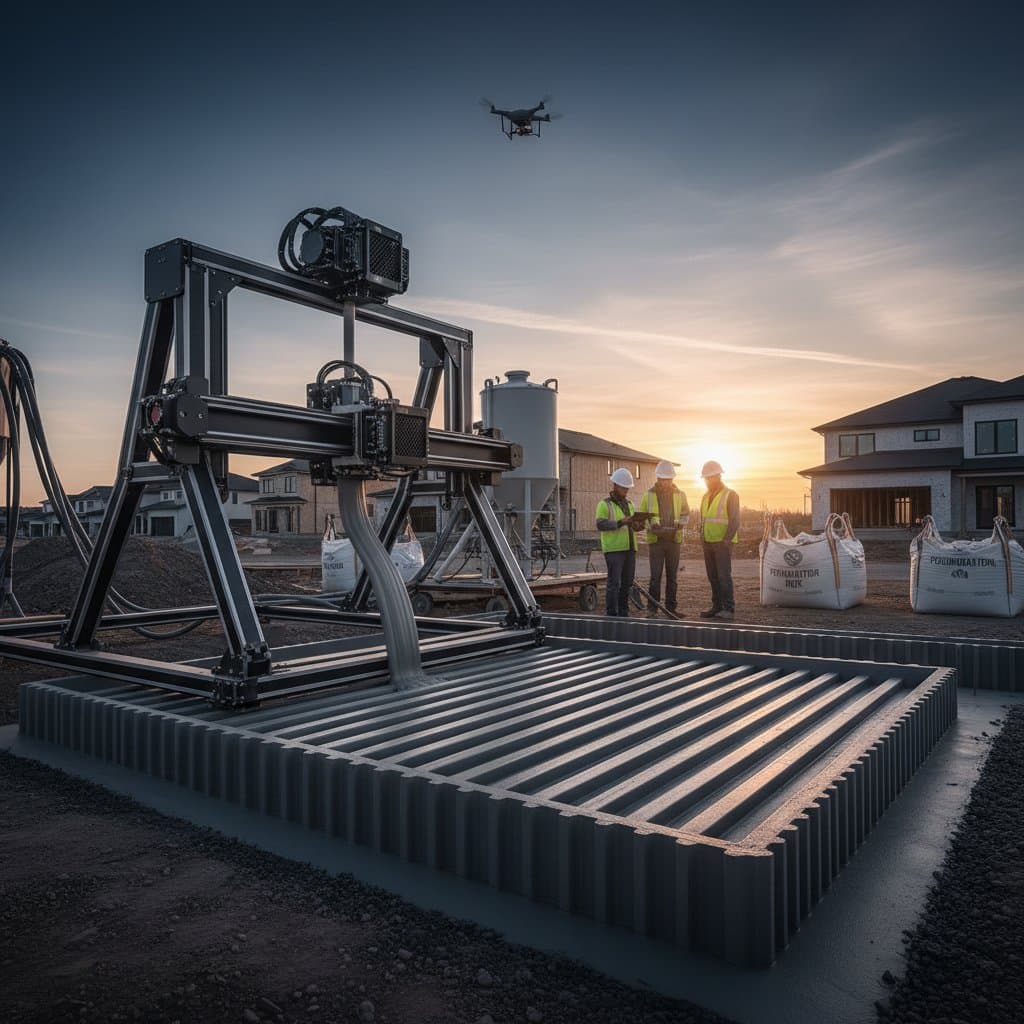
- Critical dimensions: Layer height between 0.25 and 0.75 inches, wall thickness typically 6 to 12 inches.
- Decision factors: Project scale, site accessibility, climate control, and local building code acceptance.
Planning and Regulatory Considerations
Before implementing 3D printed foundation technology, verify compliance with local building codes. Certain municipalities demand additional documentation or testing to confirm structural integrity.
Permits and Approvals
- Structural certification: The printed concrete mixture must achieve the minimum compressive strength outlined in the code, generally 3,000 PSI or higher.
- Engineer review: A licensed structural engineer must evaluate design loads, bearing capacity, and reinforcement specifications.
- Site inspection: Local authorities may request demonstration samples or test specimens prior to granting full approval.
Budget Planning
Material expenses per cubic yard align closely with those of traditional concrete, yet equipment setup fees and software modeling add distinct cost elements. A standard cost distribution includes:
- Materials: 55 percent (cementitious mix, aggregates, additives).
- Equipment: 25 percent (printer rental or purchase, calibration).
- Labor: 15 percent (operators, technicians).
- Permits and design: 5 percent.
For a mid-sized residential foundation spanning 1,000 square feet, expect total expenses of $85,000 to $110,000, influenced by the degree of automation and reinforcement method.
Step-by-Step Execution Process
1. Digital Modeling and Calibration
Initiate the process with a CAD-based model of the foundation. This digital representation specifies the path and height of each layer. Specialized software translates the model into precise printer directives.
- Enter dimensions, footing widths, and reinforcement positions.
- Establish layer thickness between 0.25 and 0.75 inches to promote strong adhesion.
- Adjust printer nozzle height via laser sensors to achieve precision within 1/16 inch.
2. Material Preparation
3D printed concrete requires a high-viscosity mix that retains its form while remaining suitable for pumping.
- Employ a cement-to-aggregate ratio tailored for extrusion, commonly 1:2.5.
- Incorporate plasticizers to regulate flow and silica fume to enhance strength.
- Confirm slump value between 0.5 and 1 inch through a mini-slump test.
3. Printing the Foundation
Following calibration and mix verification, commence the printing operation.
- The printer deposits concrete along the foundation's perimeter.
- Deposit each subsequent layer within minutes of the prior one to secure bonding.
- Proceed with continuous printing until reaching the designated wall height or footing depth.
A standard 1,000-square-foot foundation completes in 8 to 12 hours, in contrast to multiple days required for conventional pouring and formwork dismantling.
4. Reinforcement Integration
Incorporate reinforcement based on the structural blueprint, either during or post-printing.
- Place steel rods or fiber mesh between layers at predetermined intervals.
- In hybrid approaches, create hollow channels during printing and subsequently fill them with grout or high-strength mortar.
5. Curing and Finishing
Permit an initial setting period of 24 to 48 hours before imposing substantial loads. Preserve moisture through plastic sheeting coverage or application of curing compounds. Attain full strength within 7 to 14 days, akin to standard concrete.
Finish surfaces by trowel smoothing or retain the layered appearance for aesthetic purposes.
Troubleshooting Common Challenges
Automation reduces errors, yet specific issues may arise.
- Layer collapse: Results from excessive moisture in the mix or slow nozzle progression. Adjust pump pressure and viscosity accordingly.
- Cold joints: Develop if intervals between layers surpass bonding windows. Ensure uninterrupted printing or apply a bonding agent.
- Printer misalignment: Stems from uneven terrain or vibrations. Re-level the platform and recalibrate sensors.
- Cracking during curing: Arises from swift moisture evaporation. Employ curing blankets or misting techniques.
Conduct regular oversight and preliminary testing to avert these complications and promote reliable results.
Evaluating DIY Versus Professional Installation
3D printing streamlines concrete tasks, but it demands technical equipment and modeling proficiency.
When DIY May Be Viable
For modest structures like outbuildings or detached garage foundations, a proficient DIY enthusiast with adequate training and rented gear can manage the work. Such efforts yield savings of 20 to 30 percent relative to full contractor engagement.
When Professional Help Is Essential
Complex residential or commercial foundations bearing significant loads necessitate expert involvement. Professionals manage:
- Equipment calibration and upkeep.
- Mix formulation refinement.
- Regulatory paperwork.
- Operational safety protocols.
Select contractors versed in robotic concrete printing, and confirm their licensing and insurance.
Environmental and Efficiency Benefits
3D printed foundations substantially decrease waste and energy demands. Conventional techniques involve extensive formwork and repeated heavy material transport.
Material Efficiency
Extrusion layer by layer positions material precisely where required, minimizing volume and cement consumption. Certain systems incorporate geopolymer or recycled aggregates to further diminish ecological effects.
Reduced Human Risk
Automation eliminates manual heavy lifting, repetitive motions, and contact with wet concrete. On-site personnel needs decline, enhancing safety and output.
Energy and Emission Reduction
Accelerated timelines reduce machinery fuel use and delivery trips. Paired with digital accuracy, these advantages position 3D printed foundations as a viable sustainable option in contemporary building practices.
Pro Tips for Success
- Verify printer calibration prior to every print session. A 1/8 inch deviation risks layer misalignment.
- Maintain a reserve material stock. Disruptions lead to cold joints or poor bonding.
- Deploy humidity and temperature sensors to oversee the curing conditions.
- Document all printing variables, such as speed, layer height, and mix proportions, for performance analysis.
- Consult local inspectors at the outset to expedite approvals for emerging technologies.
Implementing 3D Printed Foundations
3D printing reshapes foundation construction possibilities. Quicker, less wasteful, and more uniform, this method enables project completion in roughly half the duration of established approaches, without compromising durability.
Homeowners investigating cutting-edge options or contractors pursuing greater efficiency benefit from grasping the mechanics of printed foundations. Assess your site conditions, financial resources, and technical capabilities to determine alignment with this forward-thinking technique.
Through meticulous preparation, expert execution, and diligent upkeep, 3D printed foundations herald an era of swift, accurate, and eco-friendly building that transforms foundational work.