
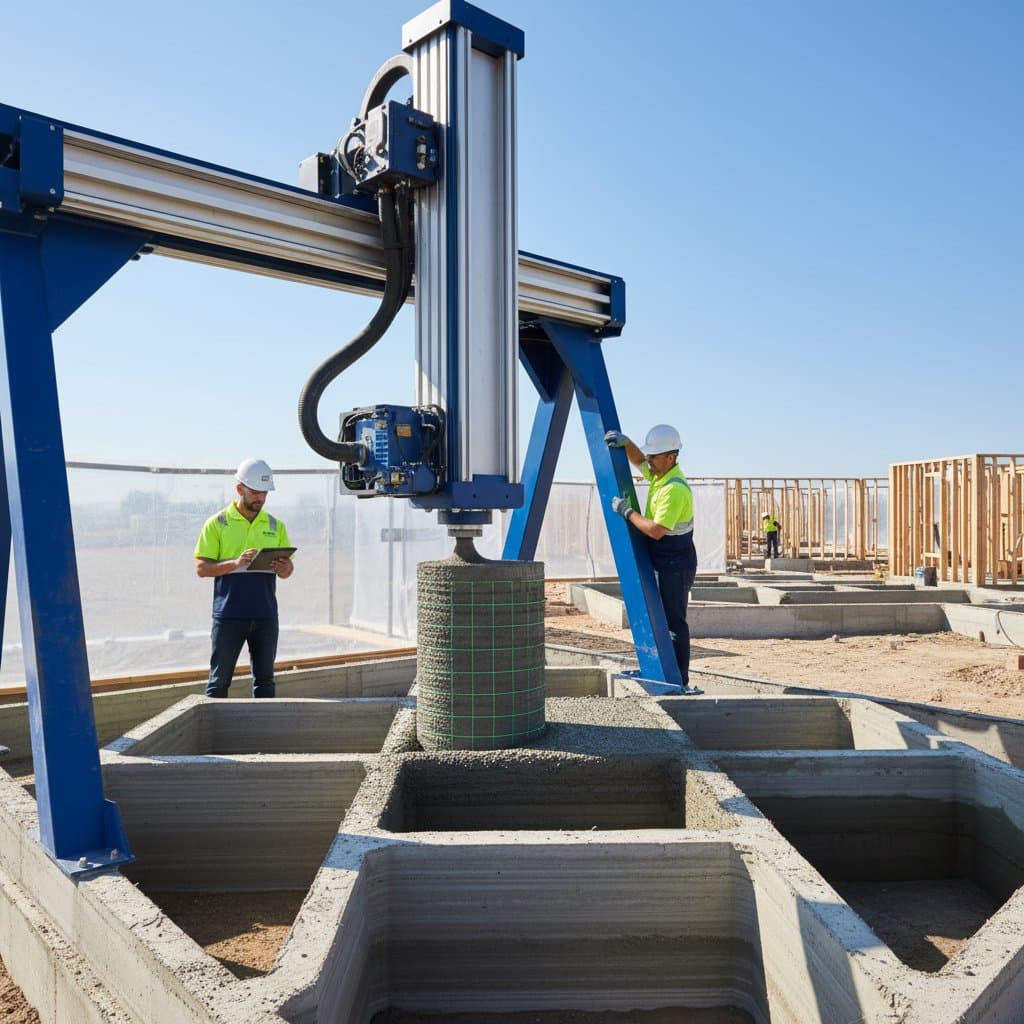
Build Strong Foundations in Just 48 Hours with 3D Tech
Quick Take
Automated 3D printing of concrete foundations is changing how builders start projects. The biggest risk is assuming speed replaces inspection. The cost drivers are raw material quality, site prep, and calibration accuracy. The promise is real, but so are the pitfalls if moisture, curing, or load paths are not managed from the start.
What To Check
Walk any 3D printed foundation site with the same focus used on a traditional pour. Early detection of defects saves expensive corrections later.
- Sightlines across the print layers. Look for consistent bead lines without bulges or voids. Uneven texture signals poor nozzle control or mix inconsistency.
- Corners and junctions where walls meet. Check for gaps or cold joints. These can collect water and weaken structural continuity.
- Surface hardness with a simple screwdriver test. If the surface scrapes too easily, curing or mix ratios need review.
- Moisture at the slab edge. Water pooling near the print base signals drainage or leveling issues.
- Anchor points. Verify embedded bolts or plates are straight and fully seated.
- Base compaction. Step on the subgrade around the foundation. Soft spots mean inadequate preparation and future settlement risk.
A printed foundation can look perfect at first glance. The goal is to confirm it performs as a structural base, not just as a finished surface.
Red Flags
- Layer separation visible between print passes.
- Crumbling or chalky surfaces after curing.
- Uneven settlement around corners or load points.
- Poor integration with traditional footings or rebar cages.
- Evidence of nozzle drag or skipped paths during print.
- Standing water at the foundation perimeter after light rain.
- Cracks forming before the top layers are completed.
- Print mix stored too long before use, leading to segregation or clogging.
These signs suggest weak adhesion or incomplete bonding. Once embedded, those flaws are hard to correct without partial demolition.
Likely Fixes and Rough Costs
When caught early, many issues can be managed without full replacement.
- Surface grinding and patching: For small voids or high spots, expect local grinding and polymer patching at modest cost.
- Reprinting select walls: If one section shows poor bonding, controlled demolition and reprinting can run from a few thousand to tens of thousands depending on access and size.
- Drainage correction: Adding gravel and regrading around the print perimeter costs less than structural repair later.
- Mix adjustment and reprint: When the problem is in the concrete formulation, expect added cost for testing and recalibrating the print mix.
- Moisture barrier retrofit: Installing membranes or coatings after printing costs more than integrating them during the process.
A cheap cosmetic fix often hides the root cause. Do not paint or skim-coat a foundation that has moisture or bonding problems. The issue will resurface, typically just as finishes and framing begin.
Scope creep is common when teams treat reprinting as minor. Equipment mobilization, calibration, and curing cycles eat into schedule and budget fast. Every reprint resets at least part of the timeline.
Repair vs Replace
Foundations: For printed foundations, repair is viable if defects are local and structural continuity remains intact. Replacement is justified when layers delaminate or curing failed across wide areas. Focus first on controlling moisture and verifying load paths before deciding.
Drainage: Always fix grading and runoff before considering structural repair. Water will defeat any patch over time.
Anchors and embeds: If misaligned, partial replacement is usually cheaper than trying to drill and epoxy anchors after the fact. The precision of automated printing relies on those inserts being exact.
The decision rule is simple. If the problem affects structural capacity or moisture performance, redo it. If it is cosmetic or isolated, repair it.
Team and Process
A printed foundation project needs more coordination than a conventional pour because the equipment, software, and materials all must sync.
- Inspector: Choose one who understands both traditional concrete and printed systems. They can spot layer bonding issues and verify curing conditions.
- Engineer: Engage early to verify load paths, reinforcement, and soil interaction. 3D printed concrete behaves differently from cast-in-place material.
- Printing technician: The operator must calibrate the nozzle, speed, and mix in response to field conditions. Wind, humidity, and surface temperature all matter.
- General contractor: Manages site prep, utilities, and integration with the rest of the build. They keep the printer from becoming a bottleneck.
- Architect: Adjusts design details for print geometry, such as curved corners or integrated ducts.
Parallel vetting reduces misfit risk. If each party joins late, coordination gaps multiply. A professional project manager typically adds ten to twenty percent to cost but can prevent schedule overruns and reprints that cost far more.
Scope Priorities
High-yield moves in early printed foundation projects are about performance, not novelty.
- Confirm subgrade compaction and drainage first. A perfect print on soft soil still fails.
- Test print a small section before full run. This verifies mix consistency and nozzle calibration.
- Integrate conduits and embeds during printing. Cutting or drilling later defeats the purpose of precision automation.
- Focus on moisture protection. Printed concrete can be porous, so add sealers or membranes where needed.
- Preserve design simplicity. Overly intricate shapes slow printing and complicate finishing.
Low-return moves include decorative surface treatments or complex curves that add time without structural gain. Keep the geometry functional and efficient.
Budget and Sequencing
The sequence should follow risk order, not excitement.
- Site prep and drainage. Grade the lot, compact the base, and confirm runoff paths.
- Printer setup and calibration. Align the print area, check mix supply, and test nozzle output.
- Layer-by-layer monitoring. Keep an inspector on site to record temperatures, humidity, and curing conditions.
- Curing and moisture control. Shield the foundation from direct sun or heavy rain during curing.
- Structural verification. Load testing, anchor alignment, and dimensional checks before framing.
- Integration with services. Only after the foundation passes all checks should plumbing, electrical, and framing proceed.
This sequence prevents rework. Skipping moisture control or verification leads to failures later that can double cost. The beauty of 3D printing is speed, but that same speed can hide mistakes that normally appear during slow curing.
Material and Equipment Risks
3D printing relies on a precisely mixed material. Even small deviations affect performance.
- Mix composition: The binder and aggregate must balance flow and strength. Too wet, and layers slump. Too dry, and bonding fails.
- Nozzle wear: A worn nozzle changes flow rate and layer height, introducing weakness.
- Pump consistency: Pressure fluctuations create voids or over-extrusion.
- Curing conditions: Temperature and humidity shifts can cause cracking or uneven drying.
Routine calibration and real-time monitoring reduce these risks. A steady print rhythm and controlled environment deliver the best results.
Cost Drivers
Printed foundations reduce labor but depend heavily on equipment uptime and material control.
- Printer rental or purchase: High initial cost, but amortized over multiple projects.
- Material supply: Specialized concrete mixes cost more per cubic yard than standard ready-mix.
- Setup and calibration: Takes several hours and skilled labor.
- Power and logistics: Reliable power and continuous material feed are essential. Interruptions add cost quickly.
When run efficiently, printed foundations can lower total cost compared to traditional methods, especially on repetitive builds. Poor planning or rework erases those savings fast.
Long-Term Performance
Properly executed printed foundations can match or exceed traditional strength. The key is uniform curing and moisture control. Early adopters report stable performance when protective coatings and drainage are maintained. Surface sealing prevents capillary water rise and extends service life.
Thermal performance improves when printed layers include internal air gaps or insulation inserts. This can reduce heat loss through the slab and improve comfort. The cost trade-off depends on local climate and energy prices.
Maintaining Your Investment
Once built, treat a printed foundation like any structural system. Keep water away, monitor for settlement, and record conditions yearly.
- Check grading and gutters each season so runoff stays clear of the foundation.
- Inspect for cracks wider than a credit card. Seal small ones with flexible masonry sealant after confirming no movement.
- Maintain the surface coating or membrane as specified by the engineer.
- Keep vegetation trimmed so roots do not disturb the perimeter.
- Record moisture readings if the site has a history of damp soil.
Small maintenance steps preserve structural integrity and help verify long-term durability of the print method.
Your Next Steps
A homeowner or builder considering 3D printed foundations should start with a short field review and a few direct questions.
- Has the soil been tested for bearing and drainage?
- Does the engineer approve the print mix and reinforcement strategy?
- Is there a moisture management plan for curing and long-term performance?
- Can the team produce a test print on site before full production?
- Are cure logs and print parameters documented for quality control?
If those answers are clear, the project can proceed with confidence. If they are vague, pause until they are resolved. The goal is not to chase novelty but to build a solid, measurable foundation faster and with less waste.
Printed foundations can be ready in two days, but strength comes from preparation, calibration, and patience. The technology delivers speed, yet the craft remains in the discipline of inspection and sequencing.