
Why 3D-Printed Foundations Reduce Build Time by 60 Percent
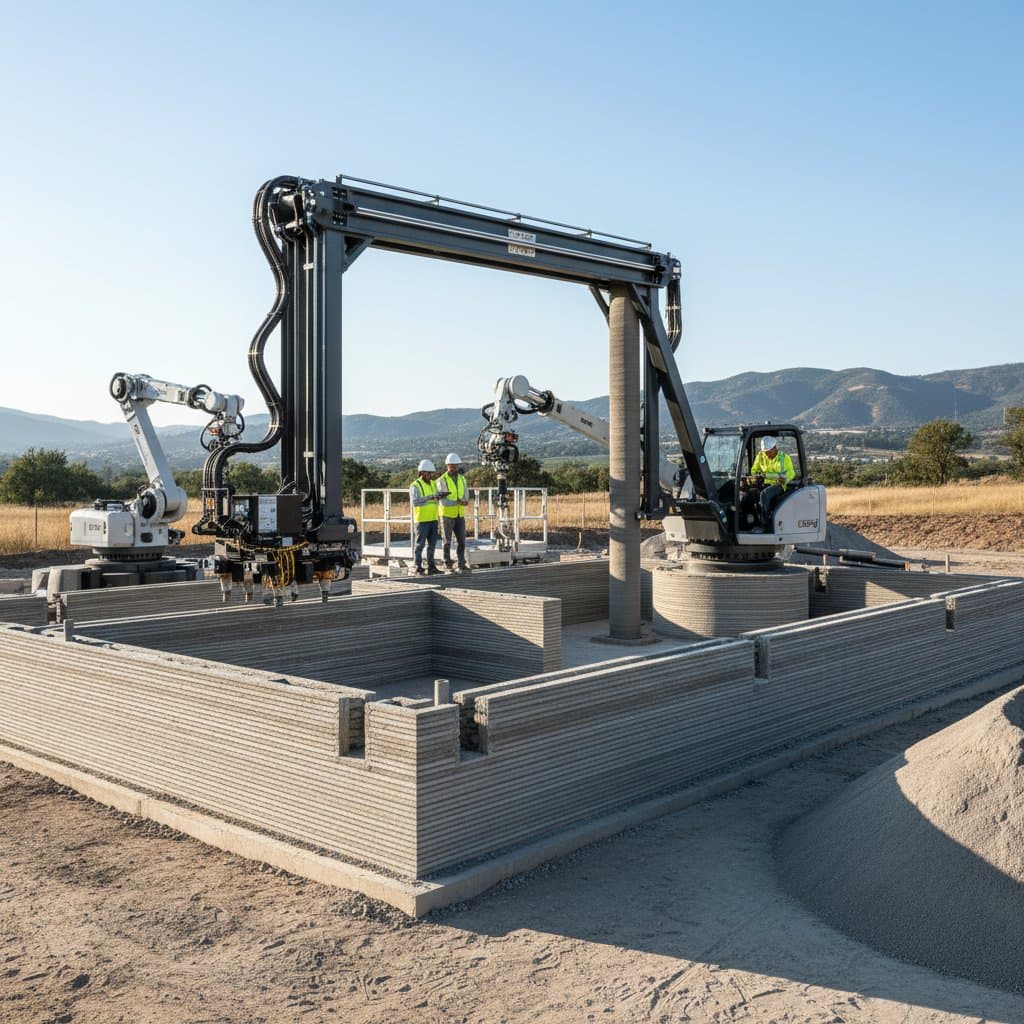
A 3D-printed foundation emerges from a robotic printer that deposits concrete in successive layers to construct the structural base. Rather than filling wooden forms with liquid concrete, the printer follows a predefined digital trajectory to shape the foundation precisely from design files. This method delivers a consistent, replicable outcome that shortens construction timelines by more than half relative to conventional pouring techniques.
How Printing Substitutes for Pouring
Traditional foundation work relies on form assembly, reinforcement placement, concrete pouring, and extended curing periods. Workers measure sites, erect forms, install rebar, pour the mix, and delay backfilling until the material hardens. In contrast, 3D printing integrates form fabrication and foundation creation in a single automated sequence, directed by a comprehensive digital blueprint that specifies all dimensions and features.
This process bypasses numerous manual tasks that typically hinder progress. After initial setup and alignment, the printer operates steadily with limited oversight from personnel.
Reasons for the 60 Percent Speed Increase
The acceleration arises from streamlined preparation, minimized material loss, and seamless execution without interruptions. Key factors contributing to this efficiency include:
- Elimination of form construction and dismantling. Erecting and removing traditional forms demands hours or days of effort. Printing fabricates walls in place, obviating this phase completely.
- Uninterrupted workflow. Robotic printers sustain extended runs, unaffected by crew shifts or adverse weather that halts manual operations.
- Accelerated setting. Specialized concrete formulations in printing achieve rapid hardening without sacrificing durability, permitting subsequent construction to commence earlier.
- Targeted material delivery. Concrete arrives exactly at required locations, reducing errors, rework, and post-process cleanup.
- Model-guided precision. Nozzle movements adhere strictly to digital specifications, avoiding adjustments for irregularities in alignment or elevation.
Advantages and Disadvantages
Advantages
- Quicker output with reduced delays across project stages
- Decreased waste and simplified material management
- Superior precision and process repeatability
- Diminished labor expenses after equipment deployment
- Uniform concrete integrity via regulated mixing procedures
Disadvantages
- Dependence on dedicated machinery and expert operators
- Scarce availability of regional suppliers and support in certain areas
- Necessity for adequate power sources and space to accommodate robotic navigation
- Constraints on design versatility tied to printer range and programming limits
- Potential misalignment between regulatory approvals and emerging technology standards
Cost Considerations and Influencing Variables
The expense of materials for printed foundations approximates that of conventional concrete per cubic yard. However, overall installation costs decline by 20 to 30 percent in optimized setups. Anticipate $8 to $14 per square foot for combined materials and printing services. Elements impacting expenses encompass:
- Scale and intricacy of the foundation design
- Accessibility of the site for transporting substantial robotic units
- Proximity to providers of printable concrete formulations and technical assistance
- Duration required for equipment calibration and digital file integration
Although the printing apparatus involves high initial investment, its productivity lowers personnel needs and shortens timelines, thereby offsetting ancillary charges.
Durability and Upkeep Requirements
Printed foundations endure equivalently to poured versions when constructed with comparable strength ratings. With adequate drainage and stable subsoil, service life extends beyond 50 years. Upkeep mirrors standard practices: monitor moisture levels, inspect for fissures, and apply sealants promptly. Interlocking layers in printed structures confine minor cracks to superficial levels.
Essential Specifications to Verify
Prior to engaging printing services or procuring supplies, evaluate these parameters:
- Compressive strength. Aim for 3,000 to 5,000 psi in residential applications.
- Formulation type. Select printable mixes incorporating stabilizers to inhibit settling and promote adhesion between layers.
- Layer thickness and nozzle dimensions. These determine finish quality and load-bearing uniformity.
- Curing integration. Ensure compatibility with rebar embedding or anchor placements mandated by local codes.
Site Preparation and Planning
Even printed foundations demand firm ground, a well-compacted subbase, and effective drainage systems. Condition the site equivalently to preparations for poured foundations. Provide unobstructed perimeter space, typically several feet beyond the foundation outline, for printer mobility. Assess terrain gradients and water flow routes in advance of operations. Locate and protect subsurface utilities prior to any ground disturbance.
Step-by-Step Installation Process
- Load digital blueprints into the printer's management interface.
- Grade and densify the subgrade layer.
- Align the printer and validate material extrusion consistency.
- Initiate layering for perimeter and interior walls.
- Interrupt as needed to insert reinforcements per design.
- Finalize wall elevations and embed bolts or pathways.
- Permit controlled curing prior to applying loads or surrounding soil.
Deciding Between DIY and Professional Services
Foundation printing defies casual implementation. Compact printers suit minor endeavors, but substantial structural bases necessitate certified specialists versed in automation and material science. Engage professionals for load-bearing elements, intricate configurations, or compliance with building regulations. Smaller printers enable self-directed projects for outbuildings or boundary features.
Frequent Challenges and Resolutions
Common problems encompass delamination between layers, extrusion blockages, or variable mix properties. Address these by fine-tuning delivery speeds or hydration levels. Aesthetic imperfections yield to surface leveling post-hardening. Load-related fractures prove uncommon with thorough subgrade testing and quality-controlled materials.
Climate and Regional Influences
Environmental conditions shape printing feasibility. In temperate zones, operations proceed year-round with standard mixes. Colder regions benefit from insulated enclosures to maintain mix fluidity during extrusion. Humid or arid climates require adjusted additives to optimize setting without excessive shrinkage. Local soil types, from expansive clays to sandy loams, influence base preparation depth and reinforcement needs. Regulatory variations across jurisdictions may dictate additional testing for seismic or frost-prone areas.
Viable Alternatives
For projects where 3D printing proves impractical, consider precast concrete panels, which arrive ready for assembly and reduce on-site curing. Insulated concrete forms (ICFs) combine speed with thermal efficiency, though they retain some formwork. Traditional slipforming offers continuous pouring for tall structures but demands larger crews. Modular foundation systems, using factory-built segments, balance customization with rapid installation, particularly in remote locations.
Steps to Implement 3D-Printed Foundations
To integrate this technology, start by consulting certified providers through industry directories. Review project blueprints for print compatibility and secure necessary permits early. Budget for equipment transport and operator training if scaling up. Pilot a small section to test site conditions and refine processes. Track metrics like timeline savings and cost reductions to inform future applications, ensuring sustained efficiency gains in your construction endeavors.