
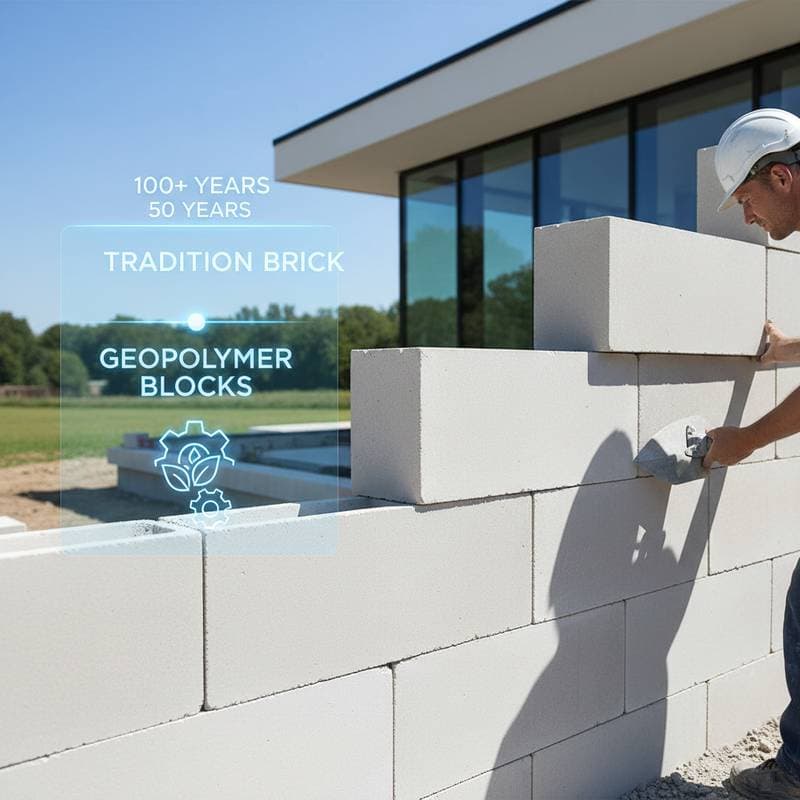
Selecting Geopolymer Block Materials
Geopolymer blocks offer diverse options tailored to specific project needs. Each type draws from industrial byproducts, ensuring sustainability without compromising strength. Consider factors such as environment, budget, and desired appearance when choosing.
Fly Ash Geopolymer Blocks
These blocks feature a lightweight design with high thermal resistance and a gray coloration. They prove affordable and energy-efficient, while remaining easy to handle during construction. However, compressive strength sits slightly below that of denser alternatives.
Cost aligns with mid-grade brick. Suitable skill level ranges from beginner to intermediate. Maintenance requires only occasional cleaning. Ideal applications include garden walls, small structures, and interior partitions. The aesthetic delivers a smooth, industrial appearance.
Metakaolin Geopolymer Blocks
Dense and fine-grained, these blocks present an off-white finish that supports easy coating or painting. They provide excellent strength and a consistent look across installations. Drawbacks include higher cost and increased weight for lifting.
Pricing positions them as premium compared to standard brick. Intermediate skills suffice for most projects. Maintenance involves low effort, with periodic sealing for decorative elements. Best suited for exterior facades, accent walls, and high-end builds. The clean, architectural surface enhances modern designs.
Slag-Based Geopolymer Blocks
Engineered for toughness, these high-density blocks excel in harsh environments. They resist chemicals and salts effectively, contributing to an extended lifespan. Challenges arise from their weight, which exceeds clay brick, and difficulty in cutting.
Cost exceeds midrange options slightly. Advanced skills prove necessary due to handling demands. Maintenance remains very low. Optimal uses encompass coastal walls, retaining structures, and industrial applications. A subtle metallic hue pairs with a rugged texture for durable appeal.
Detailed Installation Guide
Proper installation ensures geopolymer blocks achieve their full potential in durability and performance. Follow these steps methodically to build stable, long-lasting walls. Preparation forms the foundation for success.
1. Establish a Solid Base
Begin by excavating a trench that matches the wall thickness plus six inches on each side. Reach a depth below the frost line, or at least six inches for non-structural walls, to mitigate shifting. Layer in four inches of compacted gravel, followed by a two-inch sand bed for leveling. This setup promotes drainage and prevents uneven settlement over time.
2. Lay the Initial Course
Secure a mason's line between stakes at the corners to guide alignment. Position the first block at one end and verify level in both directions using a spirit level. Proceed along the line, ensuring tight joints between blocks. Tap gently with a rubber mallet for adjustments. Precision in this course sets the standard for the wall's overall straightness and stability.
3. Mortar Application Techniques
Apply mortar in a half-inch layer using a trowel for even coverage. Press each subsequent block into position with firm pressure to secure adhesion. Geopolymer mortar cures more rapidly than traditional cement varieties, so prepare batches in small quantities to avoid waste. Reassess level every three or four blocks to maintain accuracy.
4. Achieve Staggered Joint Patterns
Offset joints in each new course by half a block length to distribute weight evenly and improve visual appeal. Rely on a level tool and the mason's line to keep rows straight and uniform. This interlocking method strengthens the structure against lateral forces. Consistent staggering prevents weak points from forming.
5. Incorporate Reinforcement Where Needed
For walls exceeding standard heights or serving as retainers, embed vertical rebar through the block cores. Fill these cores with geopolymer grout for added integrity. Adhere to manufacturer guidelines on spacing, typically every 24 to 48 inches depending on load. Such reinforcement bolsters resistance to seismic activity and extends service life.
6. Tool and Refine Joints
As mortar starts to set, use a jointer tool to shape the joints, creating a concave profile that repels water effectively. Remove any excess mortar promptly with a brush or cloth before it hardens fully. This finishing step not only enhances weather resistance but also contributes to a professional appearance. Inspect for uniformity across the surface.
7. Cure the Structure Properly
Protect the freshly laid wall by covering it with damp burlap or plastic sheeting for a minimum of two days. Shield the area from direct sunlight and freezing conditions to allow even hydration. Adequate curing develops maximum strength and durability. Monitor environmental factors closely during this phase.
Practical Advice: Maintain mortar consistency by mixing from the same batch for sections where color uniformity matters, such as visible elevations.
Achieving Professional Finishes
Finishing elevates a geopolymer wall from functional to refined. Select treatments that complement the material's inherent properties. These steps protect against environmental wear while enhancing aesthetics.
Apply a breathable sealer to surfaces exposed to frequent rainfall, which deepens color and minimizes efflorescence. Install coping stones along the top edge to direct water away from the wall face. For decorative enhancements, opt for staining or mineral-based paints designed for geopolymer compatibility. Test products on a small area first to ensure adhesion and desired results.
Practical Advice: Clean with a mild detergent solution and a soft brush to preserve the surface. Steer clear of acid-based cleaners, as they risk etching and dulling the finish.
Integrating Geopolymer into Broader Projects
Geopolymer blocks adapt seamlessly to landscape and architectural designs. Their versatility supports creative integrations that boost functionality and style. Explore combinations that align with project goals.
Incorporate recessed lighting within wall niches for evening ambiance, or build in seating ledges for outdoor gathering spaces. Use matching planters to create unified garden features. The material's fire resistance suits enclosures around grills or fire pits in outdoor kitchens. Pair with natural stone veneers for added texture, ensuring the core structure retains its load-bearing capacity.
Practical Advice: Apply flexible joint sealants at interfaces between geopolymer and other materials. This accommodates expansion and contraction differences, reducing crack risks over seasons.
Realizing Long-Term Benefits in Masonry Construction
Geopolymer blocks merge stone-like robustness with engineered precision for superior outcomes. Their formulation counters degradation from moisture, chemicals, and temperature fluctuations, often surpassing brick by over 50 years in service life. Production processes cut carbon emissions significantly, aligning with sustainable building practices.
Homeowners and builders gain from reduced maintenance demands and enhanced energy efficiency. Structures endure environmental stresses while maintaining aesthetic integrity. Investing in geopolymer supports resilient, eco-conscious development that withstands time and elements effectively.