
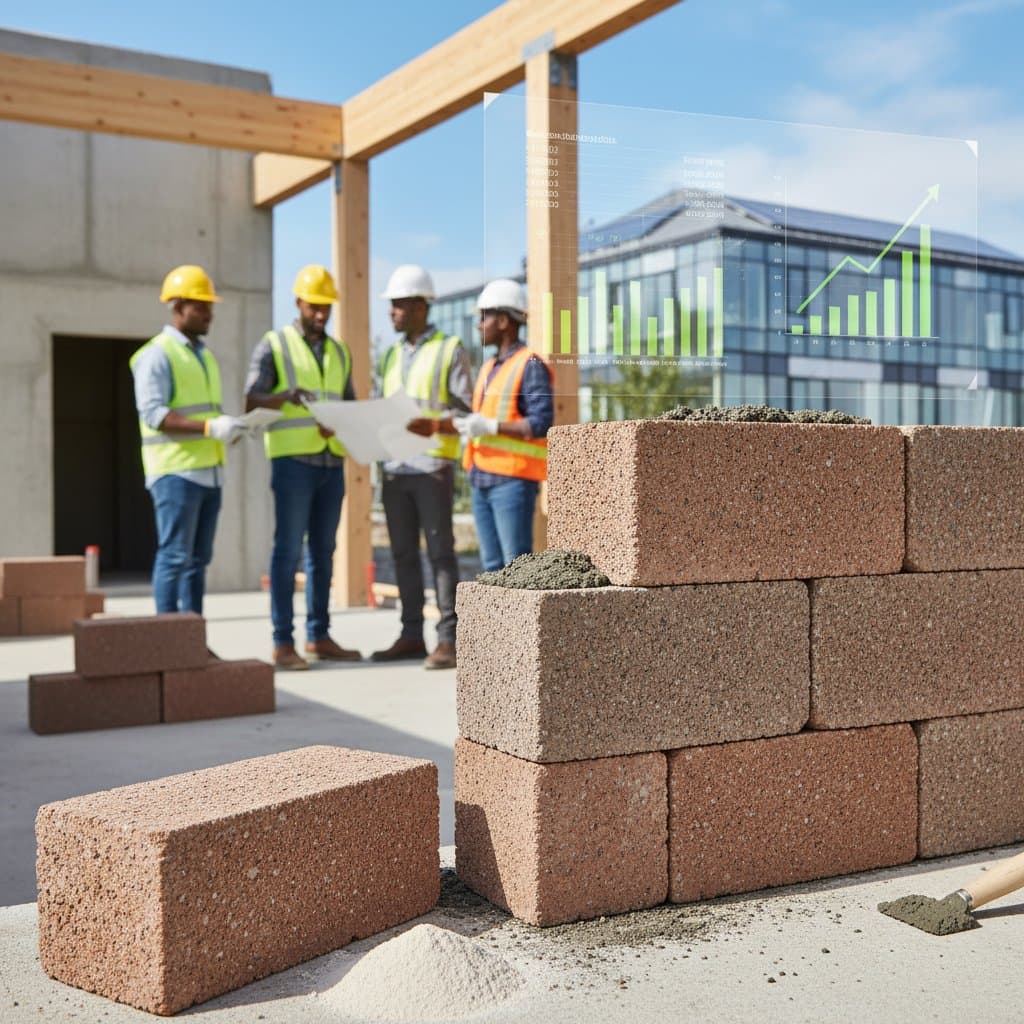
Zero-Cement Bricks: Revolutionizing Masonry by 2026
Zero-cement bricks, referred to as geopolymer bricks, represent a significant shift in modern masonry practices. These bricks incorporate industrial byproducts like fly ash or slag in place of Portland cement. Combined with alkaline activators, they create a robust binder that solidifies similarly to concrete, yet imposes a much smaller environmental burden. Builders achieve equivalent strength and longevity to traditional options, but with substantially reduced carbon emissions.
Advantages and Challenges
Advantages
- Elimination of cement production drastically lowers carbon emissions.
- Rapid early strength development, coupled with superior resistance to heat and chemical exposure.
- Incorporation of local or recycled materials minimizes waste generation.
- Reduced weight compared to clay or concrete bricks simplifies transportation and installation.
- Versatility for structural load-bearing applications and non-structural partitions.
Challenges
- Availability remains constrained due to a limited number of suppliers in various regions.
- Precise control over mixing ratios and curing processes proves essential for optimal performance.
- Variations in color and texture may occur across production batches.
- Certain activators exhibit caustic properties prior to curing, requiring careful handling protocols.
- Existing building codes often trail the emergence of these innovative products.
Cost Considerations
Geopolymer brick material costs generally fall between $1 and $2 per unit, translating to $5 to $9 per square foot when installed. Factors influencing pricing include the sourcing of raw materials, scale of production, and desired surface finishes. Regional manufacturing keeps transportation costs low, though distances from production sites can increase expenses. Specialized shapes or enhanced architectural details elevate the overall price.
Installation labor mirrors that of traditional clay or concrete masonry, as methods align closely. Benefits arise from shorter curing periods and minimized mortar usage, thanks to precise dimensional accuracy in the bricks.
Durability and Upkeep
A properly constructed wall using geopolymer bricks endures for 75 years or longer with routine maintenance. This material outperforms many cement-based alternatives in resisting color fading, cracking, and salt-induced damage. Property owners should examine mortar joints periodically for signs of shifting or moisture accumulation. Routine cleaning involves a mild detergent solution and soft brushing. Harsh acid-based cleaners or high-pressure washing can compromise the surface integrity. Resealing becomes necessary only in environments exposed to coastal salts or industrial pollutants.
Key Specifications to Verify
Prior to purchase, evaluate these critical attributes:
- Compressive strength: Target 3,000 to 5,000 psi to support load-bearing walls effectively.
- Water absorption rate: Maintain below 10 percent to ensure suitability for exterior applications.
- Freeze-thaw durability: Select products tested for the specific climate conditions of the project site.
- Dimensional accuracy: Ensure tolerances stay within 1/8 inch to facilitate uniform joint spacing.
- Fire resistance rating: Confirm Class A compliance for broad applicability.
Preparation and Site Planning
Effective drainage systems and stable foundations form the cornerstone of successful installations. Position bricks above ground level using protective caps or flashing to inhibit moisture wicking. For outdoor features like patios or retaining walls, establish a compacted gravel sub-base and incorporate weep holes where appropriate. In regions prone to freezing temperatures, design surfaces to slope away from buildings, averting ice formation. Compliance with local regulations remains paramount; verify approval for geopolymer units in intended applications.
Step-by-Step Installation Guide
- Outline the wall layout and establish reference points at corners for accuracy.
- Prepare mortar or select an adhesive specifically formulated for compatibility with geopolymer surfaces.
- Position the initial course precisely level, verifying alignment at regular intervals.
- Offset joints in subsequent courses to enhance structural integrity; gently tap bricks into position using a rubber mallet.
- Finish joints once the mortar achieves initial set, creating a smooth, weather-resistant seal.
- Remove any excess mortar smears with a damp sponge prior to full curing.
Standard masonry saws handle cutting needs for geopolymer bricks effectively. Operators must employ respirators to mitigate dust inhalation during this process.
Design Patterns and Customization
Popular layouts encompass running bond for balanced strength and aesthetic flow, stacked bond for contemporary minimalism, and herringbone for dynamic paving surfaces. Select from options featuring textured exteriors or embedded colorants. Additional customization through thin veneers or compatible paints expands design possibilities.
DIY Projects Versus Professional Installation
Individuals with foundational masonry experience and essential tools can manage modest garden walls or ornamental panels. Engage certified professionals for structural walls, expansive exteriors, or configurations involving windows, doors, or irregular geometries. Experts possess the knowledge to optimize curing techniques and joint treatments, safeguarding long-term reliability.
Identifying and Addressing Issues
White efflorescence streaks signal the presence of soluble salts; remove them by brushing and improve site drainage to prevent recurrence. Cracks typically indicate foundation settlement; a thorough footing inspection identifies underlying causes. Surface spalling, characterized by flaking, often results from inadequate curing or freeze-thaw cycles in vulnerable areas.
Adaptations for Regional Climates
Opt for freeze-thaw certified variants in cooler, humid locales, and apply permeable sealants as required. In arid, high-temperature zones, prioritize lighter hues to mitigate thermal gain. For seaside or industrial settings, choose low-permeability options to resist salt ingress.
Viable Alternatives
When geopolymer bricks prove inaccessible, compressed earth blocks serve low-rise non-structural needs with reduced cement reliance. Recycled concrete units offer robust structural performance while promoting material reuse, though they demand evaluation for environmental resilience.
Embracing Sustainable Masonry Practices
Zero-cement bricks advance environmentally responsible construction by diverting industrial waste and curbing emissions. Their proven performance in diverse conditions underscores practical viability. With scaling production and evolving standards, these materials stand ready to integrate into everyday building projects, fostering a greener built environment.