
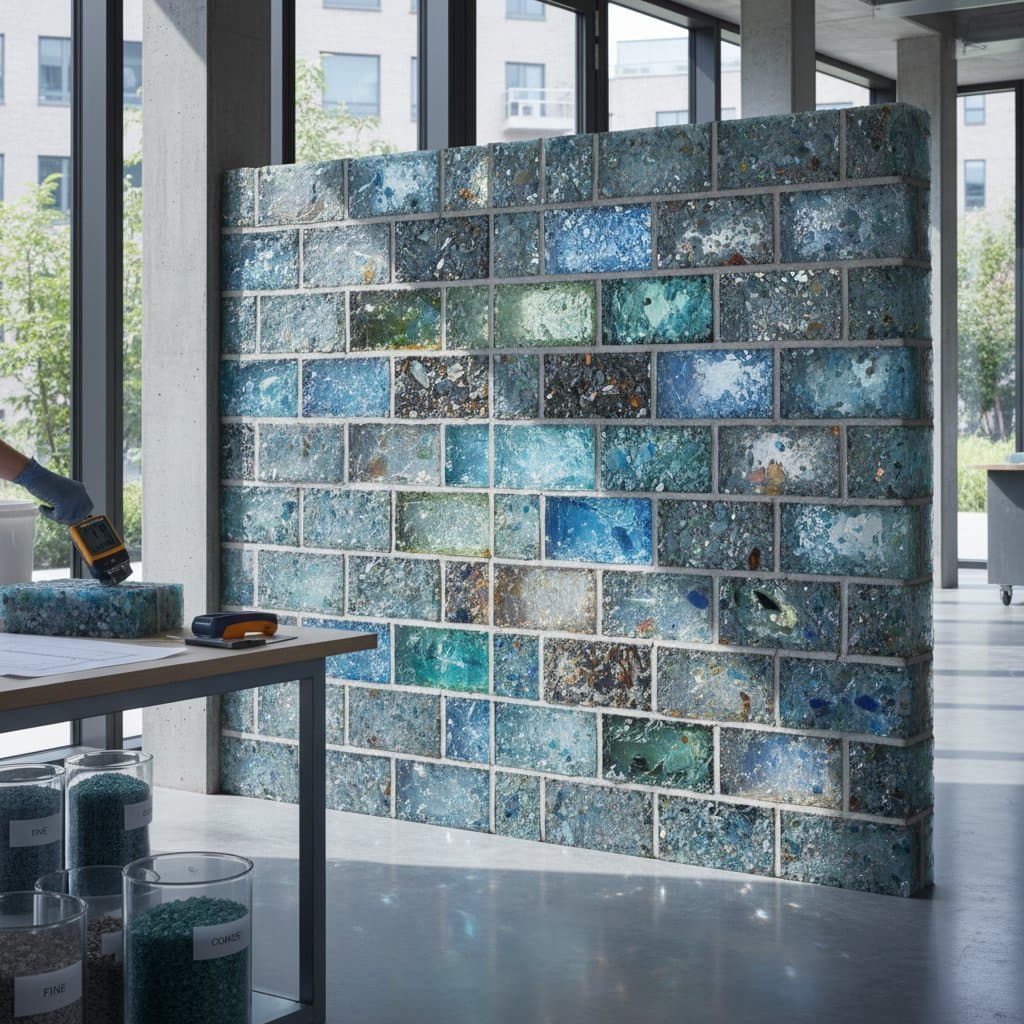
The Rise of Recycled Glass in Eco Masonry
Recycled glass masonry represents a shift toward sustainable construction practices. Builders incorporate crushed or reformed glass as an aggregate substitute in bricks, blocks, and pavers, reducing reliance on natural resources. This approach not only diverts waste from landfills but also enhances aesthetic appeal through light reflection, provided durability and moisture management receive careful attention.
Key Inspection Points
Evaluate recycled glass masonry projects using established criteria similar to those for traditional materials. Focus on structural integrity, moisture resistance, and visual consistency to ensure long-term performance.
- Maintain straight sightlines in walls, free from visible bowing or distortion.
- Ensure mortar joints remain uniform, without cracks or voids.
- Check for absence of surface scaling or glass pop-outs due to freeze-thaw cycles.
- Verify dryness at wall bases and in runoff-prone corners.
- Confirm even color and texture across panels or blocks, indicating proper curing.
- Inspect smooth transitions at control joints and penetrations to prevent moisture accumulation.
An irregular sheen or slick surface often signals an imbalanced binder ratio, which compromises adhesion and water repellency. Verify that the recycled glass proportion does not obstruct drainage or reduce surface traction.
Warning Signs of Issues
Identify potential problems early to avoid escalating repair costs. These indicators reveal underlying flaws in mix design, installation, or environmental exposure.
- Spalling or chipping at corners following initial exposure to wet conditions.
- Hollow sounds upon tapping with a hammer, suggesting delamination.
- Mortar joints detaching from units, indicating differential expansion.
- White efflorescence crusts near ground level, evidencing moisture entrapment.
- Absence of manufacturer specifications for mix composition or compressive strength.
- Visible ungraded glass shards on surfaces, pointing to inadequate blending.
Such issues often lead to compounded expenses, as unchecked moisture infiltration demands extensive remediation. A well-formulated recycled glass mix should perform comparably to standard mineral-based systems; deviations may necessitate complete wall reconstruction rather than superficial fixes.
Common Remedies and Estimated Expenses
Address surface imperfections promptly to extend material lifespan. Costs vary by project scale and location, but proactive intervention minimizes long-term outlays.
Surface scaling or blistering typically responds to grinding and resealing, at approximately 5 to 8 dollars per square foot. Mortar separation may require repointing with flexible lime-based mortar, costing 10 to 15 dollars per linear foot and providing multi-year stability. For widespread moisture-related failures involving efflorescence and joint deterioration, partial rebuilding becomes necessary, ranging from 40 to 60 dollars per square foot based on wall height and site access.
Factory-produced recycled glass blocks simplify individual replacements, at 25 to 40 dollars per unit plus labor. Steer clear of surface coatings that purport to waterproof without resolving drainage; such sealers frequently trap moisture vapor, accelerating internal degradation. Prioritize tracing and redirecting moisture pathways before applying any treatments.
High scope creep arises when cosmetic fixes mask structural or drainage deficiencies. Initiate exploratory openings during assessment to inform targeted repairs over speculative patching.
Strategies for Repair and Replacement
Distinguish between viable repairs and necessary replacements to optimize resource use. Tailor approaches to the specific failure mode and material condition.
Walls and Blocks:
Opt for repair in cases of isolated cracking where the core matrix stays intact. Reserve replacement for deep bond failures or units that disintegrate under load. Properly mixed glass-aggregate blocks frequently surpass plain cement counterparts in longevity, though they remain susceptible to joint stress from thermal shifts.
Mortar Joints:
Repoint using lime or hybrid mortars that permit gradual moisture evaporation. Rigid cement formulations risk confining water against glass interfaces, exacerbating damage.
Surface Sealers:
Apply breathable silane or siloxane penetrants only when required, avoiding acrylic barriers. Reapply periodically, guided by water absorption tests via bead formation.
Foundations and Base Courses:
Restrict recycled glass blocks to above-grade applications unless certified for load-bearing and waterproofing in submerged conditions. Rely on conventional concrete or stone for persistent moisture environments.
Pavers and Walkways:
Remediate by lifting and resetting on renewed sand or stabilized aggregate beds. Replace units solely when glass surfaces have worn excessively smooth, impairing grip.
Assembling the Right Team and Workflow
Engage professionals versed in both conventional masonry and sustainable alternatives from the outset. Their expertise ensures compliance with performance standards and mitigates common pitfalls.
Select an architect or engineer proficient in masonry design and eco-materials to assess load-bearing capacity, thermal expansion, and surface compatibility. Involve a mason with hands-on experience in recycled aggregates prior to detailing, as these mixtures demand adjusted cutting and placement techniques. Consult a structural or materials engineer for validation of curing processes and adhesion in load-bearing scenarios.
A general contractor oversees integration, sequencing, and budgeting; anticipate a 10 to 20 percent premium for oversight, which offsets potential change orders from moisture complications. Conduct parallel evaluations of at least two product suppliers and installation crews to align specifications with on-site realities.
Prioritizing Project Elements
Focus efforts on interventions that deliver the greatest impact on durability and efficiency. Sequence tasks to build upon secure foundations.
- Enhance drainage and install flashing at wall bases, openings, and transitions.
- Limit recycled glass to non-structural or elevated positions pending local performance validation.
- Incorporate air barriers and insulation behind veneers to curb condensation.
- Preserve functional existing features like trim or stonework to avoid redundant redesigns.
Defer low-value additions, such as ornamental glass inserts or mosaics in weather-exposed areas, which inflate expenses without bolstering resilience.
Budgeting and Phased Implementation
Structure the project timeline around interdependencies, addressing vulnerabilities before aesthetics. This methodical progression safeguards investments.
- Assess and rectify site drainage, ensuring slopes direct water away from structures.
- Confirm foundation integrity prior to applying recycled glass veneers or infills.
- Install or upgrade flashing at windows, sills, and expansion joints.
- Build small-scale mockups to evaluate color, texture, and curing outcomes.
- Advance to full wall construction or paving after verifying unobstructed moisture egress.
- Apply sealants or finishes post-drying, confirmed by vapor transmission tests.
- Finalize interior work and landscaping to prevent construction-related harm.
Adhering to this order averts cost overruns; neglecting drainage or trials commonly doubles subsequent expenditures.
Implementing Recycled Glass Masonry Effectively
Treat recycled glass as a robust structural component rather than a mere visual element. By substituting for quarried sand or gravel, it curtails mining impacts while delivering superior compressive strength and luminous properties that illuminate enclosed spaces.
Ultimate success hinges on meticulous mix formulation and moisture oversight. As one Pacific Northwest mason observed, glass blocks resemble quality concrete: they tolerate minor errors yet demand vigilance against oversight. This principle applies universally; flawed drainage or curing defies superficial remedies.
For newcomers, initiate with modest applications like garden walls, parapets, or paths to gather insights on weathering, maintenance, and seasonal responses. Monitor joint integrity across precipitation variations. Positive results pave the way for broader facade integrations with reduced uncertainty.
Examine installed recycled glass masonry rigorously, akin to inspections of brick or stone. Tap for solid resonance, probe for uniformity, and observe water behavior post-rainfall. These diagnostics uncover vulnerabilities preemptively.
The enduring appeal of recycled glass masonry stems from its synergy of environmental stewardship and structural reliability. Executed with precision, it repurposes waste streams and diminishes virgin material demands. Root decisions in empirical observations over promotional claims to realize these advantages fully.