
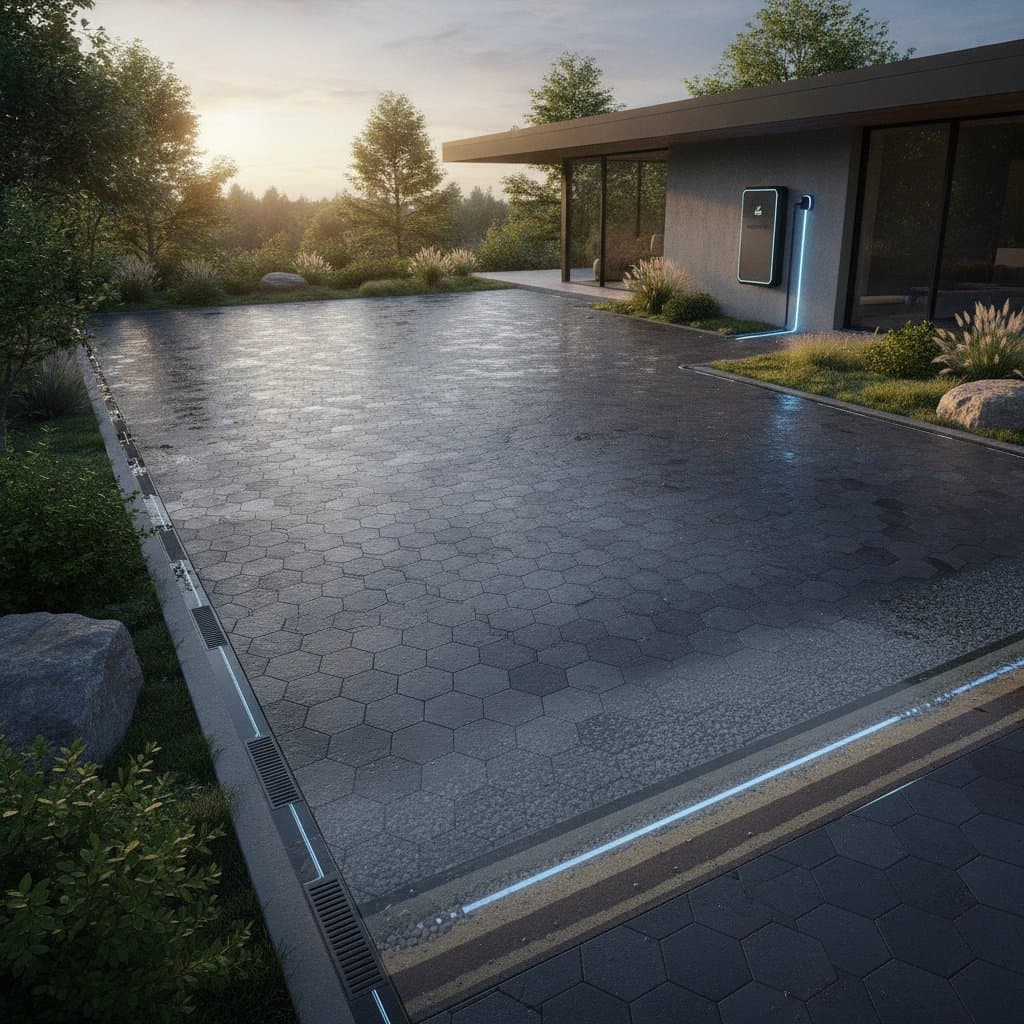
Transforming Your Driveway into a Solar Energy Source
A paved surface offers more than vehicle storage. Solar pavers generate electricity from sunlight while serving as a functional hardscape element. Primary cost factors include paver materials, wiring runs, and inverter installation. The chief installation risk involves inadequate drainage or uneven surfaces that reduce long-term performance.
Initial Assessment Steps
- Evaluate drainage patterns on the existing surface. Pooled water indicates the need for grading adjustments prior to installation.
- Observe sunlight exposure throughout the day. Identify any obstructions from trees or structures that could limit energy production.
- Assess electrical service capacity along with the path from driveway to main panel. Extended or blocked routes increase overall expenses.
- Test the subgrade for soft areas or movement. Unstable ground leads to cracking in newly placed pavers.
- Verify available space near the main panel for an inverter and disconnect switch.
Installation Concerns to Address
Driveway surfaces that slope toward the house without a trench drain create water management problems. Tree roots that lift pavement signal deeper subgrade issues. Limited sunlight from shade or northern orientation reduces output potential. Previous frost damage or drainage failures require correction before new work begins. An outdated electrical panel may need upgrades. Absence of a clear conduit route adds complexity and cost.
Cost Comparisons and Adjustments
Solar pavers typically range from 50 to 90 dollars per square foot when installed. Standard concrete driveways cost 8 to 15 dollars per square foot, which highlights the price difference. Inverter and wiring components contribute several thousand dollars more. Full driveway coverage proves unnecessary in most cases. A targeted section connected to the home system or battery storage delivers practical power without excess scale.
Poor drainage requires excavation and regrading at an added 5 to 10 dollars per square foot. Shading issues may call for targeted tree trimming. Temporary solutions such as thin overlays or plug-in mats seldom provide lasting results. Once pavers are placed, access for repairs becomes difficult, which makes careful base preparation and conduit planning essential. Additional circuits for lighting or heating increase scope unless trenching already overlaps.
Partial Replacement Options
A sound existing base supports partial replacement in targeted zones. Removal of a section near the garage or entry area allows conversion to solar pavers while controlling expenses. This approach also permits performance testing before larger commitments. Full replacement becomes appropriate only when the surface or base shows failure or when drainage work is already underway.
Stable sub-base layers should remain in place. Reuse of compacted gravel reduces material and labor demands. Complete demolition occurs only after confirmation of weak bearing capacity or contamination from clay and silt.
Contractor Coordination
An electrical contractor experienced with grid-tied systems determines inverter sizing and service capacity first. A hardscape installer familiar with modular paving systems follows. An engineer or landscape architect aligns slopes and drainage with local requirements. Early coordination ensures conduit paths and trench depths are established before excavation.
Professional oversight typically adds 10 to 20 percent to the budget yet prevents later corrections. Simultaneous review of contractor availability reduces scheduling conflicts.
Installation Sequence
- Complete solar exposure and shading analysis.
- Correct drainage and slope conditions.
- Construct a stable base layer.
- Place wiring and conduit ahead of paver installation.
- Set pavers and link them to the inverter.
- Connect the system to the home electrical service.
Decorative lighting or heated mats represent lower-priority additions. Initial focus remains on energy generation and structural longevity.
Ongoing System Care
Sweep joints regularly to remove debris. Clean surface grit that reduces light transmission. Review inverter output monthly to detect declines promptly. Examine settled areas, loose edges, or water accumulation after storms. Prompt replacement of cracked pavers protects underlying wiring.
A solar driveway delivers value through lower utility costs and added resilience. Begin with documentation of sunlight patterns, drainage routes, and wiring paths. Solid execution follows thorough preparation.