
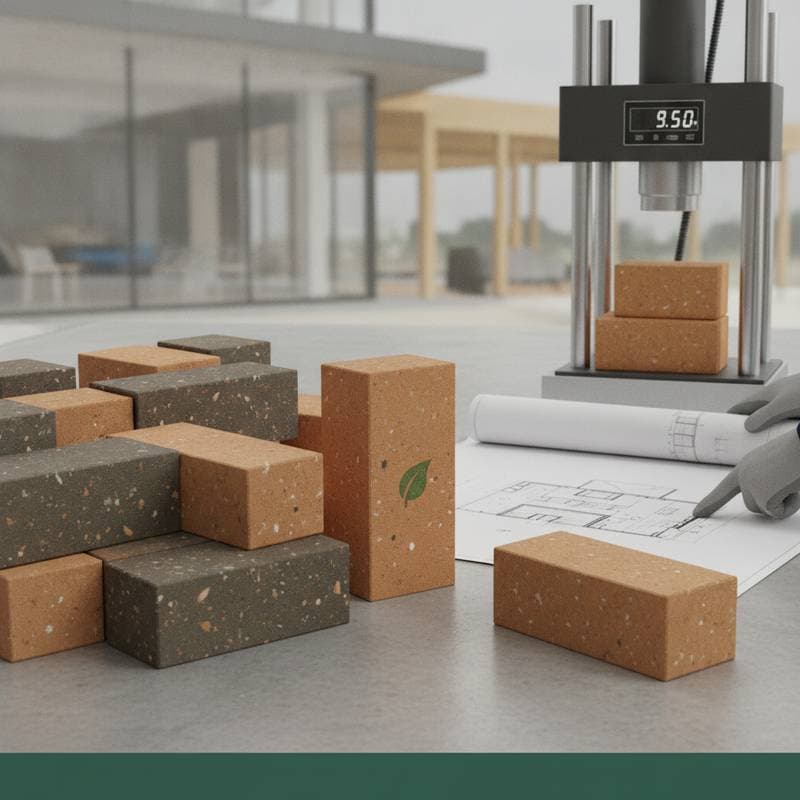
Geopolymer Bricks Deliver Cement-Free Masonry Solutions
Geopolymer bricks form a masonry unit without Portland cement. Industrial by-products such as fly ash or slag combine with alkaline activators to create a dense stone-like material. The finished product supplies a durable low-carbon substitute for fired clay or concrete bricks.
Advantages and Limitations
Advantages
- Production avoids high-temperature kilns and limestone calcination, which reduces carbon emissions.
- Many formulations achieve compressive strengths at or above conventional concrete bricks.
- The material withstands acids and salts, which suits coastal and industrial exposures.
- Thermal stability limits cracking during repeated heating and cooling cycles.
- Manufacturing diverts fly ash and slag from landfills into useful building components.
Limitations
- Consistent output requires specialized mixing and curing equipment that not every supplier maintains.
- Regional production remains limited, which can extend lead times or raise freight expenses.
- Certification standards continue to evolve, so buyers must verify test data for each batch.
- Unit prices sit slightly above conventional masonry because production volumes stay smaller.
Material and Installation Costs
Unit prices range from 0.80 to 1.50 dollars per brick based on size, strength grade, and surface finish. Complete wall costs fall between 10 and 18 dollars per square foot when mortar, labor, and basic scaffolding are included.
Key cost variables include the source and type of industrial by-product, distance from manufacturing plant to site, choice of smooth or textured finish, complexity of bond pattern, and prevailing local labor rates.
Expected Service Life and Upkeep
A properly detailed geopolymer wall can remain serviceable for 75 years or longer. The dense matrix resists moisture penetration and freeze-thaw damage. Annual inspection of joints and coatings reveals cracks or salt deposits early. Mild detergent and water suffice for cleaning. Acidic cleaners are avoided because they can affect surface chemistry. Additional sealing is unnecessary except in aggressive marine or chemical settings.
Selection Criteria
Review the following properties before purchase:
- Compressive strength of at least 5000 psi for structural applications.
- Water absorption below 10 percent to limit freeze-thaw risk.
- Freeze-thaw rating matched to the project climate zone.
- Dimensions that align with standard modular or utility brick sizes.
- Density between 110 and 130 pounds per cubic foot.
- Activator chemistry, either sodium or potassium silicate, noted for its effect on strength development and color.
Site Preparation Steps
Confirm that footings or slabs can support the finished wall load. Exterior walls require a capillary break or damp-proof course at the base. Cavity walls need weep holes and drainage paths. In freeze-prone areas, slope all ledges and sills to shed water.
Verify delivery access and staging space. Pallets are heavy, so a firm level surface and protective covering keep units dry until installation.
Installation Sequence
- Snap layout lines to establish alignment and locate openings.
- Prepare geopolymer-compatible mortar or adhesive according to manufacturer instructions.
- Place and level the first course, because alignment of this course governs the entire wall.
- Continue subsequent courses while maintaining 3/8-inch joint width.
- Tool joints to compact mortar and promote water shedding.
- Install lintels or bond beams where structural loads occur.
- Remove mortar smears before they harden.
- Protect the completed wall from rain or frost during initial curing.
Bond Patterns and Finish Options
Running bond provides optimal load transfer. Stack bond creates a contemporary appearance yet requires added reinforcement. Some producers offer interlocking profiles that reduce mortar volume. Surface textures range from smooth to tumbled or split-face. Color derives from the fly ash or slag source and typically appears in gray, tan, or reddish brown tones. Integral pigments allow custom shades when needed.
When to Engage Professional Help
Non-structural garden walls or small sheds on stable bases with simple drainage can be completed by skilled homeowners. Structural walls, openings, arches, or sites with challenging soils require a licensed mason. Code compliance and inspection approval also favor professional involvement.
Typical Problems and Corrections
Cracking usually traces to uneven settlement or inadequate curing. Verify base compaction and install control joints. White efflorescence appears when alkaline salts migrate to the surface. Dry brushing followed by clean water rinsing removes deposits. Color variation results from inconsistent batching or moisture during curing. Uniform storage and curing conditions minimize future mismatches. Weak joints often stem from contaminated or aged mortar. Remove loose material, clean the joint, and repoint with fresh binder.
Climate-Specific Guidance
Cold regions benefit from low-absorption units and robust drainage details. Coastal or de-icing salt environments favor geopolymer units because they resist chloride attack better than cement-based masonry. Hot dry climates require shading of units before laying to prevent rapid moisture loss. High-sulfate soils are handled effectively by geopolymer chemistry, which outperforms cement products under these conditions.
Comparable Masonry Options
Autoclaved aerated concrete offers light weight and insulation but lower compressive strength. Compressed earth blocks carry low embodied energy yet demand careful weather protection. Recycled concrete blocks supply partial sustainability gains through aggregate reuse. Traditional fired clay bricks remain widely available yet carry higher kiln emissions.
Practical Recommendations
Order an extra 5 to 10 percent to cover cuts and breakage. Store units dry to preserve bond strength. Check level and alignment every few courses. Shield fresh work with breathable covers during rain. Select silane or siloxane sealers when additional protection is required in harsh exposures.
Project Execution
Adopting geopolymer bricks reduces cement consumption while preserving expected strength and appearance. Advance planning for material availability, curing conditions, and detailing details supports successful outcomes on both small and large projects.