
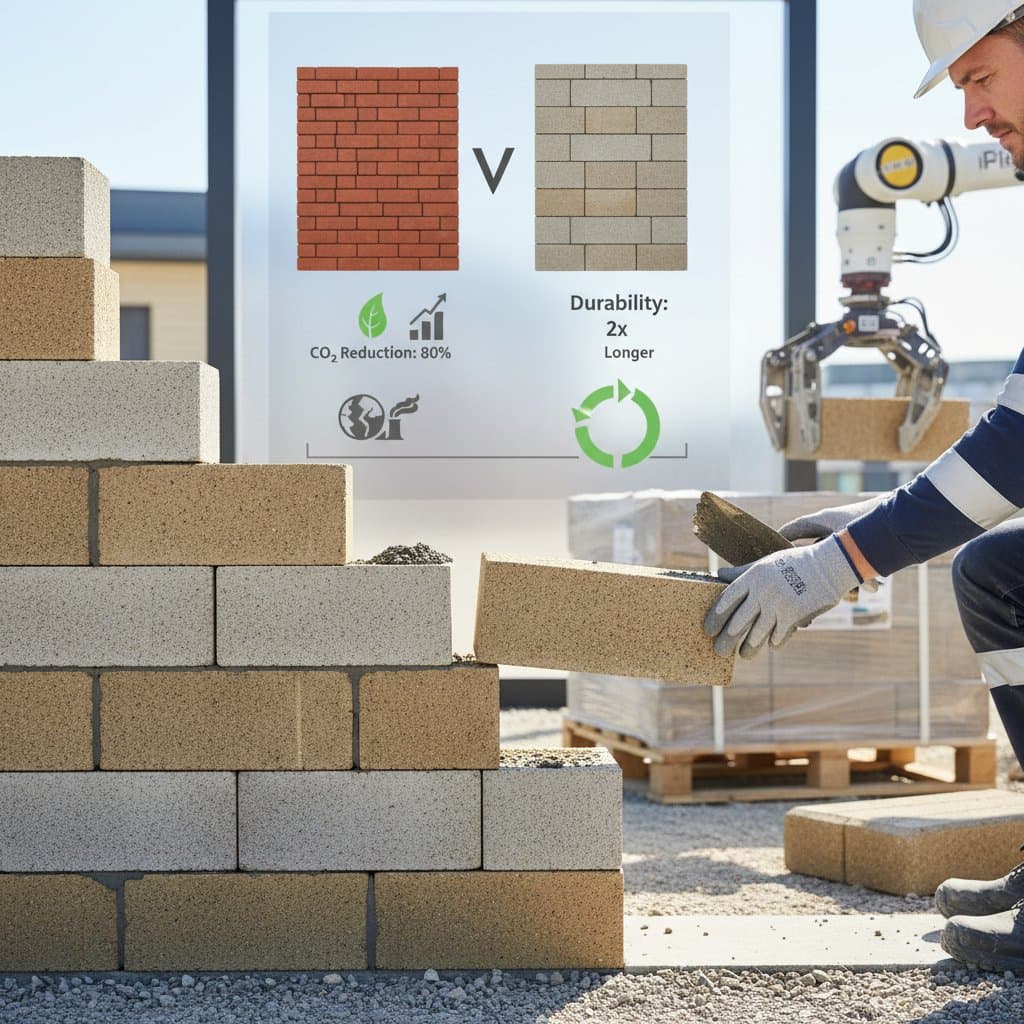
Understanding Geopolymer Bricks
Geopolymer bricks represent an advanced class of masonry materials that substitute traditional cement with mineral-based binders. These binders emerge from a chemical reaction involving aluminosilicate precursors, typically derived from industrial byproducts like fly ash or slag. The outcome yields a solid form akin to concrete, yet it generates fewer carbon emissions and exhibits enhanced long-term stability.
The designation "geopolymer" describes the intricate network of inorganic molecules that unite aggregates. Unlike Portland cement, which depends on calcium silicate hydration, geopolymerization employs alkali activation. This method restructures raw materials at the molecular scale, creating a compact, stone-like matrix resistant to elevated temperatures, humidity, and corrosive substances.
These bricks attract interest for blending environmental benefits with superior functionality. They minimize waste, curb emissions, and provide strength plus longevity that frequently surpass standard alternatives. For architects, builders, and property owners, this development signals a significant advancement in masonry design and construction practices.
The Role of Geopolymer in Modern Masonry
Conventional brick and mortar assemblies rely extensively on cement, a product whose manufacture demands substantial energy. Cement production emits substantial carbon dioxide through fuel combustion and inherent chemical processes. Geopolymer approaches circumvent much of this by repurposing materials destined for disposal.
In addition to ecological advantages, geopolymer bricks deliver tangible improvements in structural integrity, heat tolerance, and endurance. Their compact composition withstands fracturing from thermal expansion or freeze-thaw exposure, and they adhere effectively to diverse mortars. Such attributes suit them for essential applications like load-bearing partitions, exterior cladding, and ground surfaces where reliability proves paramount.
Property owners and construction professionals seeking enduring value find geopolymer bricks advantageous for reducing overall expenses across a structure's lifespan. These materials demand minimal upkeep, repel water infiltration, and preserve aesthetics over extended periods. This fusion of ecological stewardship and robust performance positions them as a leading option in environmentally sound masonry.
Deciding Between DIY and Professional Installation
Geopolymer brick initiatives span from modest garden barriers to comprehensive structural assemblies. Basic ornamental elements or pathway borders align with do-it-yourself efforts. Standard bricklaying implements and straightforward preparation suffice for these tasks.
Structural partitions, base supports, or containment features necessitate expert involvement. Variations in geopolymer formulations by origin and composition require adherence to engineering protocols for load-bearing elements. Projects encountering ground forces, earthquake forces, or moisture management call for a certified mason or structural specialist. The precise chemistry of geopolymer binders further emphasizes accurate blending proportions and controlled curing environments, best overseen by trained personnel.
Preparing for a Geopolymer Brick Project
Initiate any masonry endeavor with meticulous planning. Geopolymer applications introduce specific requirements alongside general precision demands.
Site Evaluation
Conduct a thorough examination of the location. Evaluate ground firmness, water runoff, and terrain inclination. Soils high in clay content might hold excess moisture near foundations, necessitating gravel underlayers or drainage outlets. Note proximate buildings or underground services. Contact utility locators via 811 prior to excavation to identify concealed conduits.
Essential Measurements
Determine wall dimensions including length, elevation, and depth. Calculate total area, then divide by individual brick dimensions to gauge required units. Include a 10 percent surplus for cuts and discards. Account for apertures or contours by drafting layouts to align bricks and joints.
Climate Considerations
Ambient conditions influence geopolymer setting. The activation process requires steady hydration and ambient temperatures. Refrain from construction in intense heat or downpours. Shield newly laid sections with moistened fabric or sheeting to promote uniform development.
Anticipated Challenges
Prepare for issues like irregular terrain, water flow routes, and material delivery paths. Designate zones for batch preparation and brick storage. Near vegetation or barriers, verify space allowances and subsurface root presence.
Selecting Appropriate Materials
Fly Ash-Based Geopolymer Bricks
These bricks incorporate residue from coal-fired power plants. They offer reduced weight, uniformity, and shape retention.
Advantages: Environmentally sound, effective thermal insulation, even texture.
Drawbacks: Supply tied to industrial output.
Pricing: Economical relative to kiln-fired clay variants.
Required Expertise: Compatible with routine laying methods.
Upkeep: Limited to periodic surface cleaning.
Ideal Applications: Home partitions and ornamental exteriors.
Visual Traits: Uniform neutral hue, adaptable to pigmentation.
Slag-Based Geopolymer Bricks
Derived from steel production waste, these provide density, robustness, and chemical resilience.
Advantages: Superior load-bearing capacity, moisture repulsion.
Drawbacks: Increased mass, challenging to shape.
Pricing: Mid-range to elevated.
Required Expertise: Moderate to high due to handling demands.
Upkeep: Negligible, ideal for damp or marine settings.
Ideal Applications: Supportive or commercial barriers.
Visual Traits: Deep, natural stone resemblance.
Metakaolin-Based Geopolymer Bricks
Produced from processed clay for demanding uses, these emphasize performance.
Advantages: Outstanding resilience, reliable uniformity.
Drawbacks: Elevated expense.
Pricing: High-end.
Required Expertise: Specialized, typically professional.
Upkeep: Scarce, extended service life.
Ideal Applications: Premium exteriors or design accents.
Visual Traits: Polished, elegant finish.
Assembling Tools and Supplies
Manual Implements and Their Functions
-
Brick Trowel: Applies mortar and refines seams.
-
Masonry Hammer: Adjusts bricks and secures positioning.
-
Level and Plumb Bob: Verifies straightness and upright orientation.
-
Joint Tool: Profiles mortar lines.
-
Brush and Sponge: Clears excess from surfaces and gaps.
Powered Devices and Their Functions
-
Masonry Saw or Grinder: Executes accurate divisions.
-
Drill with Paddle Attachment: Ensures homogeneous mortar mixtures.
-
Wet Saw (Optional): Minimizes airborne particles for cleaner results.
Equipment Rentals, Timing, and Substitutes
-
Mixer: Essential for bulk preparations; lease for extended projects.
-
Scaffolding: Required beyond reachable heights; alternatives include sturdy ladders for minor elevations.
-
Wheelbarrow: Facilitates movement of blends and implements.
Supply Inventory with Buffer
-
Geopolymer bricks
-
Matching geopolymer mortar or activator
-
Aggregated gravel for foundations
-
Mixing and hydration water
-
Protective sheeting or fabric
-
Reinforcement bars or netting (for load-bearing needs)
Include 10 percent additional quantities to accommodate losses.
Detailed Construction Process
-
Establish the Foundation. Dig to 6-8 inches, pack gravel fill, and smooth the surface. This step averts future shifts.
-
Place the Initial Layer. Distribute mortar uniformly, position bricks, and confirm flatness plus straightness. Precision here sets the project's foundation.
-
Erect Subsequent Layers. Offset seams by half a brick unit to enhance stability. Sustain consistent mortar depth, approximately 3/8 inch.
-
Monitor Alignment Regularly. Apply the level after every two or three rows. Address deviations without delay.
-
Facilitate Curing. Enclose the assembly and sustain moisture for days to complete the binding process.
-
Profile the Joints. Upon initial hardening, shape seams for aesthetics and weatherproofing.
-
Cleanse and Examine. Wipe away debris using a moistened sponge; assess for verticality, squareness, and even gaps.
Expert Advice: Procure 10 percent more bricks to offset trimming losses and incidents.
Enhancing and Sustaining Your Build
Annual reviews help prolong the structure's viability by detecting fissures or seam degradation. Employ a gentle brush with diluted cleaner for surface care. Steer clear of forceful sprays that might compromise mortar integrity. Consider permeable coatings suited to geopolymer compositions for added protection.
Incorporate illumination, vegetation holders, or benches to elevate visual appeal. These bricks accommodate coatings like paint or mineral washes for customized tones. In paved areas, fill joints with stabilized sand to inhibit vegetation intrusion.
Pitfalls to Sidestep in Construction
-
Inadequate Groundwork: Provokes irregular subsidence.
-
Excessive Mix Water: Compromises adhesion.
-
Variable Joint Depths: Leads to crooked layouts.
-
Neglected Curing Protection: Induces superficial fractures.
Address errors by excising compromised portions and reinstalling with new mortar. Revalidate alignment prior to proceeding.
Building a Lasting Legacy with Geopolymer
Geopolymer bricks enable resilient, earth-friendly constructions that align with forward-thinking standards. Their integration reduces environmental impact while ensuring structures withstand daily rigors. Adopt these materials to craft enduring spaces that benefit both inhabitants and the planet.