
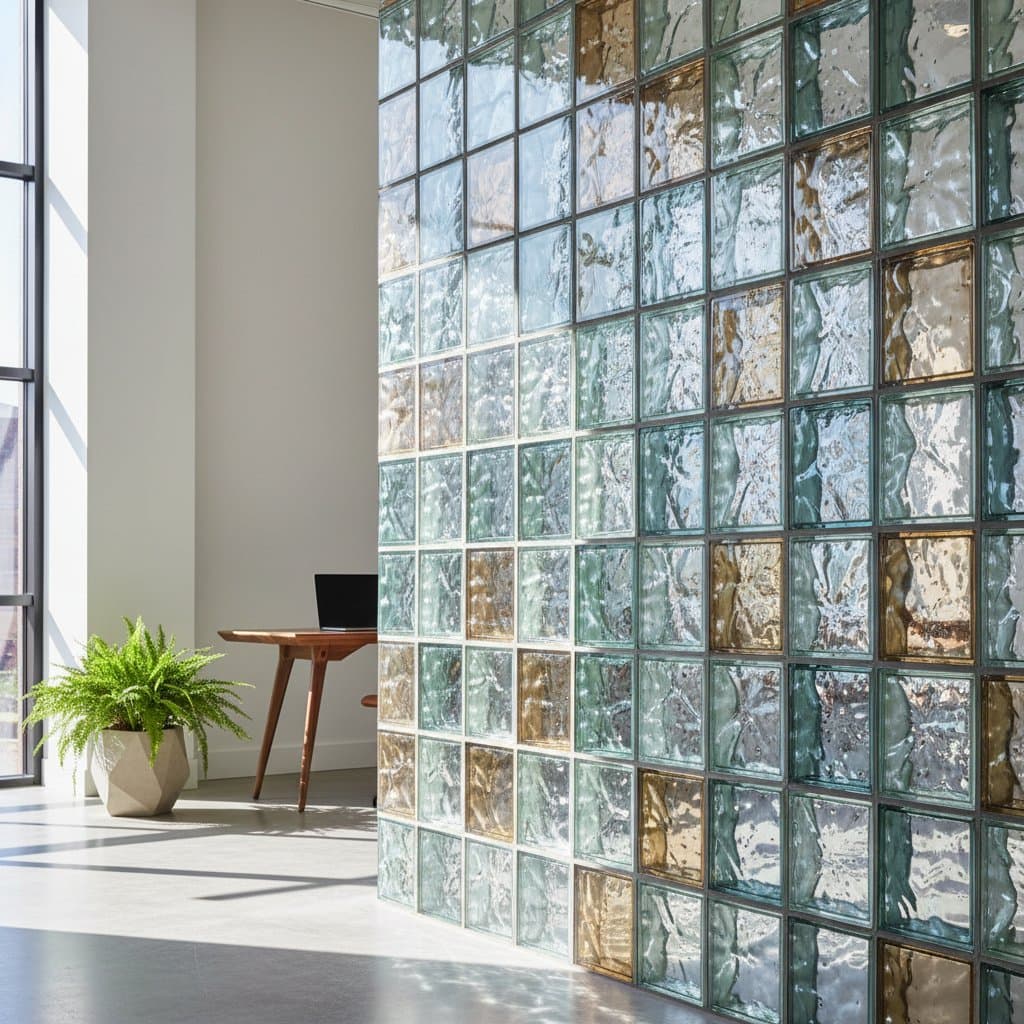
The Advantages of Recycled Glass Bricks in Contemporary Masonry
Recycled glass bricks consist of post-consumer glass that undergoes crushing, melting, and forming into sturdy masonry components. These units resemble traditional glass blocks yet originate from materials destined for landfills. They integrate robustness, light permeability, and environmental responsibility in a manner that surpasses many conventional options.
Benefits and Limitations
Benefits
- Eco-conscious origin: Derived from recycled glass, these bricks diminish landfill contributions and reliance on virgin resources.
- Illumination properties: Permit daylight to filter through partitions while preserving seclusion.
- Minimal upkeep demands: Feature a non-absorbent exterior that repels stains, mildew, and environmental degradation.
- Enduring surface: Withstand discoloration, rust, and exposure to chemicals.
- Versatile aesthetics: Offered in transparent, opaque, tinted, or patterned varieties.
Limitations
- Elevated unit pricing: Surpass the expense of clay or concrete alternatives owing to specialized fabrication.
- Constrained structural capacity: Ideal for non-load-bearing or supplementary structural elements.
- Challenging fabrication: Necessitate diamond-tipped implements and precise manipulation for cuts.
- Temperature responsiveness: Exhibit greater expansion and contraction than standard masonry under severe thermal variations.
Pricing Considerations
The base material expense for recycled glass bricks generally falls between 8 and 15 dollars per square foot. Installation fees span 18 to 30 dollars per square foot, influenced by design intricacy, panel depth, and site accessibility. Bespoke hues, arched configurations, or fortified setups increase expenditures. Basic linear installations with conventional pieces remain at the economical threshold.
Transport and delivery incur additional charges, as these glass elements weigh more than voided clay bricks and demand protective cushioning. Incorporating backlighting or embedded illumination adds 2 to 4 dollars per square foot for electrical components and hardware.
Durability and Care
When installed and sealed correctly, recycled glass bricks endure for 50 years or longer. Their impermeable glass facade prevents moisture and grime accumulation, simplifying routine cleaning. Apply a gentle soap solution with a soft cloth for maintenance.
Examine mortar joints annually for fissures or detachment. Should joints degrade or gap, extract deteriorated sections and apply fresh grout using a mortar blend formulated for glass blocks without sand. Resealing proves rare, though outdoor applications gain from a transparent silicone coating every five to ten years to deter water penetration.
Key Specifications to Verify
Prior to purchase, evaluate these attributes:
- Compressive strength: At minimum 2000 psi to support wall applications.
- Thermal expansion coefficient: Ensure alignment with adjacent building elements.
- Fire resistance: Numerous variants achieve one-hour fire endurance ratings.
- Dimensions: Standard thicknesses measure 3 to 4 inches, with face areas of 8 by 8 inches.
- Edge configuration: Select squared profiles for mortared connections or interlocking designs for mortarless assembly.
Design and Preparation Strategies
Position walls or accents thoughtfully. Recycled glass bricks require a stable, horizontal foundation and uniform gaps. Interior deployments frequently include dividers, enclosure panels, or step facings. Exterior uses encompass highlight sections, screening barriers, or landscape enclosures.
Verify that the substrate supports the load, approximately 6 to 7 pounds per unit. For outside placements, establish adequate subsurface drainage and gradient the ground to divert water from the building. Steer clear of zones prone to significant shifting or oscillations that might compromise seams.
When proximity to services exists, arrange for utility locates prior to excavating any base channel.
Installation Guidelines
- Outline the area: Delineate the panel perimeter and chalk guidelines for precision.
- Establish the foundation: Cast a fortified concrete base or position a plumb sill.
- Apply bedding mortar: Distribute a slim layer of mortar suited for glass blocks.
- Place units: Commence at a corner, embedding each piece with uniform spacing.
- Incorporate supports: Embed lateral reinforcements every other row for integrity.
- Finish seams: Profile joints with a curved tool prior to hardening.
- Remove residues: Erase excess mortar from faces before it cures fully.
- Secure perimeters: Caulk interfaces with silicone at junctions to framing or adjacent surfaces.
For mortar-free methods, adhere to producer guidelines using clips or spacers, then seal gaps with transparent silicone.
Layout Variations and Selections
Popular arrangements feature:
- Running bond: Provides a sleek, contemporary appearance with vertical alignments.
- Offset pattern: Mimics traditional bricklaying to obscure seam visibility.
- Obscured or pigmented accents: Enhance seclusion or introduce focal tones.
- Hybrid compositions: Pair with rock or alloy edging for visual differentiation.
Select configurations according to illumination objectives and confidentiality needs. Diffused or roughened surfaces disperse light softly, whereas transparent pieces convey it straightforwardly.
Self-Installation Versus Professional Services
Undertake modest indoor barriers, splash guards, or ornamental faces independently. Essential tools include a spirit level, separators, and pointing trowel. Prioritize accuracy over rapidity.
Engage specialists for:
- Expansive or elevated structures
- Fortified or bearing assemblies
- Arced or elaborate motifs
- Weather-exposed exteriors
Expert masons guarantee optimal spacing, bolstering, and protection to prevent fractures.
Addressing Typical Issues
Fractured units: Stem from substrate settlement or irregular bedding. Remedy by scoring surrounding mortar, extracting the flawed piece, inserting a replacement, and restoring the joint.
Hazed exteriors: Result from cement remnants. Restore using a vinegar-water mixture or specialized cleaner for glass blocks.
Seepage at seams: Arise from deteriorated or absent caulking. Scrape away old filler and extrude fresh silicone along the edges.
Adaptations for Local Conditions
In regions with cyclic freezing and thawing, opt for exposure-rated bricks and employ pliable sealants at boundaries to accommodate flexure. In arid, warm locales, incorporate dilation voids and select pale mortars to mitigate thermal accumulation. Coastal settings benefit from the impervious quality, which counters saline erosion, rendering these bricks suitable for marine environments.
Areas susceptible to soil upheaval demand footings extended beneath the frost depth, coupled with effective runoff to safeguard the installation.
Comparable Materials
Should recycled glass bricks mismatch project parameters or finances, evaluate:
- Poured concrete units: Offer superior load capacity and affordability, yet lack translucency.
- Synthetic resin sheets: Weigh less and provide clarity, but mar readily.
- Factory-molded glass segments: Slimmer for surface mounting on partitions, although non-structural.
- Salvaged fired bricks: Promote reuse with a vintage charm, minus luminosity.
Alternative selections involve compromises in robustness, clarity, and ecological impact.
Preserving Long-Term Performance
Recycled glass brick installations demand scant intervention, yet proactive measures prolong functionality. Maintain seal integrity, perform periodic surface wiping, and guard against forceful contact. Post-winter assessments of outdoor caulking prove beneficial.
Low-pressure rinsing suits exteriors when maintaining distance from the tip. Revitalizing illumination within semi-opaque setups alters ambiance sans structural changes. Through consistent care, these bricks retain transparency, vibrancy, and solidity across generations, embodying a prudent selection for sustainable architecture.