
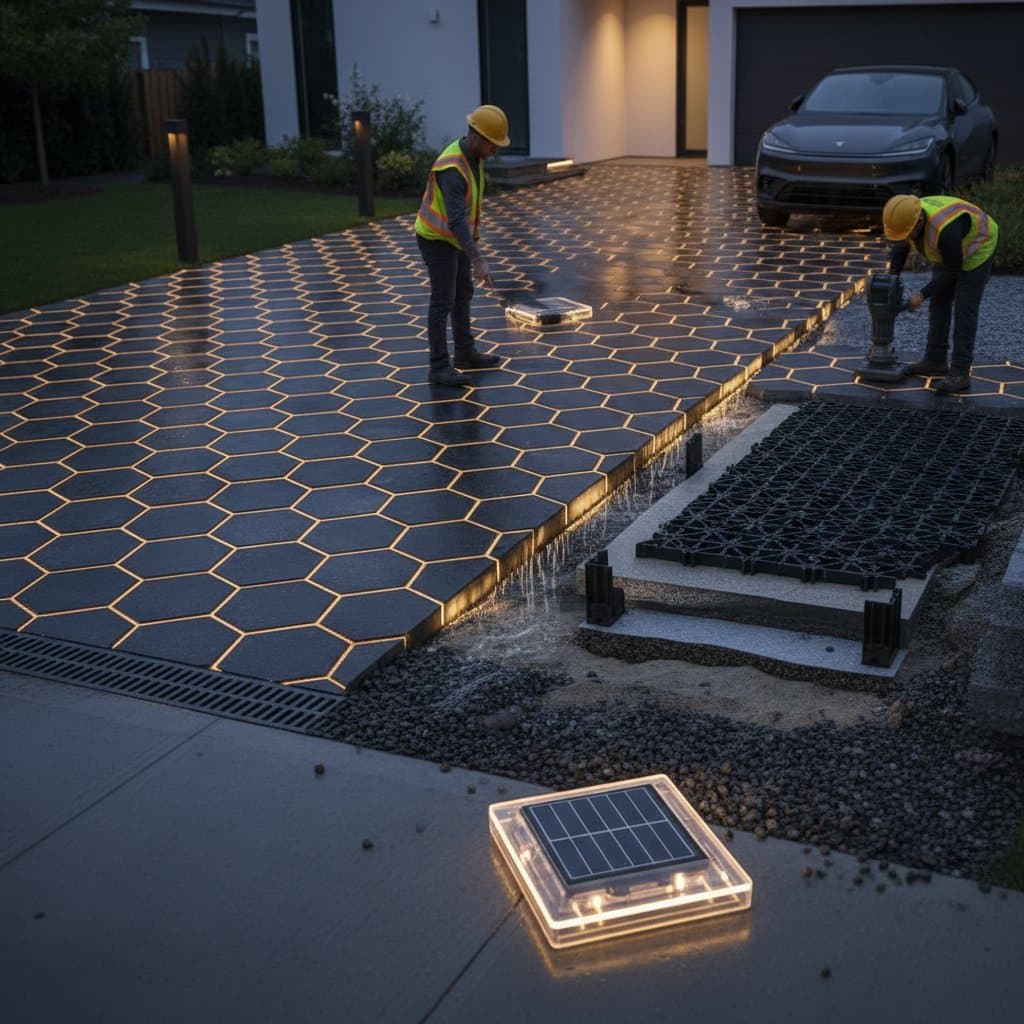
Solar Pavers: Effortless Lighting for Your Driveway
Solar pavers integrate solar panels and LED lights into durable paving stones, offering a seamless way to illuminate driveways without electrical wiring. These units absorb sunlight during the day and emit a soft glow after dark, enhancing safety and visual appeal. However, their longevity depends heavily on proper site preparation, particularly drainage and base stability, to prevent common failures like water damage or shifting.
Quick Assessment
Solar pavers eliminate the need for trenches or electrical connections, simplifying installation. They rely on daily solar charging to maintain nighttime output. Key challenges include moisture penetration, frost-induced movement, and substandard products that degrade quickly. Factors influencing expenses encompass foundation work, water management systems, and the extent of lighted areas desired.
Essential Site Evaluations
Observe your driveway during twilight hours. Identify areas cast in shadow and paths used by vehicles or pedestrians. Look for signs of water accumulation or displaced joints from frost. Such indicators reveal potential vulnerabilities for solar pavers if water management proves inadequate.
Assess the slope and elevation. Direct water flow should lead away from the home foundation. Employ a level board or taut string to verify uniform water runoff across the surface. Consider locations of roof gutters and adjacent garden features. Redirect any water that approaches the driveway prior to proceeding.
Inspect current paving materials or concrete slabs. Gently tap surfaces with a rubber mallet. Hollow echoes suggest underlying gaps. These voids retain moisture and exert pressure on embedded solar components. Confirm overall stability before incorporating new elements.
During evening hours, evaluate ambient lighting conditions. Aim for uniform distribution and steady intensity, avoiding concentrated bright spots. Traverse the pathway to pinpoint locations where illumination improves navigation, including borders, stairs, and curves.
Warning Signs of Trouble
- Persistent puddles following rainfall or thaw
- Irregular subsidence or fractures in foundational layers
- Discolored or obscured solar panels
- Unsecured connections at paver peripheries
- Evidence of battery degradation or expansion beneath protective covers
- Absence of perimeter supports during installation
- Lights that pulse, remain faint, or cease functioning shortly after setup
These symptoms often stem from inadequate water diversion, inferior components, or faulty assembly. Resolve underlying issues prior to expanding lighting features.
Recommended Solutions and Approximate Expenses
Establishing a reliable foundation typically requires $6 to $10 per square foot, covering excavation, gravel compaction, and a sand leveling layer. For targeted replacements within an established area, labor costs range from $20 to $30 per paver, including extraction and repositioning.
Premium solar pavers range from $25 to $60 per unit, featuring encased LED and battery systems for protection. Budget models priced at $10 to $15 frequently suffer from compromised seals and limited durability. A modest accent installation might total under $600, while a comprehensive driveway design with intricate patterns could escalate to $2,000 through $4,000, influenced by configuration and groundwork.
Resist superficial remedies like adhesive solar overlays on aged concrete. Such approaches retain moisture, leading to detachment and fractures. Reconstruct the substructure whenever water handling appears compromised. Temporary patches mask root problems and invite recurring issues.
Beware of inconsistencies when blending fresh pavers with legacy ones differing in hue or dimension. Incorporate deliberate borders or transitions to maintain a cohesive appearance.
Choosing Between Repair and Full Replacement
For structurally sound driveways, integrate solar pavers selectively to achieve symmetry. Update only necessary units while preserving the existing layout.
When the foundation yields or retains moisture, opt for complete renewal. Excavate to stable soil, then layer with compacted aggregate, geotextile barriers if applicable, and a even bedding course. Initial outlay increases, yet this approach averts future displacement, misalignment, and fissures.
In setups combining wiring with low-voltage networks, mend individual elements provided housings seal effectively. Substitute components solely upon seal breach or internal corrosion.
Regions prone to seasonal frost benefit from adaptable perimeter constraints and permeable seams. Transition from inflexible mortar to polymeric sand that facilitates drainage.
Assembling the Right Team and Workflow
Engage a landscaping or civil contractor versed in water-permeable and illuminated surfaces. Such experts grasp drainage dynamics and freeze-thaw patterns. Request three regional endorsements and inspect a completed project under evening conditions to gauge lighting efficacy.
For integrations with home automation systems, consult a low-voltage specialist from the outset. They ensure interoperability and adherence to regulations for combined setups.
Involve architects for projects linking lighting to broader landscape overhauls. Their expertise in patterning and elevation prevents moisture collection points.
Complex terrains with bends or substantial traffic demand a general contractor to orchestrate specialists. Oversight incurs an additional 10 to 20 percent, but streamlines timelines and mitigates coordination oversights.
Conduct simultaneous evaluations rather than sequential engagements. Allow designers, installers, and electricians to scrutinize unified blueprints prior to procurement. This alignment avoids discrepancies between selections and environmental demands.
Key Implementation Focus Areas
Prioritize hydrology corrections. Amend gutter routes, inclines, and subsurface channels before illumination. Each solar paver requires unobstructed solar exposure and moisture-free support. Accumulated water accelerates battery wear and impairs panel clarity.
Subsequently, reinforce the foundation and boundaries. A secure platform ensures lights remain aligned. Then, emphasize uniform radiance. Position units at intervals of 2 to 3 feet along edges or every third seam in open areas for optimal coverage.
For guidance purposes alone, limit to strategic rows rather than comprehensive coverage. This conserves funds and upkeep. Refrain from excessive brightness adjacent to sleeping quarters or relaxation zones, as it depletes energy reserves unnecessarily.
Retain compatible existing pavers that align in profile and tone. They frequently endure longer than contemporary alternatives and harmonize with established properties.
Planning Budget and Timeline
Sequence tasks based on interdependencies and potential pitfalls.
- Rectify water flow and surface gradients around the driveway.
- Restore or fortify the sub-base.
- Install cabling or pathways for hybrid configurations.
- Position fresh pavers and secure seams.
- Validate solar absorption and evening output.
- Apply perimeter fixes and protective coatings.
Withhold solar paver placement until drainage functionality confirms. Moisture seepage via gaps damages internals. Permit at least seven days of arid conditions post-foundation work before unit deployment.
Anticipate slight adjustments in the initial year. Replenish seams with polymeric sand after stabilization.
Sustaining Long-Term Performance
Routine upkeep preserves solar paver efficiency. Clean surfaces with gentle detergent quarterly. Prune obstructing foliage from charging areas. Monitor daily solar intake to ensure full capacity. Diminishing output signals accumulation, haze, or component fatigue.
In sealed designs, battery exchanges occur only with manufacturer endorsement. Otherwise, replace entire assemblies. Stock replacements for emerging or niche products.
Achieving Reliable Driveway Illumination
Survey your driveway post-rainfall under darkness. Target shadowy and damp zones, as they dictate solar paver viability. Remedy elevations and water paths initially. Select robust models with protected power sources and resilient covers. Moderate lighted elements to balance functionality and longevity, yielding a secure, attractive entryway that endures.