
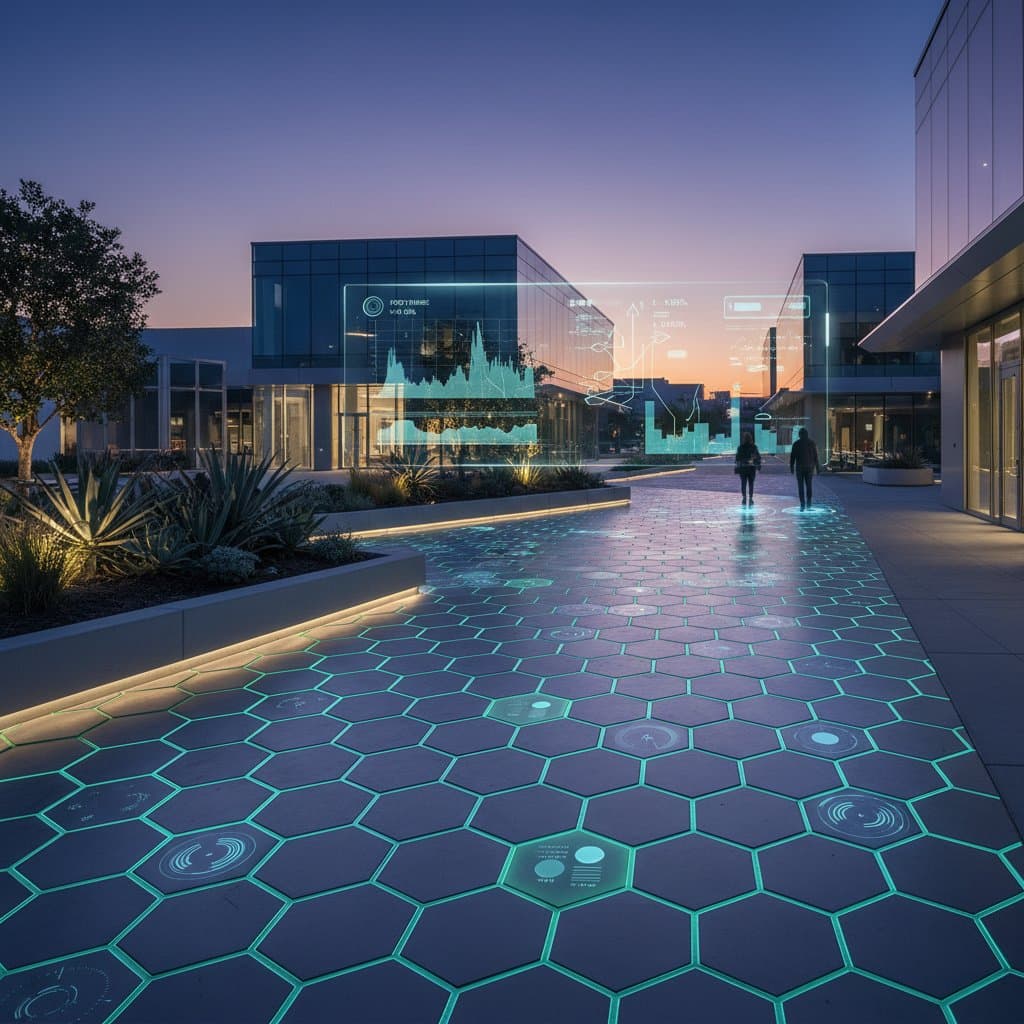
Data-driven pavers track footfall in commercial spaces
Smart landscaping now includes pavers that record pedestrian movement and send the results to property managers. These systems appear in plazas, retail centers, and public walkways where owners need clear information about how people move through a space.
Each unit contains pressure sensors that note when someone steps on the surface. The collected readings reveal peak hours, popular routes, and areas that receive little use.
Key details at a glance
- Installation cost ranges from 40 to 70 dollars per square foot, split among materials, labor, and sensor components.
- Each paver monitors one to two square feet and logs data every half second to one second.
- Power comes from low-voltage lines or small solar cells, while data travels over Wi-Fi or LoRa networks.
- A 1,000-square-foot section usually requires five to ten days for full setup and testing.
- Success depends on local traffic volume, weather exposure, and integration with existing management tools.
Site planning requirements
Proper preparation starts with an assessment of soil conditions and drainage. The base must support both the pavers and the wiring that carries sensor data.
Check that the subgrade offers stable support and maintains a slight slope for water runoff. Select paver materials rated for local freeze-thaw cycles and confirm that sensor housings remain watertight.
Review local codes for any electrical or low-voltage permits. Decide early how the system will connect to current facilities software, whether through a small Wi-Fi mesh, a longer-range LoRa network, or a cloud dashboard.
Installation sequence
- Excavate the area to a depth of six to eight inches and compact the soil to at least 95 percent density.
- Place crushed stone in two-inch layers, compacting each lift and preserving a drainage slope of one inch per eight feet.
- Run conduits for power and data lines, seal all joints, and test connections before covering them.
- Spread one inch of coarse bedding sand without heavy compaction to keep cables flexible.
- Set the pavers in the chosen pattern, link sensor terminals with quick-connect fittings, and maintain one-eighth-inch spacing.
- Connect the system to the control hub, run calibration tests, and confirm sensor response.
- Sweep joint sand into the gaps, perform a final light compaction, and verify that every sensor still functions.
Common issues and fixes
Inconsistent readings often trace back to loose connectors or uneven bedding. Water intrusion requires new seals and inspection of conduit joints. Network delays improve when routers are repositioned or a lower-frequency signal is adopted. Surface movement beyond one-quarter inch calls for checks on compaction and edge restraints.
Ongoing care
Inspect the installation twice a year to confirm sensor accuracy and joint condition. Clean surfaces with mild detergent and low-pressure water. Replace joint sand when depth loss exceeds one-eighth inch. Update firmware on schedule and review data logs for any sensor dropouts. Plan to exchange modules that lose precision after five to seven years of use.
Professional versus owner installation
The electrical connections and calibration steps usually favor professional crews who already handle sensor networks. Owners who attempt the work themselves should first confirm they possess the required tools and experience.
Practical steps that extend system life
Route conduits before excavation begins. Label every sensor connection for quick reference during service visits. Select pavers that allow individual sensor modules to be swapped. Keep a local copy of recent data in case the network connection drops. Apply the traffic information to adjust lighting times, move signage, and schedule cleaning crews more efficiently.
Value over time
Property teams gain a continuous record of how spaces are used. This record supports better safety decisions, more efficient layouts, and lower long-term maintenance costs.