
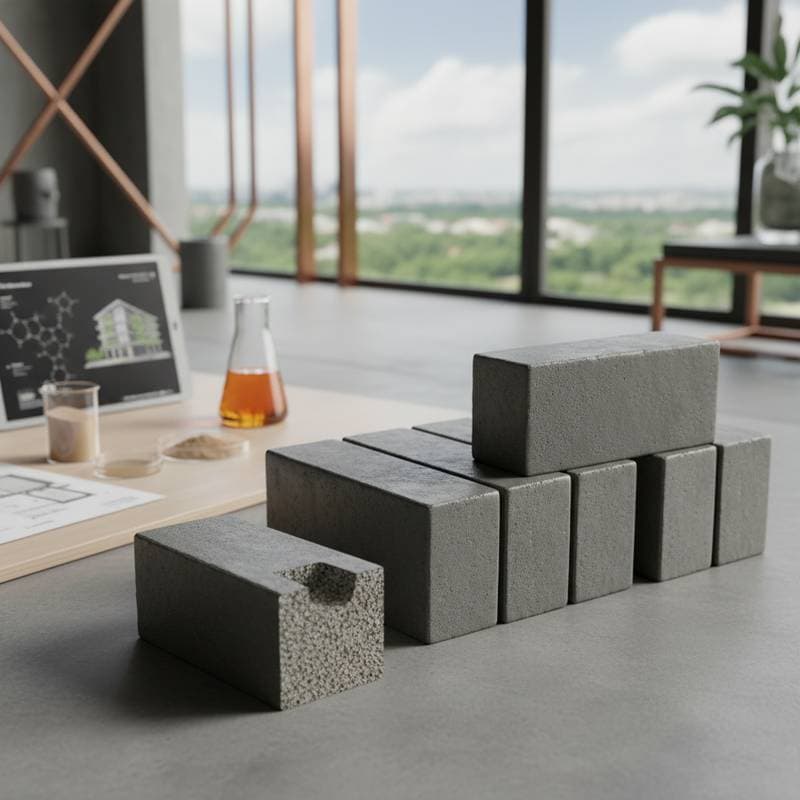
Understanding Zero-Cement Bricks
Zero-cement bricks represent a significant advancement in sustainable construction materials. These bricks employ geopolymer chemistry as a substitute for Portland cement, utilizing industrial byproducts like fly ash, slag, or rice husk ash alongside alkaline activators to create a robust binder. This approach generates substantially less carbon dioxide compared to traditional cement production, positioning zero-cement bricks as a key innovation for reducing the environmental impact of building projects.
In conventional concrete, hydration of cement produces calcium silicate hydrate, which provides structural integrity. Geopolymer bricks, however, form a three-dimensional network of aluminosilicate bonds through an alkali-activation process. This results in strength levels that match or exceed those of standard bricks, along with enhanced resistance to moisture, chemicals, and thermal stress, all while requiring fewer virgin resources.
Professionals in the construction field, including builders, architects, and homeowners, increasingly adopt these materials for their dual benefits in performance and sustainability. The bricks prove durable, fully recyclable, and adaptable to both standard dimensions and custom designs. Moreover, they typically cure at ambient temperatures, minimizing the energy required for production.
The Importance of Geopolymer Technology
Cement production ranks among the most energy-demanding industrial activities worldwide. It involves heating limestone and other raw materials to temperatures exceeding 1400 degrees Celsius, which releases substantial carbon dioxide from both fuel burning and the calcination process itself. Geopolymer binders bypass this limestone heating step entirely, slashing emissions by up to 80 percent in many formulations.
These bricks also offer tangible performance improvements over traditional options. They demonstrate greater resistance to sulfate attacks, exhibit minimal shrinkage during the curing phase, and provide superior fire resistance ratings. Such qualities contribute to longer-lasting structures, thereby lowering the need for repairs and further diminishing long-term environmental costs.
Applications for Zero-Cement Bricks
Zero-cement bricks serve in applications similar to those of conventional masonry. They work well for non-structural elements like garden walls, retaining walls, exterior facades, and interior partitions. For load-bearing roles, select formulations that meet specific compressive strength standards, and always consult manufacturer specifications or conduct independent testing to ensure compliance with local building codes.
Planning a Zero-Cement Brick Project
Assess the project's complexity before starting to determine if it suits a do-it-yourself approach or demands professional expertise. Non-structural features such as garden borders, planters, or walkways often fall within the capabilities of skilled homeowners. Projects involving load-bearing walls, water retention, or complex drainage require the involvement of a certified mason or structural engineer to guarantee safety and longevity.
Site Evaluation
Begin by examining soil composition and drainage patterns. Geopolymer bricks thrive in environments with consistent moisture levels, so prioritize effective site drainage to prevent water accumulation. Identify any slopes, adjacent plant roots, or areas prone to frost expansion that could affect stability.
For builds on existing foundations, thoroughly inspect for existing cracks, unevenness, or signs of movement. Establish a firm, level base through proper compaction to support the structure's weight over time.
Key Measurements
Determine the wall's overall length, height, and desired thickness. To estimate brick quantity, calculate the surface area of the wall and divide by the exposed face area of a single brick, then incorporate a 10 percent buffer for cuts, breakage, and adjustments. In mortarless or dry-stack assemblies, account for precise joint gaps and use alignment tools to maintain uniformity.
Environmental Considerations
Ambient conditions influence the geopolymer curing process. Although these bricks set effectively at room temperature, prolonged exposure to freezing temperatures or intense heat may slow strength gain. Shield freshly laid bricks from heavy rain or direct sunlight during the initial 24 to 48 hours to optimize bond formation.
Anticipated Challenges
Logistics often present hurdles, such as securing delivery access for bulk materials, designating space for mixing alkaline solutions, and organizing storage for safety equipment. Handle activators with caution due to their caustic nature; designate zones for safe preparation and disposal to comply with handling protocols.
Selecting Materials
The choice of geopolymer components directly influences both the project's sustainability credentials and its structural performance. Source materials from reputable suppliers who provide detailed mix designs and safety data sheets.
Fly Ash-Based Geopolymer Bricks
Fly ash, a byproduct of coal-fired power plants, serves as the primary aluminosilicate source.
- Advantages: Achieves high compressive strength up to 40 MPa, features a smooth finish for aesthetic appeal, and offers long-term durability against environmental degradation.
- Drawbacks: Regional availability can fluctuate, and the activator mixture demands precise measurement to avoid inconsistencies.
- Cost Range: Generally economical, often 20 to 30 percent less than high-end cement bricks.
- Required Expertise: Intermediate level, involving careful chemical proportioning and protective measures during mixing.
Slag-Based Geopolymer Bricks
Ground granulated blast furnace slag provides a silica-rich base for dense geopolymer formation.
- Advantages: Delivers exceptional impermeability to reduce water ingress, sets rapidly for faster project timelines, and withstands aggressive chemical exposures.
- Drawbacks: Certain mixes benefit from mild heat acceleration during curing, and the material's density increases handling effort.
- Cost Range: Mid-tier pricing, influenced by local industrial supply chains.
- Required Expertise: Intermediate to advanced, particularly for optimizing curing conditions.
Rice Husk Ash or Natural Pozzolan Bricks
These utilize agricultural residues or volcanic materials for a more eco-friendly, lightweight option.
- Advantages: Draws from renewable feedstocks, reduces overall weight for easier installation, and enhances thermal insulation properties.
- Drawbacks: Compressive strength may cap at 20 to 30 MPa, necessitating longer ambient curing times.
- Cost Range: Budget-friendly, especially in agricultural regions.
- Required Expertise: Beginner to intermediate, with straightforward mixing procedures.
Purchase an additional 10 percent of bricks beyond your calculated needs to accommodate unforeseen damages or modifications during construction.
Essential Tools and Supplies
Equip yourself with reliable tools to ensure precise and efficient work. Prioritize quality to handle the unique properties of geopolymer materials.
Manual Tools
- Brick Trowel: Essential for applying and smoothing any bonding agents or thin-set mortars in jointed assemblies.
- Spirit Level: Critical for verifying that each course remains horizontal and vertical throughout the build.
- Masonry Hammer: Ideal for splitting or shaping bricks to fit irregular spaces without excessive waste.
- Measuring Tape and Chalk Line: Necessary for marking straight lines and accurate dimensions on the site.
Powered Tools
- Masonry Saw or Angle Grinder with Diamond Blade: Provides clean, precise cuts through dense geopolymer without chipping.
- Drill with Mixing Paddle Attachment: Ensures thorough blending of activators and aggregates for uniform consistency.
- Wet/Dry Vacuum: Facilitates quick removal of dust and alkaline residues to maintain a safe workspace.
Rental Options
- Portable Mortar or Concrete Mixer: Recommended for batches exceeding 50 bricks to save time and effort.
- Vibratory Plate Compactor: Compacts gravel bases to a density of at least 95 percent, preventing future shifts.
Core Materials
- Pre-manufactured geopolymer bricks or raw mix components.
- Manufacturer-recommended alkaline activators, such as sodium silicate solutions.
- Coarse sand or crushed gravel for foundational layers.
- Polymer-modified thin-set adhesive for jointless installations.
- Safety gear including nitrile gloves, safety goggles, and a full-face respirator to counter alkaline hazards.
Building with Zero-Cement Bricks: Step-by-Step Guide
Follow these steps methodically to achieve a stable, long-lasting result. Allow ample time for each phase to account for curing dynamics.
- Establish the Foundation. Dig a trench approximately 6 to 8 inches deep, depending on local frost line requirements. Fill with 4 inches of gravel, then compact in layers using a plate compactor until the surface achieves a firm, even plane.
- Lay the Initial Course. Stretch a taut string line as a guide for straightness. Position bricks dry first to test alignment and spacing, then apply adhesive in a consistent bead along the base. Tap each brick into place and confirm level across the row with a spirit tool.
- Build Subsequent Courses. Offset joints by half a brick length in a running bond configuration to distribute loads evenly. Apply bonding material to the top of the previous course and sides as needed, pressing firmly for full contact.
- Monitor Alignment Regularly. After completing every third course, use a plumb bob or level to check verticality. Correct minor deviations immediately with shims or adjustments to avoid compounding errors.
- Facilitate Curing. Cover the structure with breathable tarps to shield from precipitation and extreme weather for a minimum of 48 hours, allowing the geopolymer network to fully develop.
- Refine Joints and Surfaces. For mortared joints, strike them with a jointer tool once the material reaches a thumbprint-hard state, creating a weather-resistant seal.
Lightly dampen brick surfaces with a fine mist if they show signs of rapid drying, which helps sustain the activation reaction without introducing excess water.
Optimizing Long-Term Performance
Protective Finishes
Consider applying a penetrating, silicate-based sealer to walls in wet or cyclic freeze-thaw climates. This treatment locks in the brick's natural hues, minimizes salt efflorescence, and bolsters resistance to weathering. For ornamental features, incorporate integrated elements like low-voltage lighting strips or modular planters to elevate functionality and visual interest.
Ongoing Maintenance
Conduct yearly inspections to detect any developing fissures or erosion. Gently wash surfaces using a neutral pH detergent and soft brush, steering clear of harsh acids that might degrade the aluminosilicate matrix. Refresh sealers every three to five years in demanding exposures to sustain protective qualities.
Avoiding Pitfalls in Construction
Failure to compact the base adequately invites differential settling and subsequent cracks. Neglecting weather protection during curing compromises bond integrity and overall strength. Inconsistent activator dosing leads to variable material quality across the project. Frequent alignment verifications prevent the accumulation of offsets that distort the final structure.