
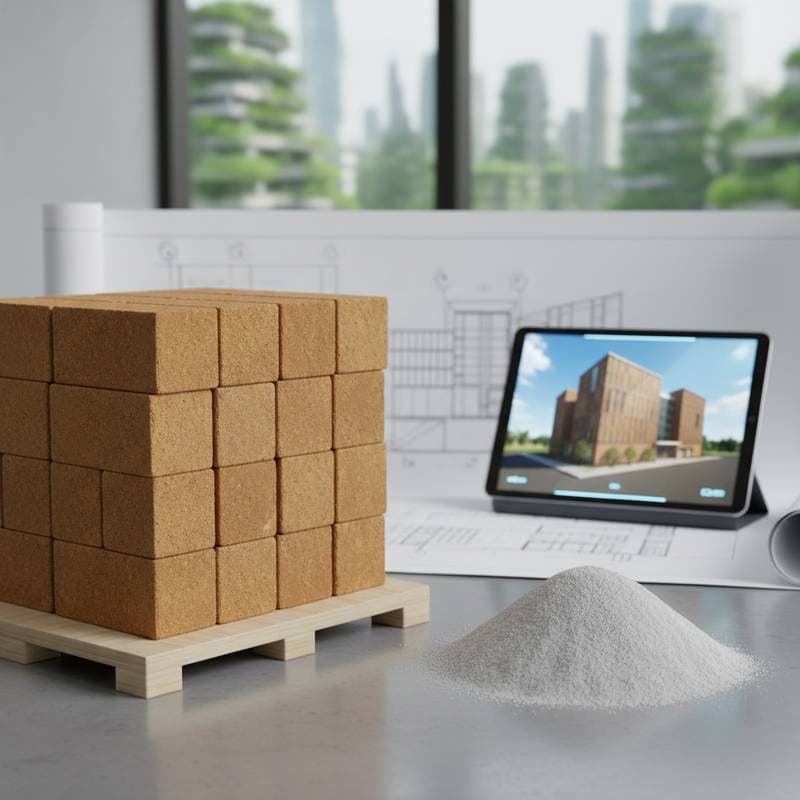
Understanding Geopolymer Bricks
Geopolymer bricks represent an innovative category of masonry units formed by activating industrial byproducts, such as fly ash or slag, through alkaline solutions. This reaction creates a robust binder that equals or exceeds the compressive strength of conventional Portland cement. In contrast to cement production, which involves energy-intensive high-temperature kilns, geopolymer formation occurs at ambient temperatures and generates only a small portion of the associated carbon emissions.
These bricks influence construction practices by providing enhanced durability, resistance to elevated temperatures and corrosive chemicals, and reduced water requirements during manufacturing. Their superior environmental profile positions them as a reliable alternative to cement-based products for both load-bearing and aesthetic purposes. Geopolymer materials have transitioned from research prototypes to practical applications in pavements, retaining walls, and structural elements, aligning with contemporary demands for robustness, ecological responsibility, and economic efficiency.
The Significance of Geopolymer Technology
Portland cement manufacturing ranks among the top contributors to global carbon dioxide emissions due to its reliance on intense heat, substantial fuel consumption, and large-scale raw material quarrying. Geopolymer technology alters this paradigm by repurposing waste materials and employing low-temperature curing processes, achieving emission reductions of up to 80 percent while preserving equivalent structural integrity.
The underlying binder chemistry enhances protection against fire, saline environments, and acidic conditions, thereby prolonging the service life of exposed structures. In areas subject to severe weather or industrial pollutants, geopolymer masonry demonstrates greater longevity than cement alternatives, which translates to decreased expenses for repairs and replacements. This blend of superior functionality, environmental benefits, and operational feasibility prompts industry analysts to forecast widespread adoption in residential and commercial projects.
Optimal Applications for Geopolymer Bricks
Geopolymer bricks serve in any scenario where standard masonry units apply, yet they excel in demanding settings. Key areas include load-bearing walls that demand high compressive strength and precise dimensional stability; paving surfaces and retaining walls that endure salts, persistent moisture, or repeated freeze-thaw cycles; coastal zones or industrial sites where corrosion and chemical degradation compromise cement durability; and architectural facades that require enduring color retention and reduced efflorescence.
For non-structural uses such as interior partitions or ornamental features, geopolymer bricks deliver uniform pigmentation and surface texture with minimal post-production treatments. Their negligible shrinkage during curing and accurate molding capabilities facilitate narrow, consistent joints, enhancing both mechanical performance and aesthetic appeal.
Transitioning to Geopolymer Masonry
Transitioning from cement-based blocks necessitates consideration of unique material properties and installation techniques. Geopolymer bricks generally match the sizes of conventional units, allowing compatibility with existing wall designs and mortar joint specifications. Variations primarily involve adjustments to curing protocols, adhesion methods, and humidity management.
Evaluating Materials and Suppliers
Sourcing depends on regional availability of byproducts like fly ash or slag, which influences pricing and aesthetic variations. Identify local manufacturers that adhere to rigorous quality standards and supply documentation on key metrics, including compressive strength, water absorption, and curing specifications. Select partners who demonstrate reliable batch consistency to avoid inconsistencies in project outcomes.
Analyzing Costs and Performance Metrics
Cement bricks benefit from broad availability and established handling procedures, yet they carry significant embodied energy and diminished resistance to chemical assaults. These options remain cost-effective for basic applications but prove less resilient in challenging exposures.
Fly ash-derived geopolymers leverage waste resources for balanced affordability and strong overall performance, making them suitable for diverse climates and routine construction tasks. Slag-based variants offer elevated strength and endurance, particularly for high-load or marine settings, although their cost may reflect supply constraints.
Opt for geopolymer bricks when prioritizing extended lifespan and reduced ecological footprint. Retain cement blocks solely in cases of limited local access or incompatibility with existing mortar formulations.
Essential Tools and Handling Practices
Standard masonry equipment suffices for most tasks, with minor adaptations to maximize effectiveness. Employ trowels and jointers to apply and finish mortar beds; utilize a rubber mallet to position bricks securely without inducing fractures; operate a masonry saw or angle grinder for precise cuts around edges and apertures; and rely on levels and plumb lines to verify alignment throughout assembly.
Certain geopolymer formulations necessitate specific mortars or preparatory coatings for optimal adhesion. Adhere strictly to producer guidelines regarding compatible products and required curing durations.
Store bricks in sheltered areas to control pre-installation moisture levels. Uniform hydration promotes reliable curing and strong interfacial bonds.
Step-by-Step Guide to Constructing with Geopolymer Bricks
-
Prepare the foundation by confirming it remains level, stable, and free of debris. Geopolymer bricks efficiently transfer loads, but irregularities in the base may lead to subsequent fissures.
-
Prepare mortar according to specified ratios, selecting geopolymer-compatible or low-cement blends. Limit water addition to prevent bond dilution.
-
Install the initial course along a taut guideline to ensure aligned joints. Verify horizontality at regular intervals.
-
Distribute mortar uniformly to achieve a bed thickness of approximately one-half inch. Seat each brick with firm pressure.
-
Offset joints in successive rows to balance stress distribution and refine visual continuity.
-
Monitor verticality and levelness using a plumb line and spirit level after completing every two or three courses. Adjust deviations promptly prior to mortar hardening.
-
Facilitate curing by shielding the assembly from intense sunlight and gusts. Apply light misting or cover with moistened fabric to regulate drying rates.
Inspect the partially set wall for solidity and absence of voids or irregular mortar profiles. If joints exhibit friability or edges display chipping, review mixture proportions and environmental controls.
Acquire ten percent additional bricks to accommodate cuts and potential damage. Subtle variations in geopolymer color and texture warrant surplus inventory for seamless integration.
Engaging Professionals for Complex Projects
For structures bearing loads from multiple levels, consult a licensed structural engineer to validate designs. Geopolymer reactions differ from cement hydration, potentially requiring customized load calculations beyond generic codes. Projects interfacing with reinforced concrete elements, such as beams or slabs, demand expert oversight to ensure seamless integration.
Refrain from independent efforts on foundational work, soil-retaining barriers, or sealed substructures. These demand precise engineering assessments and tailored curing strategies.
Post-Construction Care and Upkeep
After full curing, perform surface cleaning with a soft-bristle brush or gentle water spray at low pressure. Steer clear of acidic solutions that might react with the material composition. Application of a permeable clear sealant bolsters resistance to staining, although many geopolymer finishes require little ongoing intervention.
Conduct periodic examinations for fissures or expansion joints, particularly in seasonal cycles. Repair mortar as necessary. The inherent resistance to efflorescence minimizes unsightly salt deposits compared to cement counterparts.
In regions prone to freezing, select sealants that permit vapor transmission over impermeable films. This design accommodates moisture egress, averting damage from ice expansion.
Advancing Toward Widespread Geopolymer Adoption
Construction stakeholders face increasing mandates to lessen ecological burdens while upholding quality standards. Geopolymer bricks provide quantifiable advantages throughout the building lifecycle, from emission cuts and waste utilization to prolonged service in rigorous environments.
Although cement persists in the near term, regulatory pressures on emissions and incentives for green materials erode its economic edge. Geopolymer manufacturing adapts readily to current facilities with limited modifications. As scalability advances, reverting to emission-heavy options becomes increasingly untenable.