
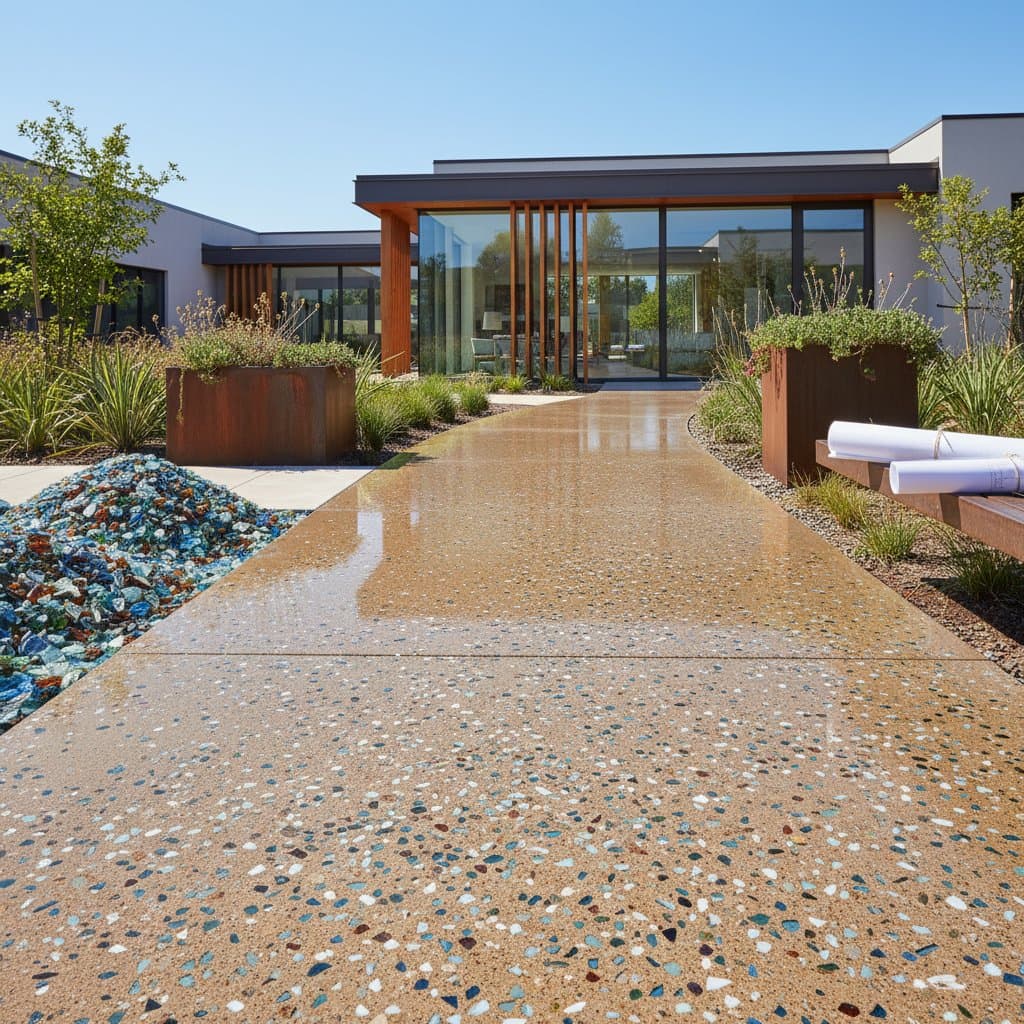
Recycled Glass: A Sustainable Shift in Concrete for 2025
Recycled glass concrete incorporates crushed glass in place of some traditional sand or gravel. Sources include bottles, windows, and industrial remnants that might otherwise fill landfills. Proper processing yields a robust, enduring material with reflective qualities suitable for structural and ornamental applications.
The Importance of Recycled Glass in Construction
Concrete ranks among the most widely used materials globally, yet its production carries significant environmental burdens. Cement manufacturing releases substantial carbon dioxide, while sand extraction depletes riverbeds and coastal areas. Incorporating recycled glass as an aggregate diminishes waste volumes and eases pressure on natural resources, yielding a sustainable option that upholds rigorous performance levels.
Advantages and Disadvantages
Advantages
- Diverts glass waste from landfills through reuse.
- Lessens the need for mining natural sand and gravel, safeguarding aquatic ecosystems.
- Provides aesthetic enhancement via sparkle and varied color choices.
- Offers superior resistance to chemical degradation compared to certain natural aggregates.
- Qualifies projects for LEED certification or other green building incentives.
Disadvantages
- Poses risks of chemical reactions if the glass lacks appropriate treatment or sizing, potentially causing cracks.
- Demands specialized handling to eliminate coatings and impurities.
- Faces availability constraints in certain locales.
- Involves higher costs per ton relative to readily available natural aggregates.
- Necessitates performance testing for load-bearing applications.
Cost Considerations
Recycled glass aggregate typically costs between 10 and 25 dollars per ton, influenced by factors such as color, grain size, and preparation methods. Installed concrete featuring this material ranges from 8 to 18 dollars per square foot, varying with slab thickness, surface treatment, and regional labor expenses. Projects involving decorative elements like polished glass exposures incur additional fees due to intricate finishing processes.
Expenses increase with the use of tinted or textured glass, elaborate formulations, or premium coatings. They decrease when employing locally obtained clear glass or matte finishes.
Durability and Upkeep
Constructed properly, recycled glass concrete endures comparably to standard formulations, spanning 50 to 100 years in structural roles. Managing the alkali-silica reaction (ASR) proves essential, as this interaction between glass and cement can compromise integrity. Strategic mix compositions and supplementary materials play a pivotal role in prevention.
Preserve visual quality by employing neutral pH cleaners and gentle brushes. Steer clear of acidic or abrasive agents that might diminish the glass's luster. Periodic sealing of refined surfaces, every few years, maintains brilliance and wards off stains.
Key Specifications to Verify
Prior to procurement, evaluate these technical aspects:
- Aggregate dimensions: Typically 1/8 inch to 3/4 inch for surfaces intended to reveal the glass.
- Glass preparation: Select providers who cleanse and apply coatings to mitigate ASR risks.
- Compressive strength: Aim for a minimum of 3000 psi in slabs and 4000 psi for load-bearing elements.
- Freeze-thaw resistance: Essential for exterior applications in cooler regions.
- Slip resistance: Critical for glossy or ornamental flooring.
Preparation and Site Planning
Site requirements mirror those of conventional concrete installations. Ensure the subgrade remains firm, thoroughly compacted, and equipped for drainage. Prevent water accumulation beneath slabs by incorporating appropriate slopes, such as 1/8 inch per foot for driveways or patios.
Consider anticipated foot or vehicle traffic when planning exposed glass surfaces, as initial sharp edges may pose hazards until ground and sealed. Contact utility services prior to excavation. Some jurisdictions mandate documentation of recycled components, so verify regulations promptly.
Installation Process
- Level and compact the subgrade meticulously.
- Incorporate a crushed stone base layer where drainage demands it.
- Erect formwork to define boundaries and maintain alignment.
- Blend the concrete using the designated glass proportion, generally 10 to 30 percent of the aggregate volume.
- Pour and level the mixture uniformly with screeding tools.
- Apply finishing touches via floating or troweling; for aesthetics, grind post-curing to reveal glass elements.
- Facilitate curing by maintaining surface moisture over several days.
- Apply sealant once the surface dries completely.
During cutting or grinding of hardened material, utilize eye and respiratory safeguards. Fine particles from glass and cement may irritate sensitive tissues.
Design Variations and Applications
Recycled glass concrete adapts to diverse uses:
- Exposed aggregate surfaces where glass fragments provide surface shimmer.
- Polished flooring integrating colored glass accents.
- Countertops featuring precise color blends for decorative impact.
- Pavers and tiles leveraging glass for vibrancy and light reflection.
- Structural blends substituting glass solely in fine aggregates to preserve strength.
Opt for finer particles in seamless areas and coarser ones for pronounced texture. Transparent glass imparts a discreet glow, whereas multicolored assortments yield striking patterns.
DIY Projects Versus Professional Services
Small-scale endeavors like decorative pours, garden stepping stones, or basic countertops suit DIY efforts. Acquire a reliable mixer, protective equipment, and allocate time for grinding and sealing phases, which may span multiple days.
Engage professionals for weight-supporting structures, intricate geometries, or uniform coloration and texture. Experts possess specialized polishing apparatus, effective dust management, and formulation expertise to circumvent ASR or structural deficiencies.
Addressing Common Issues
Cracks frequently arise from inadequate curing or untreated reactive glass. Employ low-alkali cement supplemented with fly ash to curb reactions.
Dulled surfaces result from depleted sealants; refresh with a suitable product. Discoloration stems from inconsistent glass particle sizes or residual coatings; pre-mix rinsing resolves this.
In freezing environments, scaling or spalling indicates moisture infiltration; consistent sealing and drainage slopes mitigate such problems.
For nascent cracks, apply clear epoxy fillers to block moisture entry. Revive lackluster floors through mild polishing followed by new sealant application.
Regional and Environmental Adaptations
In areas prone to humidity or freeze-thaw cycles, prioritize low-absorption glass and validate durability against such conditions. Hot or saline coastal settings benefit from glass's sunlight reflection and salt tolerance over select natural stones. Adhere to locale-specific codes regarding recycled materials and wet-surface traction.
Sustainable Alternatives
Should recycled glass prove inaccessible, enhance concrete eco-profile through these substitutes:
- Recycled concrete from demolished structures.
- Fly ash or slag as partial Portland cement replacements.
- Crushed ceramics or porcelain for ornamental effects.
- Natural pozzolans, such as volcanic ash, to curtail cement quantities.
These choices target waste reduction or emission cuts uniquely. Recycled glass distinguishes itself with inherent color and light-reflecting properties, blending utility with allure.
Expert Recommendations for Optimal Results
- Procure 10 percent surplus glass to account for losses and uniformity.
- Maintain minimal mix water content to avoid glass particle separation.
- Prototype a minor batch to assess final appearance and hue.
- Progress grinding with diamond pads at a measured pace to prevent glass thermal damage.
- Favor penetrating sealers over topical films for extended protection.
Implementing Recycled Glass Concrete
This material merges reliability, elegance, and ecological stewardship seamlessly. It repurposes everyday discards into resilient installations enduring generations. Builders and homeowners alike gain a straightforward means to lessen environmental footprints while preserving robustness and design flair. Through meticulous formulation, groundwork, and care, recycled glass elevates standard concrete to a forward-thinking, eco-conscious staple in contemporary builds.