
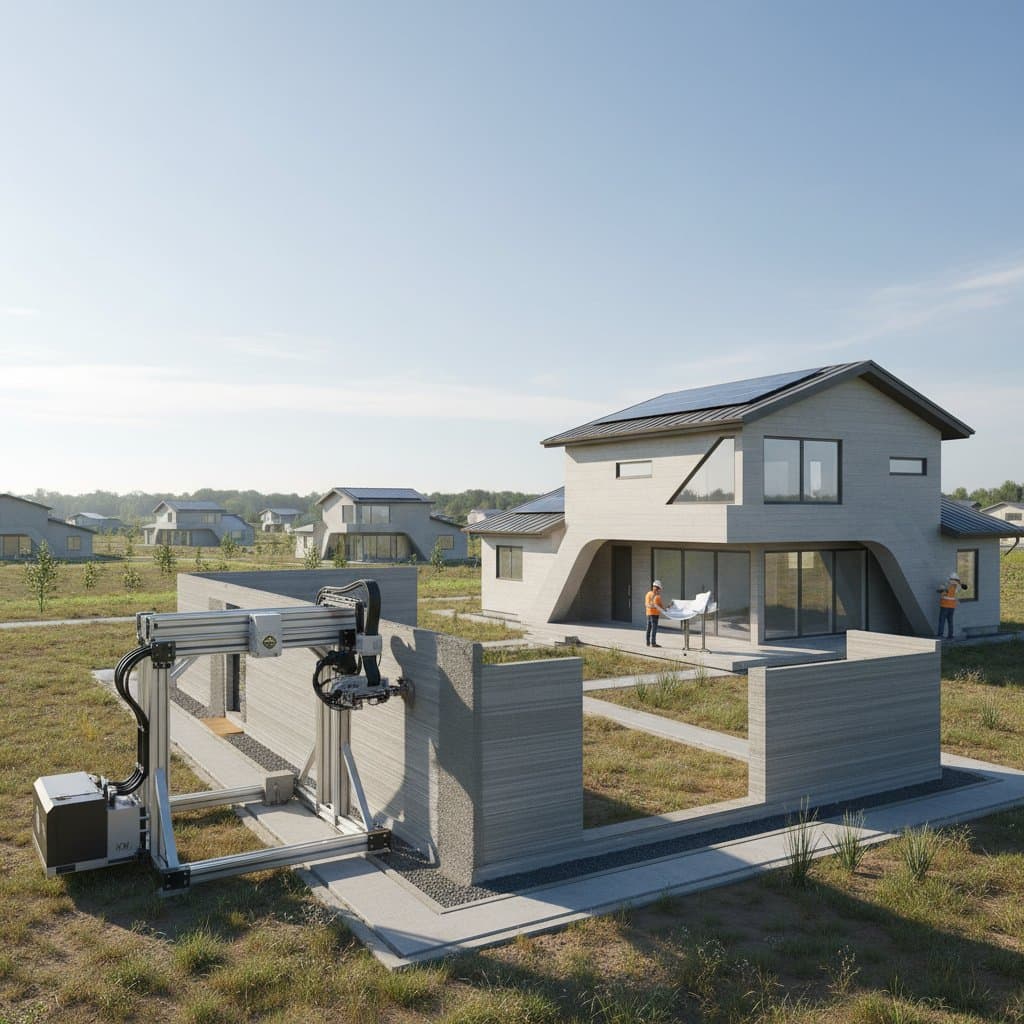
The Future of Affordable Homes: 3D Concrete Printing
Quick Take
3D concrete printing transitions from experimental stages to practical applications on construction sites. It delivers advantages in speed, accuracy, and material efficiency. Challenges include unpredictable material performance, regulatory approvals, and overlooked long-term expenses. Primary cost factors encompass equipment installation, concrete mixture adjustments, and subsequent surface treatments.
Essential Site Checks
Before pursuing a 3D-printed home or incorporating a printed element into an existing property, conduct basic on-site evaluations to assess conditions and surroundings.
- Soil stability: Verify that the ground is firmly compacted and free from softness or excessive moisture.
- Water drainage: Ensure that runoff directs away from the proposed building area.
- Equipment access: Confirm availability of a level platform and unobstructed space for the printer's operation.
- Utility integration: Determine methods for connecting plumbing and electrical systems to the printed structure.
- Regulatory compliance: Consult local authorities on policies for printed concrete elements and foundation requirements.
These initial assessments require minimal investment but influence all subsequent choices. Numerous projects encounter issues not due to printing flaws, but from inadequate preliminary preparations.
Warning Signs
- Operator lacking certification in structural engineering or material science.
- Supplier unable to provide documentation on concrete's compressive strength or curing characteristics.
- Absence of a plan for reinforcing openings or integrating with the roof system.
- Unrealistic timelines that overlook curing periods or interlayer adhesion.
- No provisions for insulation, electrical conduits, or mechanical pathways.
- Site lacking proper slab drainage or foundation detailing.
- Unconfirmed ratings for fire resistance and seismic performance.
- Missing strategy for surface protection and upkeep.
These indicators point to potential financial burdens or compliance hurdles. Although printed concrete appears robust, underlying vulnerabilities can escalate expenses over time.
Common Solutions and Estimated Expenses
Site preparation and foundations: Printed walls demand a solid base, such as a slab or grade beam. Basic grading costs a few dollars per square foot, while complex engineered supports reach thousands. Addressing drainage deficiencies increases these figures.
Printer mobilization and setup: Transporting and positioning large printers, including gantries or robotic systems, typically incurs tens of thousands in fees. Providers often charge by the hour or day, with added material surcharges. Substrate irregularities lead to material waste from errors.
Specialized concrete mixtures: Formulations for printing incorporate fine aggregates, elevated cement ratios, and flow-regulating additives. Prices per cubic yard often double those of conventional mixes. Benefits arise from labor reductions rather than lower raw material costs.
Post-print finishing: Layered textures on walls may remain visible for aesthetic appeal, or require smoothing and sealing at several dollars per square foot. Door and window cutouts frequently need manual adjustments for precise fits.
Roofing and thermal barriers: Printing usually concludes at wall height, necessitating traditional roof assembly. Insulation via spray foam or rigid panels follows, potentially equaling or surpassing printing costs without prior planning.
Opting for shortcuts, like omitting reinforcements or sealants, creates deferred problems. Issues such as water penetration, heat loss, and fractures manifest as substantial future repairs.
Repair Strategies Over Replacement
Wall surfaces: Address superficial cracks with matching mortar or polymer fillers; reserve full replacement for cases of deep delamination or load-bearing compromise.
Window and door frames: Secure openings with durable framing and effective flashing. Printed edges lack flexibility, making water entry prevalent; replace only for deterioration or poor alignment, not cosmetic reasons.
Roof assemblies: Preserve seals and flow paths. Renew roofing materials solely upon expiration of their service life or when damage affects underlying supports.
Foundation elements: Prioritize drainage improvements. Stability of printed walls ties directly to the base; replace portions only after soil capacity verification.
Interior surfaces: Apply coatings or panels directly to concrete; mend finishes instead of walls. Renew only for persistent moisture damage or bonding failures.
Utility installations: Pre-plan routes in printed designs to avoid restricted access. Post-construction modifications double typical expenses.
Assembling the Right Team and Workflow
3D-printed projects require traditional expertise with enhanced synchronization.
- Inspectors experienced in innovative materials to validate adherence to standards.
- Architects or engineers involved from inception to shape wall forms and embed supports.
- Printing specialists handling logistics, mixture development, and operator preparation.
- General contractors coordinating standard trades and timelines.
- Trade experts in plumbing, wiring, and climate control, adept at integrated pathways.
Involve these professionals concurrently rather than sequentially. Discrepancies between plans and printer capabilities can stall progress. A dedicated manager adds 10 to 20 percent to the budget but averts greater excesses.
Key Focus Areas
Target enhancements that boost longevity and performance.
- Moisture management: Establish site grading and boundary drains prior to printing.
- Structural soundness: Ensure uniform mixture application and layered curing protocols.
- Airtight barriers: Use permeable sealers to minimize drafts without retaining dampness.
- Insulation optimization: Incorporate methods that enhance concrete's thermal mass, like external foam layers or built-in voids.
- Roof resilience: Select straightforward, pitched designs with reliable coverings.
- Service pathways: Embed channels or pipes pre-printing to eliminate later alterations.
Postpone elements with marginal benefits, such as intricate shapes or ornamental surfaces, which extend printing duration and finishing demands. Stick to straightforward, modular components that ease upkeep.
Budgeting and Phased Execution
Printed constructions adhere to a rigid sequence. Deviations provoke expensive corrections.
- Secure drainage: Direct all surface water from the foundation zone.
- Build base: Compact, level, and load-test the footing or slab.
- Erect walls: Oversee bonding between layers and curing intervals.
- Add supports: Insert beams and utility conduits before enclosing surfaces.
- Attach roof: Align framing for effective load distribution.
- Integrate systems: Install insulation and services, sealing all entries promptly.
- Finalize exteriors: Coat surfaces once dryness and integrity are confirmed.
Quality assurance precedes each phase. A single adhesion flaw undermines integrity, while thorough checks mitigate major interventions.
Upkeep and Longevity
Protected printed concrete endures effectively. Primary concerns involve water entry, erosion, and joint vulnerabilities.
- Coating evaluations: Examine sealants biennially; renew upon signs of fading or staining.
- Drainage vigilance: Clear channels, eaves, and slopes regularly.
- Crack assessments: Track fine fissures; investigate expansions for load issues.
- Vegetation control: Maintain clearance to avoid root intrusion or moisture buildup.
- Junction inspections: Probe seals at roofs and edges for seepage risks.
Consistent care extends lifespan to decades, whereas ignored water issues accelerate decline.
Dispelling Myths
- Printing eliminates labor expertise: It reallocates demands to operators, formulators, and verifiers.
- Structures require no maintenance: Concrete remains susceptible to environmental effects; barriers and flows demand attention.
- Standard mixes suffice: Only tailored compositions with timed settings print reliably.
- Costs always decrease: Equipment and premiums offset workforce reductions.
- Every form prints easily: Complex features require supplementary traditional methods.
Recognizing these realities sustains feasible plans and timelines.
Assessing Risks and Returns
This method cuts framing and detailing efforts by up to 50 percent while curbing debris. Savings hinge on scale; isolated prints may exceed conventional alternatives. Benefits emerge in series production, amortizing initial outlays.
Testing and approvals pose uncertainties. Certain jurisdictions mandate comprehensive validations for habitation, inviting postponements. The core hazard lies in assuming simplicity; success requires precise management.
Sustainability gains prove more straightforward. Reduced refuse, fewer transports, and safer workflows enhance appeal. Effective water strategies further lower ongoing expenses.
Insights from Real Projects
In a coastal development, builders erected modest homes via printing. Initial appearances impressed, but omitting a slab vapor retarder allowed salt-laden dampness to trigger base efflorescence. Remedial abrasion and protection exceeded upfront prevention costs. The lead stated, "We learned that printed concrete is still concrete. It drinks water if you let it."
Conversely, a arid-area initiative thrived through simplicity. Linear walls, uniform openings, and routed services enabled uninterrupted printing. Completion halved traditional durations, with minimal revisions and waste. The client highlighted streamlined processes and efficiency.
Steps to Success
For those considering 3D-printed residences, begin with practical site observations. Inspect post-rainfall for pooling. Test ground solidity and equipment routes. Scrutinize plans for water shedding, warmth retention, and access provisions prior to commencement.
Consult engineers versed in printing outcomes. Request mixture test results and curing records. Verify operator portfolios for comparable endeavors. Secure policies covering machinery and construction flaws.