
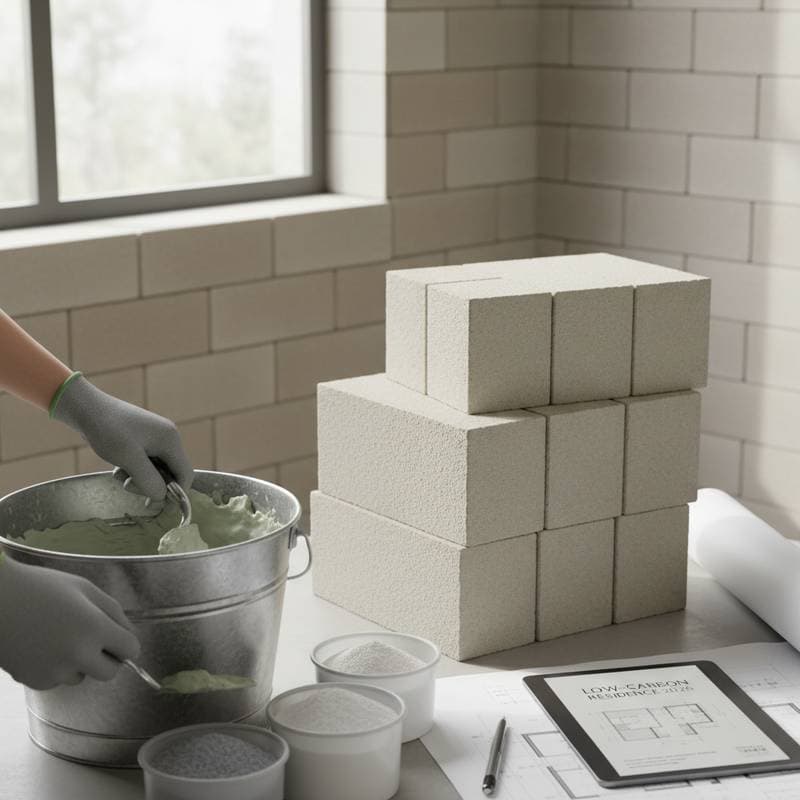
Understanding Geopolymer Bricks
Skill level: Intermediate
Physical demand: Moderate
Helpers: One recommended for transport and alignment
Safety: Wear gloves, goggles, and a respirator when mixing or cutting materials
Geopolymer bricks enable builders to construct robust, eco-friendly walls with minimal reliance on traditional cement. These bricks develop through a chemical reaction between aluminosilicates like fly ash or metakaolin and an alkaline activator such as sodium hydroxide. The outcome yields a binder that matches or surpasses Portland cement in performance.
Interest in geopolymer bricks grows due to their reduced carbon footprint, utilization of industrial byproducts, and enhanced resistance to heat and chemicals. They serve residential, commercial, and landscaping needs where durability aligns with sustainability goals. Grasping their properties helps determine suitability for specific projects and identifies when to involve experts.
Why Geopolymer Chemistry Matters
Conventional cement production involves calcining limestone, a process that emits substantial carbon dioxide. Geopolymer binders bypass this by reorganizing minerals at ambient temperatures to form hardening polymeric chains, eliminating the need for kilns. Builders benefit from equivalent compressive strength at a fraction of the environmental impact.
Best Applications for Geopolymer Bricks
Geopolymer bricks excel in:
- Structural walls for small-scale buildings
- Retaining walls not subject to persistent water
- Garden elements like planters or borders
- Pavement blocks and ornamental features
Avoid using them in subgrade foundations with ongoing groundwater exposure unless paired with appropriate waterproofing.
DIY Versus Professional Installation
DIY suits small retaining walls or garden enclosures when executed with precise planning. For load-bearing elements integrated into frameworks, engage a professional engineer. Precise chemical ratios prove essential; errors compromise integrity. Always secure professional verification for large structural uses.
Planning Your Geopolymer Brick Project
Thorough planning secures proper material proportions, precise measurements, and a solid foundation.
Site Assessment
Evaluate soil composition, drainage patterns, and terrain slope. Clay-heavy soils hold moisture and expand, necessitating a deeper gravel base. Sandy soils drain readily but require thorough compaction to avert settling. Direct slopes away from buildings to prevent water accumulation.
Clear nearby tree roots that might displace bricks over time. Eliminate organic debris and achieve a level surface within one inch variation along the wall length.
Key Measurements
Document wall length, height, and thickness. Standard geopolymer bricks measure approximately 9 inches by 4 inches by 3 inches. Calculate total bricks by multiplying wall area by bricks per square foot, then add 10 percent for cuts and breakage.
Acquire 10 percent additional bricks to account for potential damage during handling.
Environmental Considerations
Curing depends on temperature and humidity for optimal strength. Select moderate conditions and shield from direct rain or frost in initial stages. Use covers or shade to mitigate intense sunlight.
Anticipated Challenges
Expect uneven terrain, subsurface roots, or remnant concrete. Clear these prior to foundation work. On sloped sites, incorporate terracing or stepped sections for stability.
Contact utility locators if regulations mandate, to mark buried lines before excavation.
Selecting Materials
Material choice influences strength, aesthetics, and ease of use. Options differ by source, hue, and processing needs.
Fly Ash-Based Geopolymer Bricks
Description: Derived from industrial fly ash activated with alkalis.
Advantages: Strong compression, smooth surface, cost-effective with local supply.
Disadvantages: Availability varies; sets slower in cooler climates.
Cost: Budget-friendly versus high-end units.
Skill Level: Intermediate; demands accurate mixing.
Maintenance: Low; inspect joints periodically.
Ideal Applications: Exterior walls, pavements, low structures.
Appearance: Even gray akin to cement bricks.
Metakaolin-Based Geopolymer Bricks
Description: Sourced from processed kaolin clay.
Advantages: Uniform quality, pale shade, quick set, high durability.
Disadvantages: Elevated price; curing sensitive to dampness.
Cost: Higher than fly ash variants.
Skill Level: Moderate; best in controlled settings.
Maintenance: Minimal; reseal in wet areas.
Ideal Applications: Facades, accent walls, details.
Appearance: Cream or off-white, pigment-compatible.
Slag-Based Geopolymer Bricks
Description: Features blast furnace slag.
Advantages: Dense build, chemical resilience, fits harsh environments.
Disadvantages: Weighty; challenging to shape; needs equipment for handling.
Cost: Moderate, plus transport fees.
Skill Level: Advanced; precise curing essential.
Maintenance: Negligible.
Ideal Applications: Industrial floors, retaining walls, exposed sites.
Appearance: Dark gray to green with slight gloss.
Essential Tools and Materials
Hand Tools
- Brick trowel: Spreads and finishes mortar joints.
- Masonry hammer: Trims edges and aligns pieces.
- Level: Ensures plumb and even placement.
- Tape measure: Marks layouts and joint spacing.
- Brush and sponge: Removes excess mortar promptly.
Power Tools
- Masonry saw or angle grinder: Employs diamond blade for precise cuts.
- Drill with paddle: Mixes slurries uniformly.
- Vibrator or tamper: Firms up base layers.
Rental Options
- Plate compactor: Compacts extensive bases; hand tamper alternative for modest areas.
- Cement mixer: Handles bulk mortar production; drill mixer suffices for smaller batches.
Materials Checklist (Include 10 Percent Extra)
- Geopolymer bricks
- Matching mortar or binder
- Gravel or crushed stone base
- Leveling sand
- Reinforcement mesh as needed
- Sealer for exposed surfaces
Step-by-Step Construction Guide
Precision in early stages determines overall stability.
1. Foundation Preparation
Dig a trench matching wall width plus 4 inches per side. Extend depth below frost line or 6 inches minimum for non-structural walls. Layer 4 inches compacted gravel, followed by 1 inch sand. Verify level in all directions.
Stable foundations resist settling and fractures.
Checkpoint: Level within 1/8 inch over 4 feet.
2. First Course Placement
Apply thin geopolymer mortar over the base. Position bricks end-to-end with 3/8-inch joints. Gently tap into place using a rubber mallet.
This course establishes alignment for the build.
Verification: Level each brick and the full row.
Stretch a mason's line for straight guidance.
3. Subsequent Courses
Offset joints by half a brick for interlocking strength. Butter ends and beds with mortar; remove surplus immediately. Level every second row.
Bonding supports load distribution and avoids cracks.
Rushed alignment creates compounding irregularities.
4. Reinforcement Integration
For heights over 3 feet or load-bearing, add mesh or rebar at intervals. Secure within mortar layers.
This boosts tension resistance.
Adhere to engineered specifications.
5. Top Course and Joint Finishing
At target height, mortar the top smooth. Profile joints concave to direct water away.
Checkpoint: Uniform joint depth and finish.
6. Curing Process
Drape with moist burlap or plastic for days to retain humidity. Protect from sun and drafts.
Proper curing develops maximum strength.
Inadequate moisture causes cracks and reduced bonds.
7. Sealing Exposed Areas
Post-cure, apply compatible sealer via brush or spray to guard against moisture and stains.
Practical Tips
Schedule curing in temperate weather for cold climates. Incorporate iron oxide pigments for colored binders in decorative work. Wipe joints with a damp sponge pre-set for clean lines. Consult activator guidelines to avoid residue.
Achieving a Polished Finish
Align edges precisely and maintain joint consistency for professional results. Install capstones on landscape walls to manage runoff. Seal edges against weathering.
Incorporate ground covers or solar lights to enhance integration and functionality, accentuating texture.
Ongoing Maintenance
Geopolymer bricks demand little care. Annually check joints for fissures or erosion; reseal in wet or cyclic freeze areas every few years. Clean using mild soap and water; steer clear of acids.
For load-bearing setups, watch for shifts. Address issues promptly with expert input to forestall extensive fixes.
Creative Enhancements
- Seating Areas: Widen top for bench formation.
- Planters: Step out sections to contain planting medium.
- Illumination: Recess low-voltage lights for evening glow.
- Patterns: Mix hues for visual interest.
Preserve balance and levelness in additions.
Pitfalls to Sidestep
- Imprecise activator measures yield fragile results; weigh components exactly.
- Uncovered curing prompts drying cracks.
- Poor base compaction invites leaning.
- Excessive mortar mixing traps air, diminishing hold.
Repair minor cracks by clearing debris and applying matching paste.
Engaging Professionals
Seek engineers or masons for walls taller than four feet, structural supports, or unstable ground. Custom mixes warrant lab-tuned activators under supervision. This guarantees code adherence and safety.
Building for Lasting Impact
Geopolymer bricks merge craftsmanship with eco-conscious innovation. Each layer laid diminishes cement dependency and advances greener practices. Through meticulous preparation, exact execution, and timely expertise, create enduring structures that honor strength, aesthetics, and planetary health.