
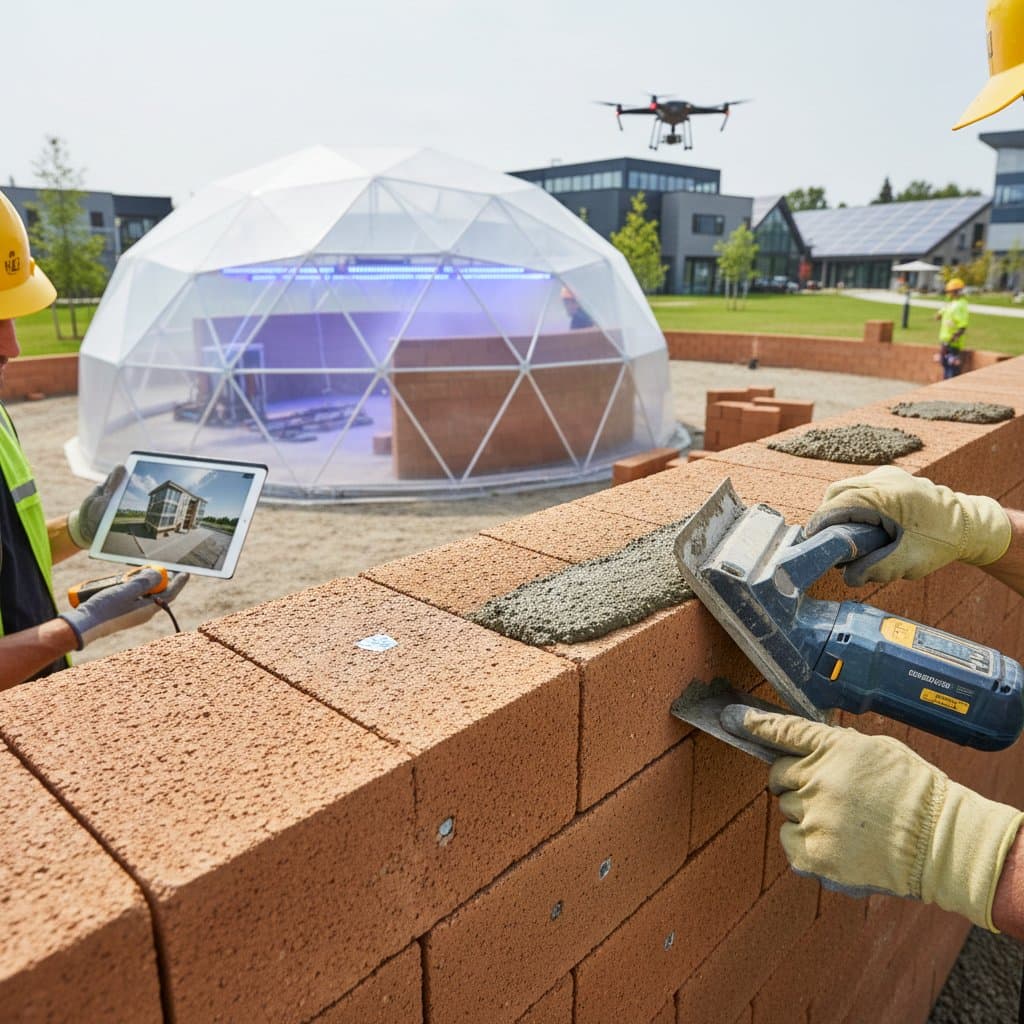
Understanding Geopolymer Bricks for 2025 Construction
Geopolymer bricks represent a shift toward sustainable building materials, formed by activating industrial byproducts like fly ash or slag with alkaline solutions. Unlike traditional cement bricks, they require no high-temperature firing, slashing energy use and carbon emissions by up to 80 percent. Builders favor them for their compressive strength, which often surpasses that of clay or concrete units, while providing excellent resistance to chemicals and fire.
These bricks perform well in diverse climates but demand careful handling during selection and installation. Proper assessment prevents common pitfalls, ensuring structures that endure for decades with minimal upkeep. As adoption grows, mastering field checks becomes essential for cost-effective, green projects.
Identifying Quality Issues in the Field
Before committing to a purchase, conduct hands-on inspections to spot defects early. A powdery surface that rubs off under light finger pressure indicates incomplete curing or weak binder activation, leading to rapid erosion in service. Similarly, cracks forming at corners without external stress signal internal inconsistencies in the mix.
Examine edges after a sample cut; soft or irregular borders suggest uneven material distribution, complicating precise laying and increasing waste. Test for white crystalline deposits, known as efflorescence, which arise from unreacted alkalis and can stain facades over time. Inquire about documentation: reputable suppliers provide certificates for mix ratios, curing temperatures, and absorption rates below 10 percent for optimal performance.
Dimension variations greater than 2 millimeters per brick disrupt alignment, extending labor by hours per square meter. Mortar compatibility tests, if available, confirm joint strength without degradation. Addressing these red flags upfront avoids callbacks and preserves project timelines.
Deciding Between Repair and Replacement
For existing geopolymer walls showing isolated cracks under 1 millimeter wide, inject geopolymer-compatible grout to restore integrity without dismantling. This approach suits stable structures where plumb lines remain within 1/4 inch over 8 feet. Full replacement becomes necessary only if cracks propagate through multiple courses or if softening affects load-bearing capacity, as verified by a structural engineer's tap test for hollow sounds.
Repointing eroded mortar joints requires an alkaline-resistant formulation, applied in thin layers to match original depths of 3/8 inch. Steer clear of Portland cement mixes, which react adversely and accelerate bond failure within two years. Prioritize flashing and weep hole maintenance: replace corroded metal with durable polymer alternatives to prevent water accumulation, a primary cause of efflorescence in geopolymer systems.
When coatings fail, opt for breathable silicate-based paints that allow vapor transmission, applied after gentle pressure washing at 1000 psi. For structural beams or lintels, monitor deflection with a laser level; exceed 1/360 of span length warrants immediate replacement to avert progressive collapse. These targeted repairs extend asset life while controlling costs at 20 to 30 percent of full rebuild expenses.
Prioritizing Project Scope for Optimal Results
Begin with moisture management as the foundation of any geopolymer integration. Verify site grading slopes at least 5 percent away from walls, and install code-compliant gutters with downspouts extending 5 feet from foundations. These steps mitigate water infiltration, which accounts for 60 percent of masonry failures.
Next, stabilize the substrate: use dial indicators to measure settlement, correcting differentials over 1 inch with helical piers before laying bricks. Enhance envelope performance by sealing transitions with self-adhering membranes, reducing air leakage by up to 50 percent. For thermal efficiency, position rigid foam insulation continuously on the exterior, achieving R-values of 15 or higher without risking interior condensation.
Defer aesthetic enhancements until core systems prove reliable. Architectural scoring or color washes add visual appeal but invite maintenance if underlying issues persist. This sequenced approach maximizes return on investment, often recouping upgrades through energy savings within five years.
Key Material Properties and Selection Criteria
Geopolymers derive strength from aluminosilicate reactions, yielding units with 5000 psi compressive ratings after 28-day cures at ambient temperatures around 70 degrees Fahrenheit. Sources like Class F fly ash ensure low calcium content, minimizing expansion risks. Select bricks with absorption rates under 8 percent to withstand freeze-thaw cycles in regions with 50 or more annual events.
Thermal mass benefits steady indoor climates, absorbing daytime heat and releasing it nocturnally for natural regulation. Pair with 2-inch cavity insulation to boost overall U-factors below 0.05 BTU per hour-square foot-degree Fahrenheit. Joint mortars must match pH levels above 12 to prevent delamination; test samples cure for seven days to confirm adhesion.
Sourcing reliability hinges on verified supply chains; prefer manufacturers with ISO 9001 certification for batch consistency. On-site mixing demands precise scales for 1:2:4 ratios of activator to precursors, monitored via digital thermometers to stay within 68 to 86 degrees Fahrenheit.
Evaluating Long-Term Performance and Risks
Field data from installations since 2020 highlight geopolymers' fire ratings exceeding 4 hours under ASTM E119 standards, ideal for urban high-rises. Shrinkage remains below 0.1 percent, far less than concrete's 0.5 percent, reducing random cracking. However, batch variability poses risks; demand third-party lab reports for every shipment to confirm uniformity.
Ultraviolet exposure may dull surfaces if activators migrate; mitigate with UV-stable sealers applied post-cure. Embodied carbon savings of 1 ton per cubic meter offset premiums of 15 percent over clay bricks, with faster laying rates of 500 bricks per day per mason narrowing the gap. Lifecycle analyses project 75-year service lives, versus 50 for traditional masonry, when drainage excels.
Safeguarding and Extending Geopolymer Longevity
Document every aspect from supplier specs to installation logs, facilitating insurance claims or value assessments at resale. Schedule biannual inspections using a 4-foot level to detect deviations and a pin moisture meter targeting under 15 percent content in walls. Clear debris from weep holes quarterly, ensuring 3/8-inch openings remain unobstructed.
Surface care involves low-pressure rinsing with pH-neutral solutions, followed by air drying to prevent residue buildup. For modifications, drill at 500 rpm with diamond cores, sealing with elastomeric caulk rated for alkaline substrates. These practices minimize interventions, preserving the material's inherent resilience.
Integrating geopolymer bricks positions projects as leaders in sustainable design, delivering enduring performance with reduced environmental impact. Focus on foundational preparations to unlock their full potential, ensuring builds that stand strong through 2025 and beyond.