
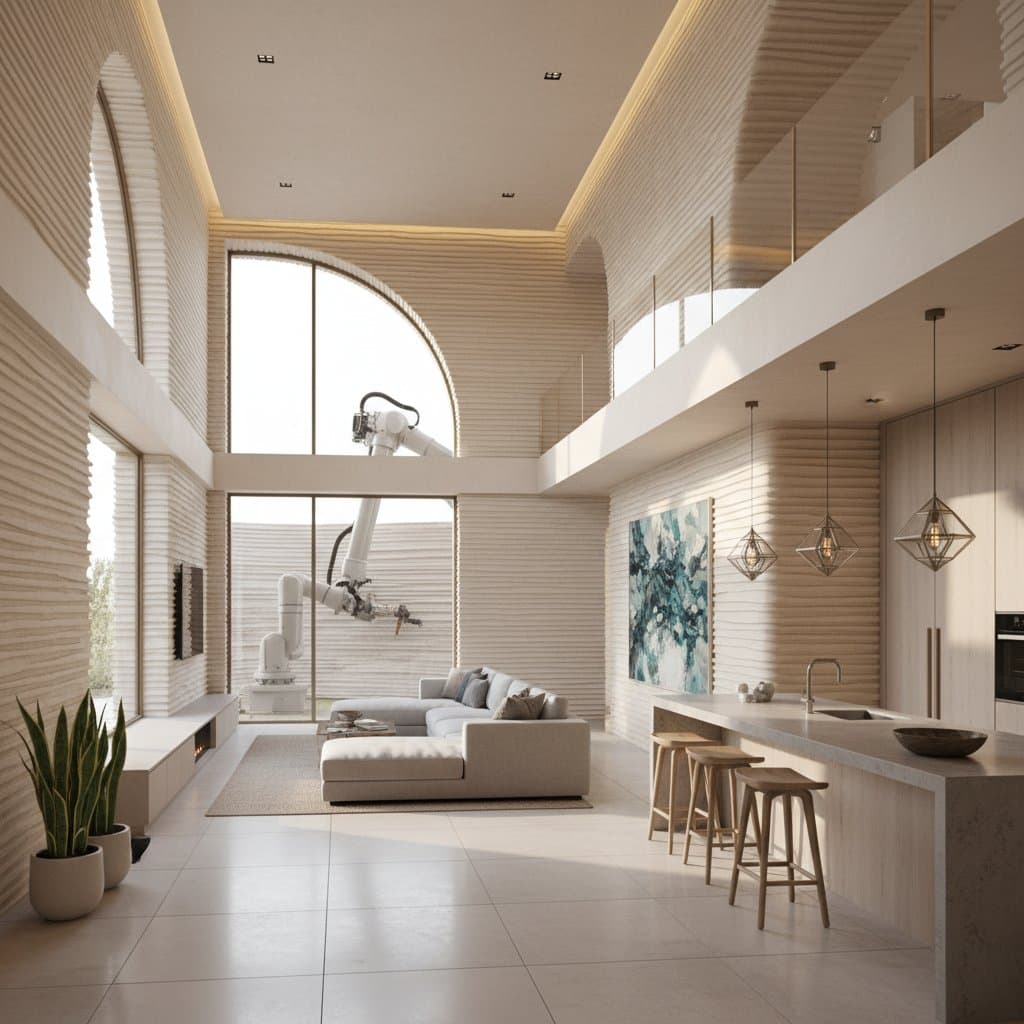
3D-Printed Homes Cut Build Time 70%
3D-printed homes employ large-scale robotic printers that deposit layers of concrete or comparable materials to construct complete wall systems. These printers adhere to digital blueprints, erecting walls directly on the construction site while bypassing conventional framing, sheathing, and extensive manual work. This method yields a streamlined process that completes a modest home in significantly less time than traditional approaches.
Pros and Cons
Pros
- Speed: Printing operations shorten overall construction timelines by approximately 70 percent relative to conventional masonry or wood framing techniques.
- Precision: Structures emerge directly from computer-aided designs, ensuring walls meet exact dimensions with uniform consistency.
- Waste reduction: Precise material deposition minimizes excess, often reducing waste by over 50 percent in various initiatives.
- Durability: The concrete formulation withstands fire, insects, and decay effectively.
- Design freedom: Intricate curves or bespoke wall configurations print effortlessly, eliminating additional workforce demands.
Cons
- Limited finishes: Exposed printed surfaces frequently require grinding, plastering, or exterior coverings to match standard residential aesthetics.
- Permitting gaps: Numerous building codes have yet to establish definitive guidelines for 3D-printed edifices.
- Material sourcing: Custom concrete formulations may incur higher expenses or necessitate suppliers with specialized expertise.
- Upfront cost of equipment: Printers represent a substantial investment, typically managed by dedicated service firms rather than individual contractors.
- Skill learning curve: Teams need proficiency in robotic operations, mixture formulation, and interlayer adhesion.
Costs
Printed concrete wall assemblies generally range from $20 to $35 per square foot for the core structure. Including roofing, fenestration, and interior elements, comprehensive home costs typically span $130 to $180 per square foot.
Factors that elevate expenses include:
- Elaborate geometries or multi-level configurations.
- Distant locations demanding equipment relocation.
- Custom surfacing or embedded insulation during printing.
Elements that lower costs encompass:
- Standardized, repeatable layouts ideal for modular developments.
- On-site material preparation with minimal haulage.
- Collaborations with printers who maintain their own machinery.
Lifespan and Maintenance
Concrete walls from 3D printing endure for 50 years or longer under routine care. Conduct yearly inspections for fissures, seam deterioration, or water penetration near apertures. Employ gentle soap solutions and moderate water pressure for cleaning. Apply fresh sealants every 5 to 10 years on coated or painted exteriors as required.
Specs to Check
Evaluate printed wall systems by verifying:
- Compressive strength: At least 3,000 psi for load-bearing elements.
- Bond strength between layers: Substantiated via laboratory testing documentation.
- Thermal performance: Insulation ratings vary with thickness and infill materials.
- Water resistance: Incorporation of additives or coatings suitable for exterior conditions.
- Dimensional accuracy: Deviations not exceeding 1/8 inch over full wall elevations.
Planning and Prep
Prior to printing, ensure the site features even grading and firm compaction. Establish drainage gradients of at least 1 inch per 10 feet directing away from the base. Identify utility lines before excavation or earthmoving. Provide unobstructed pathways and space for the printer's arm or overhead framework.
In regions prone to freezing, extend foundations below the frost line. For humid environments, integrate boundary drains and vapor barriers under the concrete pad.
Installation Overview
- Design and modeling: Develop the residence blueprint using three-dimensional modeling programs.
- Site setup: Pour the foundation and route essential services.
- Printer calibration: Align and stabilize the machinery on location.
- Mix preparation: Blend proprietary concrete for optimal viscosity and flow.
- Printing: Extrude successive layers to raise walls from the foundation upward.
- Openings and embeds: Integrate frames for windows, electrical pathways, and pipe conduits mid-process.
- Curing: Allow walls to set for multiple days prior to upper-level construction.
- Finishing: Options range from exposed textures to smoothed, plastered, or coated surfaces.
Patterns and Options
3D-printed residences adapt to diverse architectural styles:
- Single-story cottages: Straightforward in execution and completion.
- Modular units: Fabricated in sections for subsequent assembly.
- Hybrid builds: Combine printed bases with conventional upper frameworks.
- Curved or rounded designs: Achievable without supplementary molds.
Select configurations aligned with financial constraints, regulatory approvals, and stylistic preferences.
DIY vs Pro
Constructing via 3D printing demands professional involvement due to the complexity of machinery, formulations, and software. Owners may undertake subsequent tasks like painting or trim installation once the shell completes.
Engage specialists for:
- Comprehensive structural extrusion.
- Structural analysis and regulatory adherence.
- Site groundwork and machinery deployment.
- Integration of wiring and piping systems.
Common Failures and Fixes
Layer separation: Arises from variable mixtures or extrusion rates; remedy involves grout injection or joint sealing.
Surface cracking: Stems from accelerated evaporation or formulation errors; address small fissures with elastic caulk.
Uneven curing: Results in tonal discrepancies or vulnerabilities; mitigate by shrouding structures and sustaining hydration.
Poor window alignment: Trace to modeling inaccuracies; correct post-cure with shims or frame adjustments.
Regional and Climate Notes
Freeze-thaw zones benefit from air-entrained concretes for enhanced durability. Arid climates call for hydration aids during setting. Seaside areas require anti-corrosive embeds for any metal inclusions. High-velocity wind regions demand verification of ties and resistance to uplift per jurisdiction standards.
Alternatives
When 3D-printed concrete proves unfeasible, explore:
- Insulated concrete forms (ICFs): Polystyrene blocks poured with concrete, providing superior thermal barriers yet extended timelines.
- Modular panel systems: Prefabricated assemblies for rapid erection.
- Structural insulated panels (SIPs): Foam-core units that prioritize efficiency over concrete's robustness.
- Traditional masonry: Widely accepted but demanding more time and personnel.
These choices balance automation benefits against familiarity and accessibility.
Making It Happen
Homeowners should seek contractors boasting verified portfolios and familiarity with regional ordinances. Request material certifications, assurance details, and site visits to prior installations.
Executed properly, 3D-printed homes furnish resilient, resource-efficient dwellings swiftly, with scant refuse and expansive creative latitude. This technology exemplifies automation's profound influence on residential construction fundamentals.