
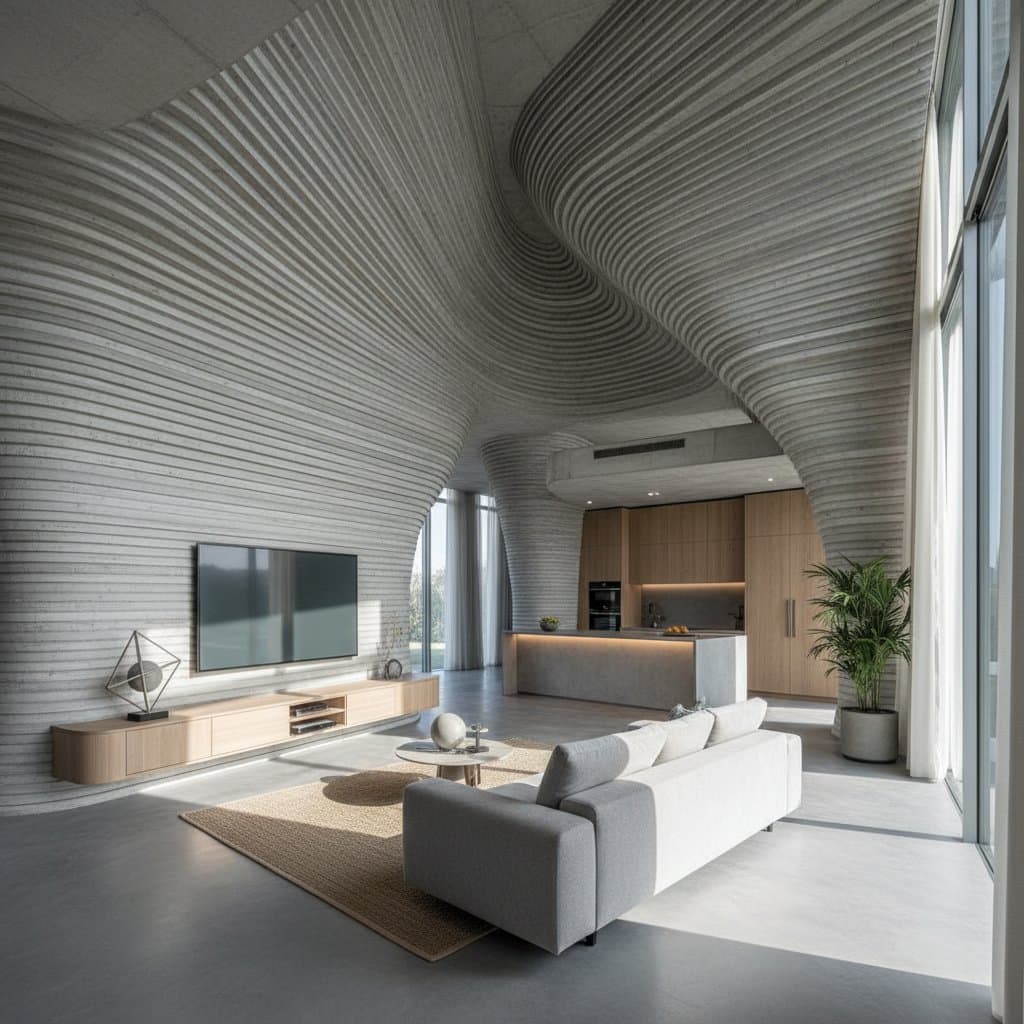
3D-Printed Concrete Homes: 2026's Fastest Build Method
The construction industry continues to advance through automated methods that reduce timelines and material waste. 3D-printed concrete homes rely on large-scale printers that deposit specialized mixes layer by layer to create walls and structural elements. This approach delivers completed single-story homes in days rather than weeks while meeting standard residential strength requirements.
Key takeaways
- Average total cost falls between $120 and $180 per square foot, with materials representing 35 percent, labor 25 percent, and equipment plus automation 40 percent.
- Print time for a complete single-story home ranges from 24 to 72 hours.
- Printed mixes reach compressive strengths of 4,000 to 6,000 PSI, satisfying or surpassing conventional residential benchmarks.
- Wall designs accommodate curves, integrated conduits, and thicknesses from 4 to 12 inches.
- Permits require verification of load capacity, insulation performance, and fire resistance.
Planning requirements before building
Successful projects begin with attention to zoning rules, material specifications, and equipment logistics. Early coordination prevents schedule disruptions and ensures code compliance.
Permits and codes
Authorities review 3D-printed structures under existing concrete construction standards. Submit engineering reports that document compressive strength, wall dimensions, and reinforcement details. In regions with cold winters, confirm that exterior walls achieve R-20 to R-30 insulation values.
Site and foundation preparation
Prepare a level, compacted surface free of obstructions. Most projects use a slab-on-grade concrete foundation held to a tolerance of plus or minus 0.25 inch so the printer maintains accurate layer placement.
Material selection
Printable concrete requires rapid setting and stable buildability. A standard mix contains Portland cement as the primary binder, fine aggregates for flow control, plasticizers and accelerators for workability, polypropylene or steel fibers for tensile performance, and a water-to-cement ratio between 0.35 and 0.45.
Step-by-step process of printing a concrete home
1. Design and modeling
Create a digital model that accounts for openings, utility paths, and structural loads. Limit single-session wall height to 10 feet to match printer capabilities.
2. Printer calibration
Level the gantry or rail system and set nozzle height and flow rate. Deviations larger than 0.1 inch produce uneven layers or weak bonds.
3. Layer printing
Print perimeter walls first, then interior walls. Each layer measures 0.75 to 1 inch high. Allow a 5- to 10-minute interval between layers for initial curing.
4. Integration of reinforcement
Place rods or mesh at 12- to 24-inch intervals according to structural calculations. Many systems pause automatically for insertion.
5. Openings and embeds
Form door, window, and utility openings during printing or cut them afterward. Embed conduits and sleeves for plumbing and electrical lines as layers rise.
6. Roof installation
Current printers focus on walls. Attach conventional truss or panel roofs to printed bond beams or anchor plates placed in the top courses.
7. Finishing and curing
Apply a curing compound or damp cover for seven days. Finish exterior surfaces with stucco or paint and interior surfaces with texture or drywall-ready smoothing.
Troubleshooting common challenges
- Uneven layers usually result from inconsistent extrusion or incorrect nozzle height. Recalibrate the system and clean the nozzle.
- Cold joints form when pauses exceed recommended intervals. Maintain continuous material supply and treat weak areas with bonding agents.
- Cracking often follows rapid moisture loss. Apply misting or curing blankets promptly.
- Hose clogs arise from poorly filtered aggregates or incorrect water content. Screen materials and monitor mix proportions.
- Misalignment occurs when rails shift or the foundation deviates from level. Verify both before resuming work.
DIY versus professional construction
Small-format printers now allow limited owner participation, yet most full-scale homes require trained operators.
When DIY is viable
Owners with concrete experience can print accessory buildings or tiny homes. Savings on labor may reach 20 to 30 percent, though weekly equipment rental costs range from $3,000 to $5,000 plus training fees.
When to hire professionals
Select contractors who hold general contracting and code certifications, supply structural engineering packages, provide warranties on printed elements, and carry complete equipment and liability insurance.
Next steps for project execution
Preparation of site conditions, material batches, and permit packages positions a project for efficient printing. Partner with experienced operators to achieve consistent layer quality and long-term durability. This method reduces labor demands and material waste while producing homes that satisfy contemporary performance standards.