
Geopolymer Bricks Deliver Extended Lifespan and Environmental Benefits
Geopolymer bricks provide a durable alternative to traditional clay bricks through chemical bonding rather than high temperature firing. These materials achieve compressive strengths often exceeding 40 megapascals while resisting degradation from fire, salts, and acids. Builders select them for projects that require reduced maintenance over decades.
Core Composition and Production Process
Geopolymer bricks form when aluminosilicate materials such as fly ash or slag react with alkaline activators. The reaction creates a three dimensional network that binds aggregates without kiln firing. This process operates at ambient temperatures and cuts energy consumption compared with clay brick manufacturing.
Raw material selection influences final performance. Consistent particle size distribution and proper activator ratios produce uniform blocks suitable for load bearing walls. Quality control during mixing prevents weak zones that could shorten service life.
Performance Advantages Over Clay Bricks
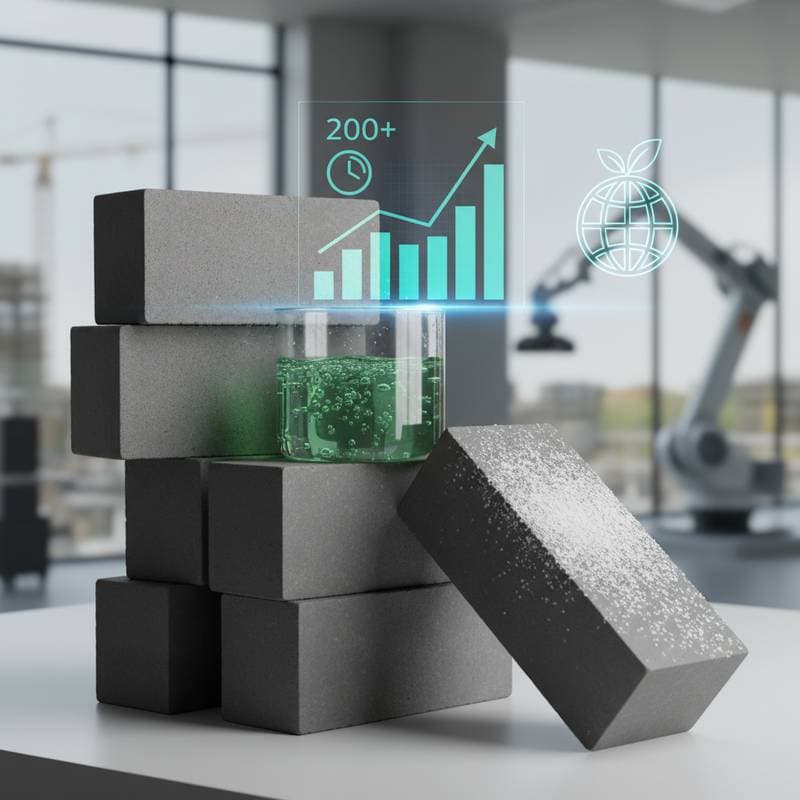
Independent testing shows geopolymer bricks maintain structural integrity for periods exceeding 200 years beyond typical clay brick lifespans under similar exposure conditions. Their low porosity limits moisture ingress and subsequent freeze thaw damage. Salt crystallization that commonly erodes clay masonry causes minimal surface loss on geopolymer surfaces.
Fire resistance ratings reach four hours without spalling. Acid exposure tests confirm mass loss below 2 percent after 90 days in solutions that rapidly deteriorate Portland cement products. These characteristics reduce replacement frequency in industrial and coastal settings.
Practical Applications in Construction
Residential projects use geopolymer bricks for garden walls, retaining structures, and facade cladding. Their consistent color and texture support clean architectural lines without additional coatings. Commercial buildings incorporate them in shear walls where high compressive strength and ductility improve seismic performance.
Infrastructure applications include bridge abutments and tunnel linings. The material tolerates aggressive groundwater chemistry that would require protective membranes on conventional masonry. Precast geopolymer elements speed on site assembly while maintaining dimensional tolerances within 2 millimeters.
Installation Guidelines for Reliable Results
Prepare a level, compacted base with proper drainage to prevent differential settlement. Lay bricks in a running bond pattern using thin bed mortar formulated for geopolymer chemistry. Maintain joint widths between 2 and 4 millimeters to accommodate minor movement.
Cure freshly laid sections under moist conditions for at least 48 hours. Protect work from direct rainfall during initial setting to avoid surface leaching. Reinforcement with galvanized ladder ties at every fourth course increases lateral stability in taller walls.
Inspect completed masonry for alignment and joint fill before applying any surface treatments. Breathable sealers can further reduce staining in high traffic areas without trapping internal moisture.
Material Selection and Project Planning
Specify geopolymer bricks according to required compressive strength, absorption limits, and exposure class. Request batch test reports that document activator concentration and curing regime. Coordinate delivery schedules to match construction pace and minimize on site storage time.
Budget for skilled labor familiar with alkali activated systems. Early coordination with suppliers ensures consistent supply of matching units for future repairs. Document material sources and mix designs for long term asset management records.
Long Term Value in Sustainable Building
Reduced firing energy lowers embodied carbon by 60 to 80 percent relative to clay brick production. Local sourcing of industrial byproducts further decreases transport emissions. Structures built with these bricks require fewer interventions over their service life, supporting lower whole life costs.
Owners achieve certification credits under green building programs through documented material performance and waste reduction. The extended durability aligns with goals for resilient infrastructure that withstands changing climate conditions.