
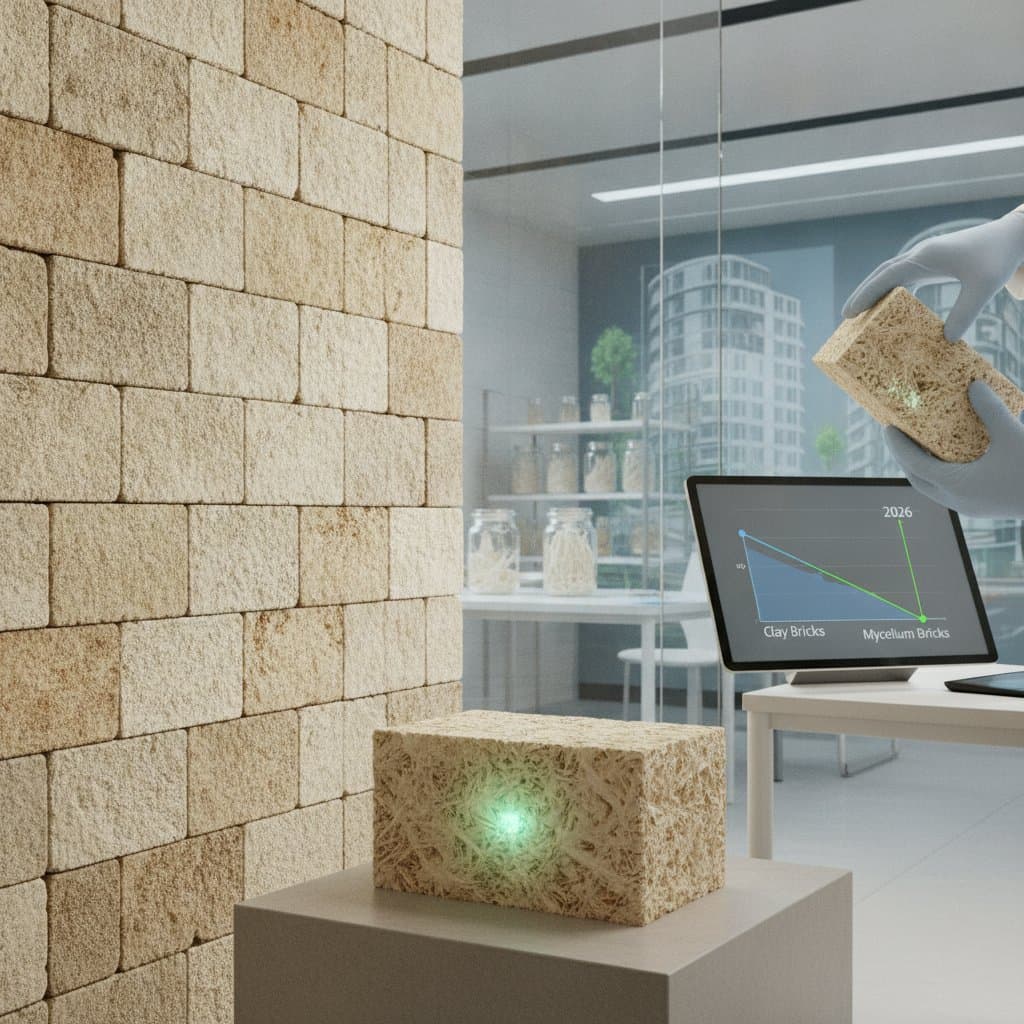
Mycelium Bricks Set to Replace Clay Masonry by 2026
The construction industry is entering a new era of sustainable innovation. Mycelium bricks offer a living, fungal-based material that reshapes how builders approach strength, sustainability, and regeneration. These bricks provide a renewable and biodegradable alternative to traditional clay masonry while reducing environmental strain. This guide explains how mycelium bricks work, what it takes to use them, and what builders and homeowners can expect as the technology matures.
Key takeaways
- Cost range: Mycelium bricks currently cost between $3 and $6 per unit, about 30 to 50 percent lower than fired clay bricks once scaled to full production. Labor represents approximately 40 percent of total cost, materials 45 percent, and equipment 15 percent.
- Production time: Each brick requires 5 to 10 days of controlled growth, depending on strain and humidity conditions.
- Strength and density: Properly cured mycelium bricks achieve compressive strengths between 300 and 900 PSI, suitable for non-load-bearing walls and insulation layers.
- Moisture tolerance: They maintain integrity at relative humidity levels of 40 to 60 percent, requiring surface sealing for external exposure.
- Environmental benefit: Manufacturing emissions are 80 to 90 percent lower than those of fired clay masonry according to industry trials.
Planning requirements before construction
Before using mycelium bricks in structural or architectural applications, several planning steps are critical. Confirm acceptance with local building departments, as some jurisdictions categorize mycelium bricks as bio-composite materials that require fire resistance testing to ASTM E84 or equivalent standards. Choose reliable suppliers who provide sterilized growth substrates and verified spore cultures to prevent contamination. Plan for protective coatings such as lime render, clay plaster, or bio-based sealants to prevent fungal reactivation. Account for controlled growth chambers or partnerships with fabrication labs if producing bricks on-site.
A 1,000-square-foot structure built primarily with mycelium masonry panels typically costs $8,000 to $12,000 in materials, excluding finishing. Costs decrease sharply as production scales and automated growth systems improve.
Step-by-step execution process
1. Mold preparation
Clean and sanitize all molds with alcohol or hydrogen peroxide. Apply a thin layer of biodegradable release oil to ensure smooth demolding.
2. Inoculation and packing
Combine the sterilized substrate with mycelium spawn in a clean environment. Pack the mixture firmly into molds, compressing lightly to remove air pockets.
3. Incubation
Store the molds in a dark, warm space for 5 to 10 days. Mycelium will grow through the substrate, binding it into a dense, sponge-like mass. Avoid disturbing the molds during this stage.
4. Demolding and drying
Once fully colonized, remove the bricks and allow them to air-dry under moderate airflow. Then heat-cure them at 180 to 200 degrees Fahrenheit for 2 to 3 hours to halt biological activity and enhance stability.
5. Finishing
Apply protective coatings or compress the bricks slightly under hydraulic pressure to improve surface hardness. For exterior use, add a weather-resistant sealant.
Troubleshooting common challenges
Uneven growth is caused by inconsistent humidity or contamination. Clean molds thoroughly and maintain steady environmental conditions. Weak structure often results from insufficient incubation or nutrient imbalance. Extend growth time or adjust substrate ratios. Identify unwanted mold by color variation and discard affected batches immediately. Prevent warping by drying slowly at consistent temperatures, as rapid drying leads to shrinkage cracks.
Comparing DIY and professional approaches
DIY production suits small projects and educational experiments when proper sterilization equipment is available. Professional fabrication delivers consistent quality for larger builds through controlled environments and standardized testing. Home builders should evaluate their access to growth chambers and technical expertise before choosing either path.
Scaling Production for Widespread Adoption
Mycelium bricks represent more than an alternative to clay masonry. They reflect a shift toward materials that regenerate rather than deplete. As production techniques mature and regulations adapt, builders will gain access to safe, lightweight, and low-carbon materials that literally grow from waste.