
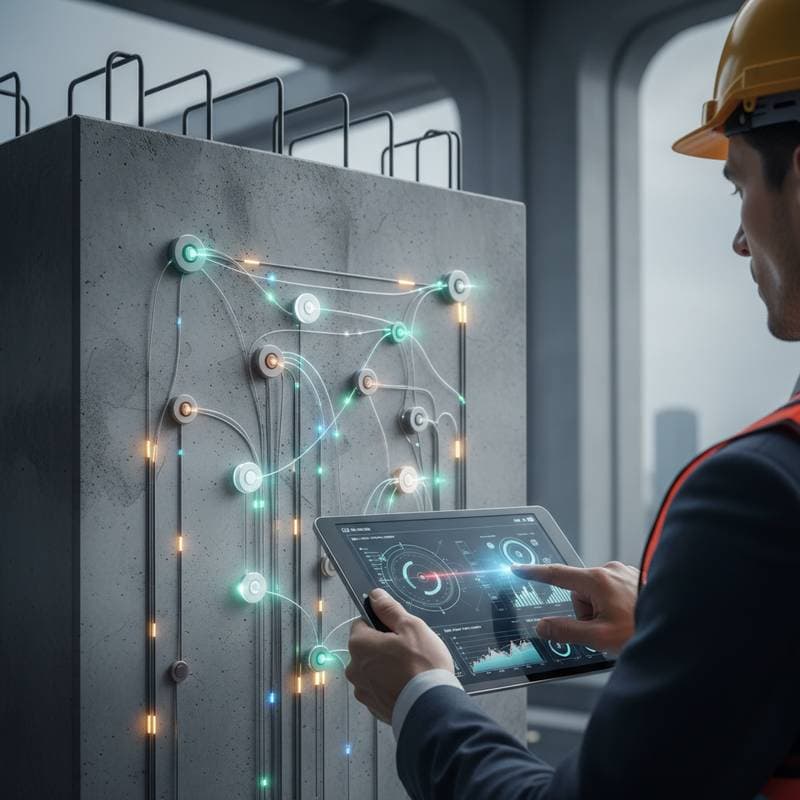
Smart Concrete: Enhancing Structural Integrity with IoT Sensors
Essential Overview
Concrete forms the foundation of critical infrastructure such as bridges, tunnels, and high-rise buildings. Its reliability underpins safety and operational continuity. Failures in concrete lead to substantial financial losses, risks to public safety, and damage to organizational credibility. Smart concrete addresses these challenges through embedded IoT sensors that continuously monitor key factors like moisture, stress, and temperature. This technology allows property owners to identify internal issues proactively, preventing widespread deterioration. Initial implementation involves expenses for sensor installation, data management platforms, and ongoing system upkeep.
Conducting Field Inspections
Traditional on-site evaluations remain essential, even with advanced sensor technology. Professionals should methodically inspect structures to identify visible indicators of distress or water intrusion prior to analyzing sensor outputs.
- Examine floor joints and wall interfaces for cracks that exhibit widening or irregular patterns.
- Inspect roof surfaces for areas of standing water or areas that yield under pressure.
- Gently tap accessible concrete surfaces with a hammer; a dull, echoing tone may indicate separation from underlying layers.
- Identify any discoloration from rust, which often signals corrosion in embedded steel reinforcement.
- In multi-level parking facilities or below-grade areas, observe for powdery efflorescence or persistent moisture along construction seams.
- Document internal humidity and temperature variations if sensor access is available; consistent increases typically suggest accumulating water within the material.
These procedures validate sensor data against observable conditions. Alignment between physical observations and digital metrics ensures accurate assessments.
Identifying Critical Indicators
Certain patterns signal significant or progressive degradation that requires immediate attention.
- Persistent moisture levels exceeding established safety limits.
- Unexpected internal temperature increases without corresponding external influences.
- Multiple sensors ceasing transmission in proximity, potentially due to corrosion or wiring compromise.
- Observable fissures correlating with elevated strain measurements.
- Increasing concentrations of chlorides in regions adjacent to steel elements.
- Abrupt shifts in stress readings following intense precipitation events.
Each alert necessitates cross-verification with visual surveys and historical loading records. Overlooking these signals may escalate minor interventions into comprehensive structural overhauls.
Recommended Interventions and Estimated Expenses
Sensor-detected deterioration guides the selection of appropriate remedies based on the extent and origin of the issue.
- Surface treatments including sealants and fillers typically cost a few dollars per square foot. These measures block further water penetration but fail to restore diminished structural capacity.
- Epoxy-based crack filling incurs higher costs, frequently several hundred dollars per linear foot, and applies only to intact frameworks.
- Cathodic protection systems to mitigate reinforcement corrosion may total tens of thousands of dollars for extensive surfaces.
- Sectional removal and reconstruction represents the highest expense, often surpassing rates for complete new builds when factoring in demolition, temporary supports, and curing periods.
Early detection via smart sensors minimizes overall expenditures by enabling targeted actions. However, superficial solutions that overlook underlying problems prove inefficient. For instance, applying sealants over undrained water pockets conceals progression and postpones effective resolution.
Evaluating Repair Against Replacement
Data from smart concrete empowers decision-makers to base choices on evidence rather than assumptions.
- For floor slabs and elevated platforms, opt for repair when core metrics indicate stable stress and moisture profiles. Proceed to replacement if sensors detect internal fracturing spanning over half of the observed zones.
- For foundational elements, address drainage deficiencies first. Replacement follows only after confirmation of compromised soil support or base stability.
- For load-bearing members like beams and columns, consider epoxy strengthening or composite wrapping if deformation data remains within acceptable bounds. Full substitution becomes unavoidable when loading behavior alters irreversibly.
Repairs maintain existing resources and minimize environmental impact. Replacements initiate a fresh durability cycle yet introduce operational interruptions. The optimal strategy emerges from consensus between sensor insights and inspection findings.
Assembling the Response Team
Sensor data requires expert interpretation and execution to yield results.
- A structural engineer analyzes metrics, validates implications, and develops tailored solutions.
- A concrete repair specialist executes on-site work using materials compatible with the original composition.
- A data specialist or system technician oversees sensor reliability and highlights deviations.
- A property overseer or client representative monitors outcomes, budgets, and long-term efficacy.
Engage the engineer at the outset to establish reference benchmarks. Solicit contractor estimates grounded in practical scenarios prior to finalizing plans. For intricate projects, dedicated oversight increases costs by 10 to 20 percent but averts errors, delays, and additional work. Select team members with proven expertise in sensor-enhanced concrete applications beyond conventional practices.
Prioritizing Project Elements
Approach enhancements systematically, focusing on high-impact areas that deliver measurable risk mitigation and value.
- Initiate with precise sensor tuning and protective enclosures against environmental exposure.
- Address water management through improved drainage and sealant applications at joints.
- Enhance data processing tools once the hardware foundation proves reliable.
- Postpone aesthetic improvements like surface treatments until stability persists across multiple monitoring cycles.
Steer clear of non-essential modifications, such as visual overlays, until moisture regulation is achieved. Retain viable original components verified as sound through ongoing sensor evaluation.
Allocating Resources and Phasing Work
Effective sequencing optimizes outcomes in smart concrete projects.
- Halt water infiltration and adjust site grading to redirect flow away from the structure.
- Test and adjust sensor accuracy to ensure dependable performance.
- Reinforce stability via fracture sealing or temporary load adjustments.
- Refine monitoring infrastructure for sustained observation.
- Implement final barriers such as coatings after core issues resolve.
Inverting this order invites complications like entrapped humidity or obscured stress indicators. Investments in foundational steps like hydrology and instrumentation yield substantial long-term savings.
Sustaining Long-Term Performance
Smart concrete represents an ongoing commitment rather than a singular upgrade. Sensors demand regular functionality checks, and data integrity requires vigilant oversight. Conduct monthly reviews of outputs, integrating them with routine visual assessments. Archive records meticulously to support compliance, insurance claims, and future planning. Upon detecting anomalies, perform targeted inspections to distinguish genuine threats from transient variations. Prompt responses to validated issues preserve investments, while overlooked cues invite irreversible decline.
This integrated approach augments professional expertise without supplanting it. Optimal outcomes arise from collaborative vigilance: combining precise measurements, observant fieldwork, and strategic foresight to safeguard structures proactively.