
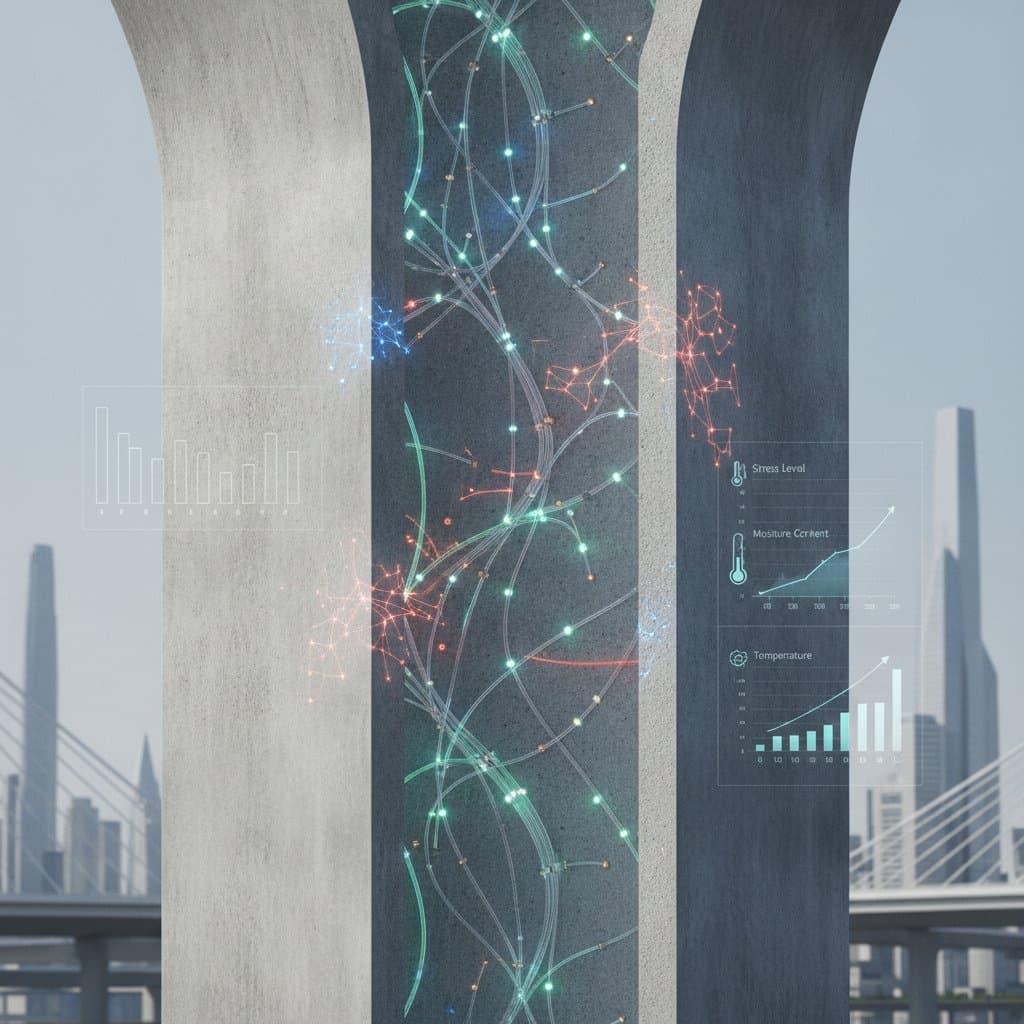
Smart Concrete Monitors Structural Stress in Real Time
Quick Take
Concrete supports nearly every modern building, bridge, and road. Failures develop gradually, yet early warning signs often remain hidden until cracks widen or surfaces spall. Smart concrete addresses this gap by embedding sensors that track stress, moisture, and temperature within the material itself. These sensors deliver continuous data that supports proactive maintenance and limits repair costs.
Warning Indicators
Several conditions signal elevated risk even before sensors are installed. Repeated cracking near heavy point loads often indicates concentrated strain. Uneven settlement at column bases or slab edges suggests foundation movement. Moisture intrusion through control joints accelerates deterioration. Corrosion stains on exposed reinforcement point to ongoing rebar damage. Temperature cycling in uninsulated spans creates micro-fractures over time. Erratic or missing sensor readings reveal system faults that require immediate attention.
Repair Decisions
Sensor data supports evidence-based choices between repair and replacement. Concrete surfaces warrant repair when cracks remain stable, narrow, and dry. Replacement becomes necessary only when sensors confirm active strain or unsealable moisture paths. Reinforcement can be preserved if corrosion stays at the surface. Rebar replacement is required when sensors detect deep oxidation or significant section loss. Sensor nodes should be recalibrated or replaced when readings drift or power fails. Overlays and sealants must follow verification of structural integrity and dryness.
Priority Actions
High-value tasks focus on conditions that affect both monitoring accuracy and long-term durability. Install foundation drainage and waterproofing before any pour, since sensors cannot correct wet conditions. Stabilize the structure prior to embedding electronics to prevent wire damage or fiber misalignment. Sequence pours with clearly mapped sensor zones. Record baseline data during curing for meaningful future comparisons. Plan maintenance access for gateways and power supplies to avoid dead systems.
Project Sequence
Every smart concrete installation follows a dependency-based order that reduces errors.
- Confirm site drainage and subgrade moisture before placement.
- Prepare stable formwork to maintain sensor calibration.
- Embed sensors and conduit, then test signals prior to the pour.
- Place and cure concrete while tracking temperature and humidity.
- Store baseline stress readings securely.
- Connect the system to the monitoring platform and set alert thresholds.
- Schedule maintenance according to sensor trends.
This sequence prevents false readings caused by environmental factors rather than structural strain.
Practical Experience
Site engineers report measurable benefits from properly interpreted data. One structural engineer noted that sensors revealed thermal gradients causing slab warping within weeks. A materials specialist explained that sensor confirmation of superficial cracks avoided an unnecessary full replacement. These outcomes require ongoing field calibration. Periodic manual checks with strain gauges or crack meters maintain data accuracy as loads and curing effects alter readings.
Ongoing System Care
Smart concrete functions as a living network that requires regular attention. Inspect wiring and nodes annually for moisture or rodent damage. Recalibrate thresholds as loads evolve. Maintain redundant data storage with both cloud and local copies. Analyze trends rather than isolated spikes. Connect alerts directly to maintenance management systems for rapid response. Budgets must cover software updates and periodic data audits.
Cost and Return Considerations
The primary adoption risks involve integration effort and overreliance on technology. Hardware installation is straightforward, yet data interpretation demands expertise. Owners should recognize that sensors highlight conditions rather than guarantee safety. Costs range from several thousand dollars for basic parking deck monitoring to hundreds of thousands for comprehensive high-rise strain mapping. Payback occurs when early detection prevents major rehabilitation. Insurance carriers increasingly offer premium reductions for verified continuous monitoring when records remain consistent and accessible.
Repair Process Integration
Live sensor data reduces destructive testing during repairs. Technicians locate stress zones before opening surfaces. After patch work, sensors confirm whether stress has redistributed. During epoxy injection on bridge decks, dropping strain readings indicate successful bonding. Persistent high readings signal deeper cracks. Each structure requires its own baseline established immediately after curing rather than reliance on factory defaults.
Material and Sensor Coordination
Concrete chemistry influences sensor performance. High alkali content or certain admixtures can disrupt embedded wire conductivity. Laboratory testing of the proposed mix with selected sensors identifies necessary adjustments. Fiber optic sensors demand alignment within manufacturer bend limits. Conductive aggregate systems require uniform dispersion to eliminate dead zones. Thermal sensors need documented depth and location on as-built drawings to avoid ambient air or delayed readings.
Data Governance
Owners must retain full access and control over all collected information. Contracts with third-party hosts should specify retention periods, export formats, and liability for loss. Proprietary data formats should be avoided. Construction site networks require encryption and regular firmware updates to prevent breaches that could expose structural or occupancy details.
Execution Steps
Successful implementation begins with drainage verification and structural stabilization. Sensor placement follows only after formwork stability is confirmed. Baseline collection during curing establishes the reference point for all future analysis. Continuous trend review and scheduled maintenance convert raw data into extended service life and reduced repair frequency.