
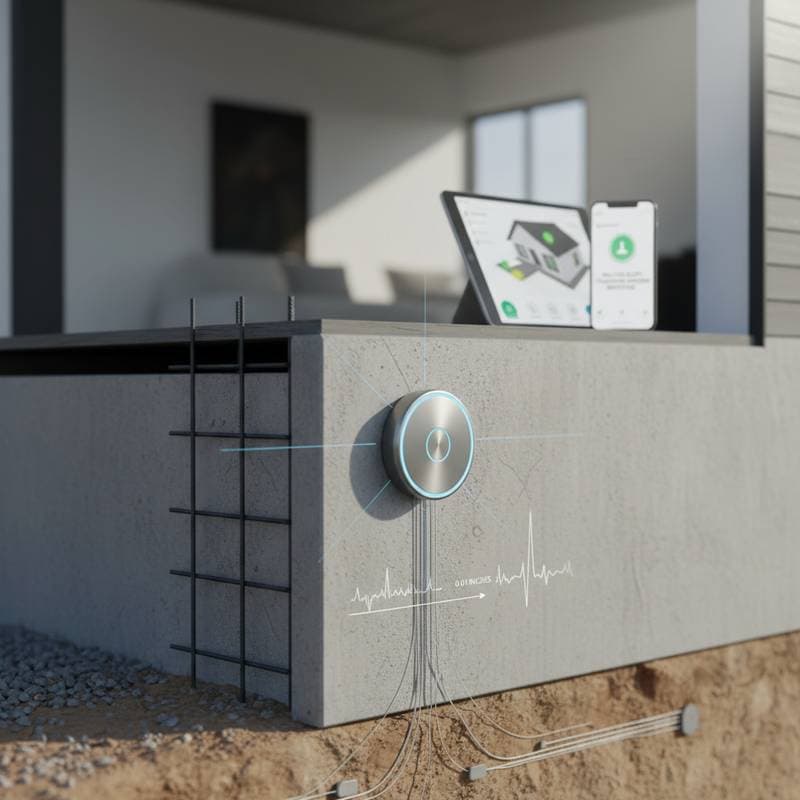
Save Your Foundation: Smart Sensors Predict Settling
Your home's foundation forms the structural base that supports the entire building. When it shifts or settles unevenly, problems such as cracked walls, misaligned doors, and water intrusion can emerge. These issues often signal underlying stress. In the past, homeowners discovered such damage only after it became visible. Now, smart sensor technology enables early detection of foundation movement. This approach reduces repair costs and prolongs structural integrity. The following sections detail how these sensors function, their costs, and integration into a predictive maintenance strategy for residential properties.
Key Takeaways
- Typical cost range: Installation ranges from $500 to $2,500, with materials accounting for 40 percent, labor for 50 percent, and software subscriptions for 10 percent.
- Detection precision: Sensors track vertical or horizontal movement down to 0.01 inches.
- Monitoring timeframes: Continuous data collection supports real-time alerts delivered within seconds of detected movement.
- Installation depth: Place sensors 6 to 12 inches below grade, targeting critical load-bearing points.
- Decision factors: Consider soil type, regional climate, home age, and structural design when determining sensor placement and interpreting data.
Understanding Foundation Settling and Its Importance
Foundation settling happens as soil beneath a structure compresses or shifts. Minor settling proves normal in most cases. However, differential settling, where one area moves more than adjacent sections, leads to cracks and distortion. Structures on expansive clay soils, loose fill, or regions with fluctuating moisture levels face heightened risks.
Conventional inspections depend on visual signs and manual measurements. By the time cracks surface, substantial movement has likely already taken place. Smart sensors alter this process by pinpointing subtle shifts well in advance of visibility. They deliver timely warnings that avert severe structural issues.
Planning Your Foundation Monitoring System
Prior to installing monitoring equipment, assess your foundation type and local soil conditions thoroughly. Concrete slabs, crawl spaces, and basements each react uniquely to applied stresses.
Evaluating Your Site
- Soil composition: Soils high in clay expand with moisture and shrink during dry periods, producing detectable movements that sensors record.
- Drainage patterns: Inadequate drainage builds hydrostatic pressure, promoting uneven settling.
- Climate conditions: Cycles of freezing and thawing cause ground heave and contraction, particularly in cooler climates.
Permits and Compliance
Residential monitoring systems rarely demand permits. Professional setups connected to building management may require them. Verify requirements with your local building authority, especially for installations involving wiring or trenching near utilities.
Cost Planning
Budget $500 to $2,500 based on home size and system intricacy. A compact single-story residence may need only 6 to 8 sensors. Larger or multi-level homes often require 12 to 20. Opt for professional installation to achieve precision, though it elevates expenses. Surface-mounted wireless sensors suit DIY approaches.
Preparing the Site and Selecting Materials
Effective installation hinges on precise placement and dependable connectivity. Proper preparation allows sensors to gather reliable data free from disruptions.
Material List
- Smart foundation sensors: Devices that quantify tilt, vibration, or vertical displacement.
- Wireless hub or gateway: Unit that aggregates and relays sensor data to a monitoring application.
- Mounting brackets: Hardware to affix sensors to foundation walls or footings.
- Sealant: Material to shield wiring and sensor enclosures from moisture.
- Power source: Battery packs or low-voltage wiring, varying by sensor specifications.
Preparation Steps
-
Locate monitoring points: Pinpoint vulnerable zones like corners, load-bearing walls, and areas showing cracks.
-
Clear the installation area: Eliminate debris, plants, and loose soil along the foundation perimeter. A cleared surface facilitates precise sensor alignment.
-
Check connectivity: Evaluate Wi-Fi or mesh network signals at intended locations. Poor signals result in incomplete data and missed alerts.
Step-by-Step Installation and Calibration
Installation of smart sensors remains straightforward, yet demands accuracy for optimal performance.
-
Mark sensor points: Employ a chalk line or laser level to indicate uniform intervals along the foundation exterior or interior support walls.
-
Install mounting hardware: Drill pilot holes and secure brackets with corrosion-resistant screws. On concrete, select masonry anchors with a minimum 75 PSI pull strength.
-
Attach sensors: Secure each unit firmly, following manufacturer alignment instructions. Ensure level positioning and uniform orientation.
-
Connect power and data hub: Integrate sensors with the central hub. Systems typically pair via a mobile application or web interface.
-
Calibrate baseline readings: After setup, capture initial measurements to set a reference point for subsequent changes.
-
Verify communication: Confirm data transmission from all sensors. Ensure alerts and visualizations display accurately in the dashboard.
Ensuring Data Quality and Reliability
Sensors produce essential data, but precision requires stable environments. Position units away from vibration sources such as HVAC equipment or sump pumps. Sustain consistent temperatures around housings to avoid calibration shifts.
Conduct quarterly inspections for corrosion, loose components, or power failures. Swap batteries every 12 to 18 months in non-wired setups. Apply software updates routinely to maintain compatibility with smart home ecosystems.
Troubleshooting Common Challenges
- False alerts: Recalibrate if temperature variations produce readings beyond established norms.
- Signal loss: Incorporate a mesh extender or relocate the hub to enhance connectivity.
- Moisture interference: Apply waterproof silicone to reseal housings affected by condensation.
- Data inconsistency: Install firmware updates addressing identified sensor inaccuracies.
Long-Term Maintenance and Predictive Insights
Smart foundation sensors excel in developing predictive maintenance profiles. Accumulated data illustrates responses to seasonal variations, precipitation, and thermal changes. Homeowners identify progressive settling well before outward signs emerge.
Perform quarterly reviews to measure current readings against baselines. Flag cumulative shifts surpassing 0.05 inches in sensor groups. Early intervention, including soil stabilization or drainage enhancements, averts repairs that could exceed tens of thousands of dollars.
DIY or Professional Installation?
Select a professional for homes exhibiting cracks wider than 1/8 inch or uneven flooring suggestive of ongoing movement. Verify that contractors hold general liability insurance and possess expertise in foundation monitoring systems.
Pro Tips for Success
- Initiate monitoring prior to any visible damage. Initial datasets prove most insightful.
- Pair sensor outputs with biannual visual examinations.
- Link the system to a smart home hub for immediate notifications.
- Archive digital records of readings for insurance claims or property sales.
- Remedy minor drainage or grading problems promptly upon detecting soil shifts.
Smart sensor technology shifts foundation management from reactive fixes to proactive strategies. Informed by precise data, homeowners safeguard their investments, uphold structural soundness, and sidestep the burden of unforeseen repairs.