
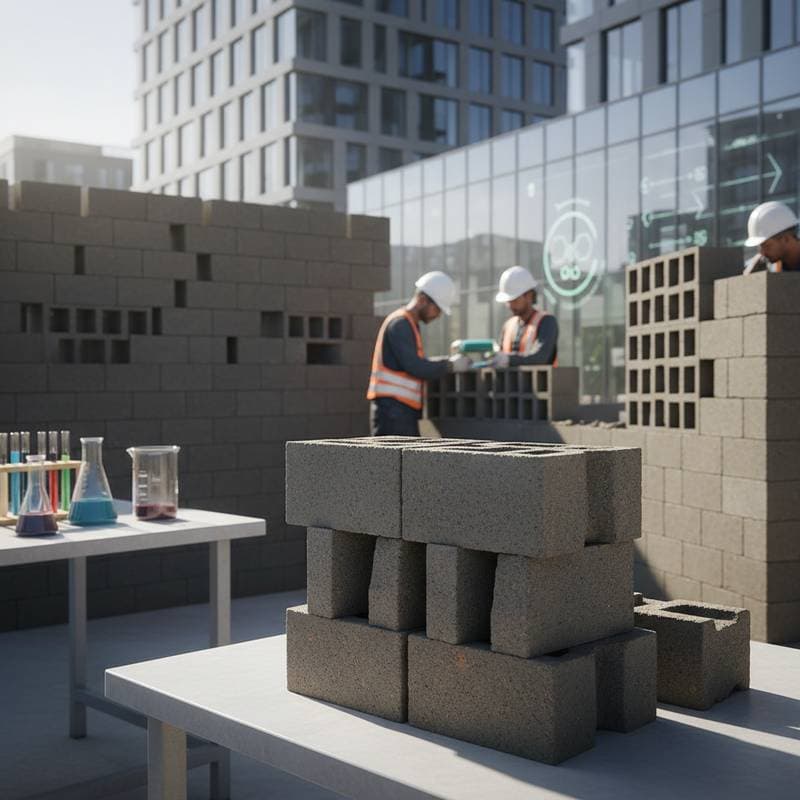
Zero-Cement Bricks: A Sustainable Evolution in Masonry
Zero-cement bricks represent a significant advancement in the masonry industry by substituting traditional Portland cement with geopolymer binders. These bricks incorporate industrial byproducts such as fly ash or slag in place of limestone-based clinker. The outcome yields a robust, long-lasting, and low-carbon option suitable for walls, pavements, and load-bearing structures.
In contrast to conventional bricks that rely on cement for structural integrity, geopolymer or zero-cement bricks achieve rigidity via a chemical reaction between aluminosilicate materials and alkaline activators. This process creates a compact, stone-like matrix that avoids the substantial carbon emissions associated with cement manufacturing. Builders, homeowners, and architects take note of these bricks because they match the performance of concrete blocks while incurring far less environmental harm.
Understanding Costs
The material price for zero-cement bricks generally ranges from $1.00 to $2.50 per unit, influenced by factors such as dimensions, material blend, and surface treatment. For wall installations, the total cost including mortar, foundation preparation, and labor averages $10 to $18 per square foot.
Expenses increase in scenarios involving custom configurations or textured finishes. Projects with challenging site access or the need for extensive scaffolding also elevate costs. Additionally, the use of specialized mortars or sealants designed for geopolymer compatibility adds to the budget.
Costs decrease through strategies like purchasing in large volumes from local producers. Standard running bond layouts that minimize cutting further reduce expenses. Leaving surfaces unsealed can simplify the process and lower overall outlay.
Although upfront prices may exceed those of clay or cement bricks, the reduced need for maintenance and extended service life frequently offset the difference over time.
Key Specifications to Verify
Prior to purchasing zero-cement bricks, evaluate these essential attributes:
- Compressive strength: Target at least 5,000 psi for load-bearing walls; opt for higher ratings in paving applications.
- Water absorption: Select units below 10 percent for outdoor exposure to prevent moisture damage.
- Freeze-thaw resistance: Ensure adherence to ASTM standards or local equivalents for durability in varying weather.
- Dimensional accuracy: Confirm uniform sizing to facilitate precise jointing and straight alignment.
- Thermal properties: Review conductivity values to inform energy efficiency calculations in wall systems.
Verify mortar compatibility as well. Certain geopolymer bricks perform optimally with lime-based or polymer-enhanced mortars rather than those containing Portland cement.
Installation Guidelines
The installation of zero-cement bricks mirrors traditional masonry procedures, yet demands careful consideration of curing times and mortar choices.
- Prepare layout and base: Mark guidelines with chalk lines and verify right angles at corners.
- Prepare mortar: Select or mix formulations suitable for elevated pH environments or non-cementitious adhesion.
- Lay initial course: Establish a level foundation; minor deviations amplify in subsequent layers.
- Apply bedding material: Distribute mortar uniformly to achieve consistent 3/8-inch joint depths.
- Monitor alignment: Use levels to adjust each row for plumb and straightness prior to setting.
- Finish joints: Tool surfaces to compact and seal against water penetration.
- Facilitate curing: Shield from direct sun and maintain moisture for a minimum of two days, following manufacturer directives.
For paving or retaining walls, prioritize compacted sub-bases, perimeter restraints, and adequate drainage gradients.
DIY Projects Versus Professional Installation
Projects Suitable for DIY
- Garden borders or planters not exceeding three feet in height.
- Patios or pathways covering less than 200 square feet.
- Basic linear patterns without complex intersections.
Situations Requiring Professionals
- Structures supporting significant loads.
- Sites prone to water pooling or unstable soil.
- Designs featuring arches, contours, or retention elements.
- Installations subject to local permitting for licensed work.
Individuals undertaking DIY efforts require basic tools including a spirit level, rubber mallet, pointing trowel, jointer, and safety equipment for material handling and cutting. Professionals employ advanced gear such as plate compactors, dust-suppressed saws, and laser levels to guarantee accuracy and compliance.
Considerations for Regional Climates
Zero-cement bricks perform reliably in diverse environments, provided adjustments address local conditions.
- Cold regions: Specify low-absorption variants certified for freeze-thaw endurance, incorporating drainage planes and ventilation gaps.
- Arid, hot locales: Moisten bricks during initial curing to avert premature cracking from rapid drying.
- Coastal environments: Select salt-tolerant compositions and periodically rinse with freshwater to mitigate corrosion.
- Wet, rainy areas: Install protective ledges and projections to limit water accumulation.
- Wind-prone zones: Adhere to reinforcement protocols for facade attachments and secure anchoring.
Consult municipal authorities to determine approvals for structural versus decorative uses.
Purchasing and Quality Assurance
When sourcing zero-cement bricks, scrutinize supplier credentials and manufacturing processes. Seek evidence of:
- Conformance to ASTM C34 or comparable standards for longevity.
- Provenance of fly ash or slag, confirming non-hazardous quality and uniform particle size.
- Documentation of batch testing for consistency.
- Guidance on matching mortars and protective coatings.
- Logistics ensuring dry delivery and storage to avoid pre-installation dampness.
Anticipate ordering 5 to 10 percent surplus to account for on-site alterations, damage, and reserves. Stack materials on pallets under tarps until deployment.
Safety Protocols and Regulatory Compliance
Handling geopolymer components necessitates standard precautions to protect health.
- Don gloves and goggles during contact with alkaline solutions or fresh mortar.
- Employ respirators for dust generated in cutting or blending dry components.
- Restrict access to work zones involving children or animals during curing.
- Ensure airflow in confined mixing areas to disperse vapors.
- Direct wastewater disposal to approved channels, avoiding stormwater systems.
Obtain necessary permits addressing height restrictions, property lines, and engineering for retaining features. In select areas, geopolymer systems may demand specialist review due to innovative classification.
Expert Recommendations for Optimal Results
- Manage curing environment: Sustain stable temperatures and humidity levels in the early stages to promote uniform hardening.
- Maintain batch uniformity: Weigh ingredients accurately to prevent discrepancies in hue or integrity.
- Prepare limited mixes: Geopolymer formulations harden more rapidly than cement alternatives, so work in small portions.
- Shield from elements: Drape plastic over fresh assemblies to block precipitation until fully set.
- Validate connections: Construct a test panel to assess adhesion and aesthetics prior to committing to the full project.
Following these practices yields even curing and a cohesive final appearance.
Long-Term Care for Durability
Structures built with zero-cement bricks demand minimal upkeep compared to legacy materials, yet periodic attention preserves performance.
Clean exteriors annually using gentle soap and a non-abrasive brush. Examine joints seasonally for fissures or erosion. Replenish sand in paved joints to stabilize surfaces and inhibit movement.
Divert surface water from upright faces to minimize discoloration. Promptly substitute compromised units to block moisture entry.
Regular maintenance ensures these installations endure for generations, fostering enduring environmental benefits.
Advancing Toward Sustainable Builds
Integrating zero-cement bricks into projects accelerates the transition to greener construction practices. Their blend of performance and reduced emissions empowers informed choices for resilient infrastructure. Builders who adopt this technology contribute to a legacy of innovation that balances strength with planetary stewardship.