
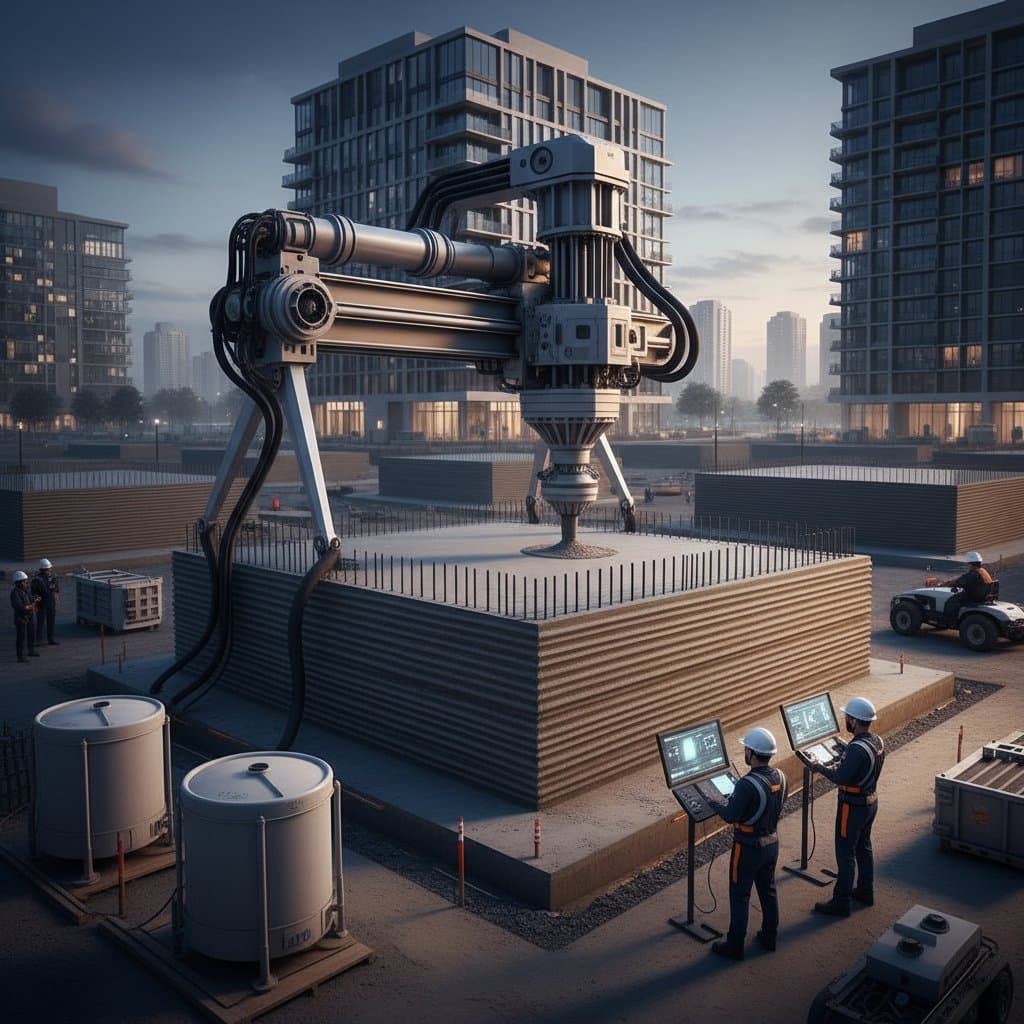
3D-Printed Foundations: Faster Builds, Half the Cost
The foundation serves as the essential base for any structure, yet traditional methods often involve prolonged timelines and high expenses due to labor-intensive formwork, curing periods, and weather dependencies. 3D-printed foundations address these challenges through robotic automation and custom concrete formulations. This approach delivers rapid construction, significant cost reductions, and precise execution while upholding structural standards and regulatory compliance.
This guide details the mechanics of 3D-printed foundations, essential planning steps, execution procedures, and ongoing maintenance. Readers gain insights into cost structures, required equipment, and key considerations to assess suitability for upcoming projects.
Key Takeaways
- Average Cost: Expect $6 to $10 per square foot, with labor at 20 percent, materials at 50 percent, and equipment at 30 percent of the total.
- Speed: Complete a 1,000-square-foot foundation in 8 to 12 hours, versus 3 to 5 days using conventional techniques.
- Precision: Achieve layer accuracy to 0.04 inches, promoting uniform thickness and minimizing waste.
- Technical Requirements: Secure a large-format concrete printer, a compatible mix, and stable site preparation.
- Major Decision Factors: Assess soil type, permit processes, printer availability, and compatibility with overlying construction methods.
Planning and Permitting Requirements
Evaluating Site and Soil Conditions
Start by confirming soil suitability to bear structural loads. Engage a geotechnical engineer to measure bearing capacity and frost line depth. Aim for at least 1,500 pounds per square foot in residential applications. For unstable or swelling soils, incorporate printed grade beams alongside compacted backfill or helical piles to enhance stability.
Permit and Code Compliance
Building regulations evolve to accommodate 3D printing, but many areas apply existing concrete foundation rules. Prepare to
- Engineering analyses verifying load-bearing capabilities.
- Formulation details and lab tests demonstrating compressive strength above 3,000 PSI.
- Documentation of printer setup and certified operator credentials.
- Provisions for on-site inspections during curing, rebar installation, and anchor embedding.
Contact municipal officials at the outset to clarify requirements and streamline approvals.
Cost and Logistical Planning
Allocate funds across these categories for a 3D-printed foundation:
- Printer Rental or Service: $1.50 to $3.00 per square foot.
- Material Mix: $3 to $5 per square foot, influenced by performance enhancers.
- Labor and Oversight: $1 to $2 per square foot.
- Testing, Permits, and Setup: $0.50 to $1.00 per square foot.
Overall installation falls between $6 and $10 per square foot, half the $12 to $18 of poured alternatives. Factor in initial transport and site mobilization costs of $1,500 to $3,000 based on distance.
Executing the 3D Printing Process
Step 1: Site Preparation and Design Finalization
Clear and level the building footprint to within 0.5 inches of grade. Finalize the digital model in CAD software, incorporating rebar placements and utility routings. Verify printer rails align precisely with the design coordinates.
Step 2: Equipment Setup and Calibration
Position the gantry-style printer over the site, securing rails to withstand extrusion forces. Calibrate nozzles for 0.4-inch layer heights and test run a small section to confirm alignment. Ensure power supply and material pumps operate without interruptions.
Step 3: Base Layer Application
Pour a thin slurry base to seal the soil and provide a smooth starting surface. Allow initial set for 30 minutes before commencing the main print. This step prevents adhesion issues and ensures even load distribution.
Step 4: Material Preparation and Testing
Blend the concrete per supplier guidelines, targeting a slump of 7 to 9 inches for flowability. Perform rheology tests to verify pumpability and avoid blockages. Store the mix at 50 to 85 degrees Fahrenheit to support consistent extrusion and early strength gain.
Step 5: Layer-by-Layer Printing
The robotic arm deposits material in 0.4- to 0.6-inch layers, following the programmed path for walls, footings, and stems. Bonds form through hydration and interlock. Integrate reinforcement via:
- Embedded Elements: Insert rebar or fibers at designated intervals.
- Matrix Additives: Incorporate micro-fibers for enhanced ductility.
A standard 1,000-square-foot print requires 8 to 12 hours, scaling with height and features.
Step 6: Curing and Protection
Apply moisture immediately post-print using wet burlap or automated sprayers for seven days minimum. This promotes full hydration and reaches design strength. Restrict access to light foot traffic only. In arid areas, seal with compounds; in moist environments, monitor for excess water pooling.
Troubleshooting Common Challenges
Uneven Layer Extrusion
Problem: Gaps or irregular deposits occur.
Cause: Fluctuating pump pressure or nozzle elevation.
Solution: Adjust to 90-120 PSI and re-level the head; test viscosity with a flow cone.
Cracking During Curing
Problem: Fissures appear on surfaces.
Cause: Accelerated evaporation or low humidity.
Solution: Enclose with tarps and sustain 60 percent relative humidity initially; apply sealers if needed.
Weak Bonding Between Layers
Problem: Layers separate under stress.
Cause: Prolonged intervals between passes.
Solution: Print continuously and match speed to the mix's 10-15 minute set window.
Printer Drift or Misalignment
Problem: Structure veers from blueprint.
Cause: Unstable tracks or GPS errors.
Solution: Anchor the frame firmly and reset coordinates using laser alignment tools.
DIY Feasibility Versus Professional Service
When DIY Is Possible
Experienced builders with concrete handling and modeling skills can tackle modest foundations. Acquire:
- A rented printer plus hands-on training.
- Proficiency in software like AutoCAD or Revit.
- Pre-arranged approvals and safety gear.
Such efforts yield 25 to 35 percent savings, particularly with existing tools and self-performed finishes.
When Professional Help Is Essential
Engage specialists for:
- Multi-level buildings demanding advanced analysis.
- Challenging soils needing custom supports.
- Strict codes requiring verified materials and oversight.
- Projects with embedded systems like conduits.
Professionals ensure compliance and mitigate risks through proven workflows.
Integrating 3D-Printed Foundations into Your Build
Adopt 3D printing to accelerate timelines and budgets without sacrificing quality. Evaluate site specifics against these guidelines to proceed confidently. This method not only halves costs but also sets the stage for efficient, resilient structures that endure.