
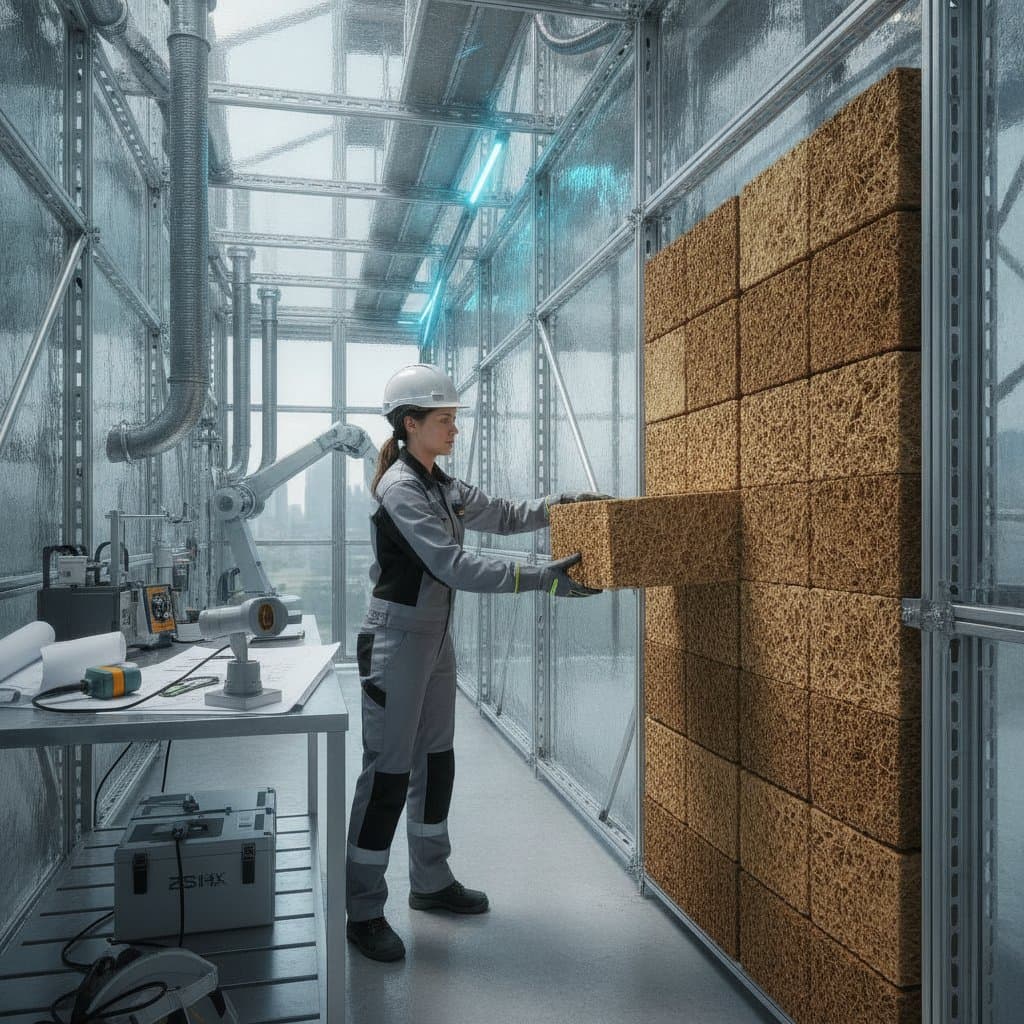
Mycelium Bricks Offer a Sustainable Alternative to Clay
Quick Assessment
Mycelium bricks form from fungal root networks and replace fired clay in nonstructural applications. Builders gain lower embodied energy and reduced weight. The primary challenge remains moisture sensitivity that requires careful sealing and ventilation design.
Field Checks for Quality
Homeowners and builders evaluate material suitability through direct tests.
- Press a block edge with moderate thumb pressure to confirm resistance without crumbling.
- Mist the surface and observe absorption speed. Rapid darkening indicates the need for immediate sealing.
- Detect odor by smelling a fresh sample. Sour notes signal incomplete drying during production.
- Examine color consistency across the block face. Uniform tone reflects even colonization and curing.
- Compare weight against standard clay units. Lighter mass reduces foundation loads yet limits compressive capacity.
- Dry fit several blocks to verify clean edge contact and minimal gaps.
Warning Indicators
Persistent damp spots after curing point to future decay. Visible mold growth or brittle edges that chip during handling require rejection. Inconsistent sizing and expanding odor also indicate production flaws. Cracking during installation or missing exterior coatings signals immediate structural risk.
Cost and Correction Options
Surface sealing with breathable silicate or limewash coatings costs 3 to 6 dollars per square foot. Exterior rainscreen cladding adds 10 to 20 dollars per square foot and protects against saturation. Replacement of failed blocks reaches 15 to 25 dollars per square foot when mold or poor curing occurs. Controlled growth environments increase material price by 10 to 15 percent yet prevent larger wall failures.
Material Compatibility Guidelines
Repair surface chips with mycelium slurry patches followed by resealing. Replace units only when load capacity or moisture resistance is compromised. Separate mycelium from traditional clay in load bearing sections to avoid differential movement. Pair the blocks with vapor permeable insulation such as wood fiber. Maintain a capillary break at the foundation through stone bases or membranes.
Project Team Roles
Engage an architect early to verify wall thickness and code compliance. Specify exact substrate and curing standards with suppliers to control strength variation. Select masons experienced with lightweight blocks to prevent edge damage. Consult envelope specialists in humid climates for drying rate modeling. Professional coordination adds 10 to 20 percent to total cost but reduces sequencing errors.
Implementation Sequence
Grade soil and confirm drainage before material arrival. Accept only certified dry blocks. Construct foundations to accommodate lighter loads. Install units, apply seals, then add cladding. Route mechanical systems in accessible chases. Apply finishes after complete drying.
Ongoing Maintenance Practices
Inspect coatings each season for cracks and renew as required. Clear gutters to limit splash back. Maintain six inches of ground clearance at wall bases. Monitor discoloration near openings. Provide interior airflow to support natural humidity regulation.
Practical Recommendations
Produce or source blocks locally to reduce contamination risk during transport. Avoid impermeable membranes that trap vapor. Store units on pallets with airflow. Use clips rather than screws for fastening. Build and monitor a small exposed mock up through one full weather cycle before larger installation.
Pilot Project Steps
Mycelium bricks support low energy construction when moisture management stays rigorous. Begin with a nonstructural test wall. Record weight and appearance changes across seasons. This direct observation confirms performance before scaling to full building applications.