
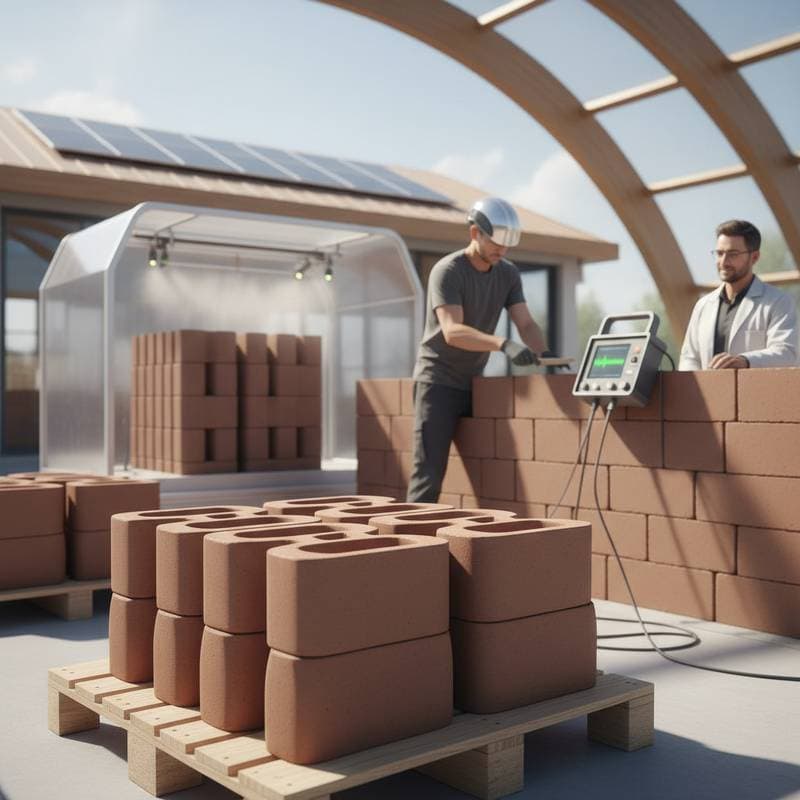
Zero-Cement Bricks Advance Sustainable Masonry Practices
Quick Overview
Cement-free masonry emerges as a viable option for construction professionals seeking materials with reduced carbon footprints that satisfy rigorous structural demands. Primary concerns involve unproven formulations or inadequate curing, which can compromise material cohesion. Production expenses stem from procuring stable industrial byproducts and implementing supervised manufacturing, distinct from on-site cement blending.
Essential Field Inspections
Evaluate zero-cement or geopolymer bricks through straightforward, hands-on assessments to gauge their suitability.
- Surface Consistency: Examine for uniform coloration and texture. Irregularities or excessive white deposits indicate curing inconsistencies or formulation flaws.
- Edge Sharpness: Inspect edges for clarity and solidity. Friable corners suggest insufficient binding agents or inadequate compaction during production.
- Weight and Density: Lift individual bricks. While lighter variants aid handling, they must achieve specified compressive strength standards.
- Sound Evaluation: Strike two bricks together. A clear, resonant tone indicates strong internal cohesion; a muted response signals potential internal gaps.
- Water Absorption Check: Apply water droplets to the surface. Gradual absorption reflects low porosity and enhanced longevity; quick penetration denotes vulnerability.
Apply these same tactile and visual tests as you would to conventional clay or concrete products. Field observations provide valuable insights prior to laboratory verification.
Warning Indicators
Specific traits can swiftly elevate both expenses and reliability issues.
- Pronounced white, powdery residue across multiple surfaces, evidencing salt migration.
- Flaking material when lightly scratched with a metal tool.
- Proneness to chipping upon standard handling or drops from waist height.
- Variations in size exceeding two millimeters in length or height.
- Incorporation of unidentified or untested industrial residues as aggregates.
- Claims of immediate usability or cure-free processes lacking supporting evidence.
Such markers reveal lapses in quality oversight or exaggerated assertions. Material shortcomings at the outset often amplify problems in assembled walls, joints, and surface treatments.
Practical Remedies and Estimated Expenses
Geopolymer and zero-cement bricks utilize aluminosilicate bases like fly ash, ground slag, or thermally processed clay, activated via alkaline agents. Success requires exact proportions and environmental controls during curing. Remediation strategies vary by defect origin.
- Efflorescence on Surfaces: Cleanse with a vinegar-water solution or gentle acidic wash. Expenses remain minimal, below one dollar per square foot. Recurring issues may necessitate penetrating sealants or refined curing protocols.
- Inadequate Strength or Softness: Replacement stands as the sole dependable solution. Recasting batches incurs a 20 to 30 percent increase in project costs.
- Size Irregularities: Minor adjustments via grinding suit limited quantities; extensive operations demand full remanufacturing.
- Excessive Moisture Retention: Coat with vapor-permeable silane-siloxane treatments. Application costs range from two to three dollars per square foot.
Surface disguises such as paints or impermeable films merely conceal defects and promote moisture entrapment. Prioritize adjustments to formulations and storage practices from the start.
For comprehensive wall assemblies or fresh constructions, zero-cement brick costs exceed standard concrete masonry by 15 to 25 percent, influenced by project volume and logistics. Proximity of suppliers significantly affects pricing. Regional manufacturing helps mitigate these differentials.
Deciding Between Repair and Replacement
Masonry systems necessitate definitive thresholds for intervention. With novel materials, clarity in decision-making proves essential.
- Individual Units: Address superficial flaws only after confirming core robustness. Substitute if strength dips below regulatory minima or if fissures appear internally.
- Joint Connections: Employ geopolymer-compatible or lime mortars. Standard cement variants disrupt chemical harmony, risking separation.
- Protective Layers: Opt for permeable mineral-based paints or stains. Discard synthetic films that impede vapor diffusion.
- Load-Bearing Assemblies: Reconstruct segments exhibiting extensive dusting or adhesion loss. Proactive replacement averts escalated remediation expenses.
Adhere to the principle of retaining verified, intact elements while avoiding mismatched integrations. Uniform chemical profiles and moisture dynamics outweigh experimental appeal.
Collaborative Team and Workflow
Zero-cement masonry requires integrated efforts across planning, procurement, and on-site implementation. Engage specialists at project inception.
- Materials Specialist: Oversees formulation validation, curing methodologies, and assessment of regional inputs.
- Design Professional: Specifies aesthetics, patterning, and environmental tolerances.
- Load Analyst: Verifies capacity for vertical, lateral, and dynamic forces.
- Seasoned Installer: Manages transport, storage, and assembly protocols.
- Independent Tester: Conducts assays for strength, permeability, and cyclic durability prior to deployment.
Concurrent evaluations minimize uncertainties. Secure supply assurances before finalizing plans, as fabrication facilities and curing zones frequently constrain timelines.
Dedicated oversight elevates total expenses by 10 to 20 percent yet curbs deviations through methodical progression and diminished corrections. Benefits accrue via streamlined operations and reduced waste.
Strategic Investment Focus
In sustainable masonry, allocate resources to high-impact areas yielding quantifiable gains.
- Envelope Integrity: Enhance air barriers and continuity to curb thermal escape.
- Water Management: Integrate effective drainage, edge protections, and flashing to safeguard assemblies irrespective of composition.
- Heat Transfer Minimization: Incorporate insulated interiors or separated walls to boost efficiency without expanding profiles.
- Joint Renewal: Limit to documented degradation sites. Refrain from disrupting functional areas for appearance alone.
Bypass marginal enhancements like ornamental facings that burden structure without functional uplift, or moisture-prone subterranean expansions. Direct funds toward robust detailing and empirical validations.
Planning Budget and Phased Execution
Selecting alternative materials alters workflow sequences and hazard profiles. For geopolymer or zero-cement applications, establish moisture safeguards initially, followed by structural buildup and final treatments.
- Preparation of Site and Runoff: Slope terrain to divert water from bases. Channel precipitation distant from vertical elements.
- Base Evaluation: Ensure foundations remain arid and aligned prior to unit placement.
- Fabrication and Maturation: Time production to permit thorough setting and pre-use analysis.
- Assembly of Walls: Proceed under steady climatic conditions, minimizing humidity fluctuations.
- Joint Completion: Finish after preliminary hardening; early manipulation impairs adhesion.
- Protective Applications: Introduce permeable barriers or washes post-full stabilization.
Finalize exteriors last. Withhold internal insulations or linings until wall equilibrium is achieved. Hasty phases invite condensation and seasonal damage.
Insights from Industry Experts
"Moisture remains the foremost hazard," noted a structural analyst from Vermont. "Zero-cement bricks outperform concrete in moisture resistance when properly formulated, yet drainage and weatherproofing demand precision."
An installer from Oregon observed, "The material cuts and places smoothly, but teams must maintain uniform joint widths. It mimics natural stone more than standard blocks."
A researcher in Ontario emphasized, "Strength poses no issue; consistency does. Variations in fly ash or slag batches require ongoing monitoring to sustain standards."
These perspectives align with empirical observations. Mastery of hydration, composition, and fabrication underpins enduring outcomes beyond promotional narratives.
Enduring Qualities
Zero-cement bricks match concrete's robustness while surpassing it in ecological profiles. They exhibit strong fire endurance and color stability sans additives. Thermal inertia parallels traditional options, complemented by drastically reduced embedded emissions.
Longevity depends on precise composition, controlled setting, and moderated exposure to dampness. Lapses in these domains yield early surfacing defects like fissures or erosion. Optimal management ensures multi-decade service.
Resistance to freeze-thaw stresses the binder-aggregate interface. Compact, minimally porous units perform optimally. In damp regions, facilitate vapor transit via open coatings, discontinuity zones, and sealant upkeep.
Upkeep involves routine checks and selective joint work, with lifecycle evaluations indicating favorable returns as regional scaling advances and logistics optimize.
Supply Chain and Market Dynamics
Viability ties to proximate, uniform feedstocks. Fly ash, slag, or processed clays demand reliability. Distant sourcing undermines sustainability objectives.
Artisanal operations may yield inconsistent outputs in trials. Industrial-scale facilities provide uniformity but constrain adaptability. Weigh accessibility versus tailored options.
Pricing converges with norms as domestic production expands. Regulatory hurdles persist, with some areas mandating validated performance records for structural approval. Engage authorities promptly to sidestep revisions.
Integration with Existing Builds
For heritage or hybrid edifices, zero-cement bricks serve as harmonious infills when calibrated thoughtfully. Reduced contraction and aligned permeability minimize entrapment risks compared to cement repairs.
Trial in non-critical zones like enclosures or perimeter features. Monitor over an annual cycle before broader adoption. Assess adhesion between legacy lime works and novel binders; bridging agents may facilitate seamless unions.
Defer direct attachment to saturated or contaminated substrates until ingress sources are eliminated. Moisture mitigation precedes all interventions.
Preserving Structural Value
Post-installation vigilance simplifies upkeep. Review assemblies annually and following severe weather.
- Recurring deposits on basal layers.
- Minor fissures adjacent to apertures or edges.
- Degradation in sealants or metalworks.
- Obstructions in drainage vents or channels.
Employ gentle cleansers and bristle tools exclusively. Eschew high-pressure methods that ingress fluids. Refresh vapor-friendly treatments every ten years or upon rising permeability.
Implementing Sustainable Choices
Zero-cement bricks represent a substantive evolution in masonry, harnessing waste streams to lower emissions and uphold performance standards through rigorous protocols. Builders and owners prioritizing endurance and stewardship find alignment in these principles: fortify against water, affirm stability, and harmonize components.