
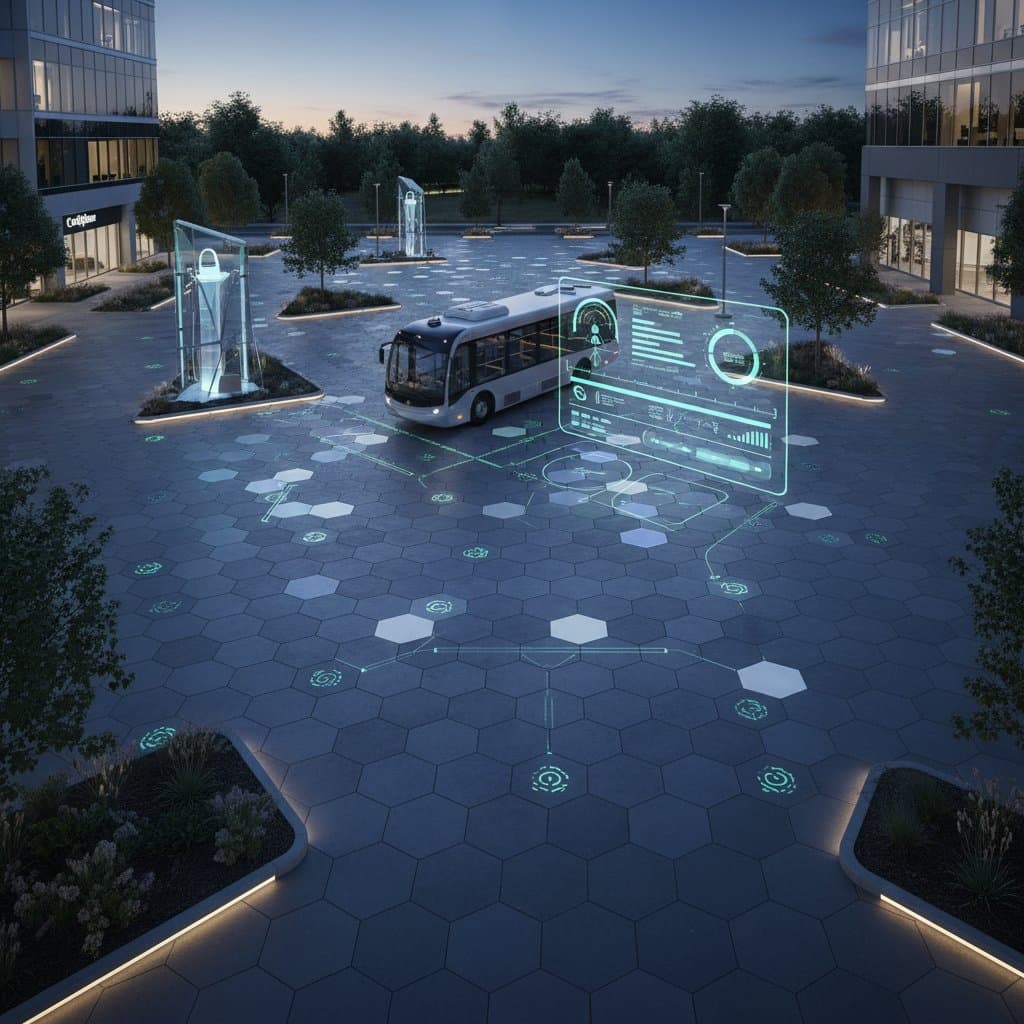
Smart Pavers Unlock Traffic Insights for Commercial Sites
Smart pavers integrate traditional hardscaping materials with advanced sensor technology. Embedded sensors within each paver monitor movement, weight distribution, temperature fluctuations, and moisture levels. This data transmits to a central processing system, which generates actionable insights for property managers and facility operators. For commercial properties, these innovations convert standard driveways, parking lots, and walkways into dynamic information hubs that enhance safety, operational efficiency, and maintenance strategies.
Functions of Smart Pavers
Smart pavers resemble and install similarly to standard concrete or stone varieties, yet they incorporate discreet sensors to capture real-time activity. These sensors record the volume of vehicles or pedestrians traversing the surface, duration of occupancy, and structural responses to applied loads or environmental changes. Property owners gain detailed usage patterns, enabling proactive measures to minimize wear, identify potential failures early, and optimize resource allocation.
Advantages and Disadvantages
Advantages
- Monitors real-time usage and load conditions to inform strategic planning
- Enables targeted maintenance interventions to prevent expensive repairs
- Enhances site safety by pinpointing high-traffic areas or surfaces prone to slippage
- Advances sustainability objectives via precise, data-informed resource management
- Increases property value through contemporary technological integration
Disadvantages
- Involves elevated upfront costs compared to conventional pavers
- Demands reliable power or data connectivity, often via wireless networks
- Requires regular calibration and occasional battery replacements
- May prove uneconomical for sites with minimal traffic
- Necessitates robust data security protocols to safeguard privacy
Cost Considerations
Smart paver materials generally cost between $10 and $25 per square foot, varying by sensor sophistication, surface finish, and connectivity features. Total installed costs range from $18 to $40 per square foot, accounting for specialized labor in wiring, network configuration, and system testing. Expenses increase for intricate designs, restricted site access, or demands for high-resolution data capture. Entry-level systems focused on weight or motion detection align with lower pricing, whereas comprehensive models incorporating temperature, pressure, and moisture sensors command premium rates.
Durability and Upkeep
Smart pavers typically endure 25 to 40 years, akin to premium concrete products, assuming sensors remain encapsulated against moisture penetration. Essential maintenance practices encompass:
- Conducting visual assessments for cracks or displaced joints
- Cleaning surfaces with mild detergents and low-pressure water streams
- Verifying sensor performance via dedicated monitoring applications
- Substituting batteries or components according to manufacturer guidelines
Applying protective sealants or coatings prolongs the integrity of both pavers and internal electronics. Steer clear of abrasive acids or de-icing agents that could degrade embedded components.
Key Specifications to Evaluate
Prior to purchasing smart pavers, examine these critical attributes:
- Load capacity: Ensure compatibility with anticipated traffic, ranging from foot traffic to heavy vehicular loads
- Ingress protection (IP) rating: Measures resistance to dust and water ingress for sensor longevity
- Wireless communication protocol: Options include Bluetooth, Wi-Fi, or mesh networks for efficient data relay
- Power supply method: Choices encompass batteries, solar augmentation, or direct wiring
- Freeze-thaw resistance: Vital in temperate zones to withstand moisture-induced expansion and contraction
Consult the supplier's technical documentation for details on sensor precision, operational temperature ranges, and calibration procedures.
Project Planning and Preparation
Initiating a smart paver installation mirrors standard hardscape projects, with additional provisions for electrical and data infrastructure. Essential preparatory measures include:
- Evaluating soil stability and drainage to avert settling or water accumulation
- Mapping routes for conduits or wireless access points prior to groundwork
- Confirming a slope gradient of approximately 1 inch per 8 feet for effective runoff
- Requesting utility locates to avoid subsurface conflicts
- Achieving a base layer depth of 6 to 8 inches of compacted aggregate for vehicular support
Incorporate provisions for ongoing access to facilitate maintenance or sensor replacements, particularly in busy areas.
Installation Process
- Mark the layout. Employ chalk lines or string to outline the design pattern and ensure proper slope alignment.
- Excavate the foundation. Clear soil to accommodate aggregate base, bedding material, and paver thickness.
- Compact the base. Apply a plate compactor in layered increments to achieve uniform density and slope.
- Position conduits or hubs. Install power and data lines beneath the bedding sand layer.
- Level the bedding. Screed a consistent 1-inch layer of sand for even support.
- Place the pavers. Start from a fixed reference edge, ensuring uniform joint spacing.
- Activate sensors. Adhere to manufacturer instructions for wiring or wireless pairing.
- Secure edges. Install restraints to inhibit shifting under load.
- Joint the pavers. Fill gaps with polymeric or standard sand, followed by light compaction.
- Validate functionality. Test data flow and connectivity prior to site finalization.
Design Patterns and Variations
Smart pavers mirror the shapes and color palettes of conventional interlocking systems. Popular arrangements feature herringbone for vehicular strength, basket weave for pedestrian aesthetics, and running bond for versatile applications. Select patterns according to load demands and visual preferences. Certain configurations permit hybrid installations, integrating smart units selectively in data-critical zones alongside traditional pavers.
Self-Installation Versus Professional Services
Individuals with experience can manage DIY projects for modest walkways or patios using straightforward wireless smart pavers, provided they possess essential tools like a plate compactor and proficiency in application configuration. Engage professionals for:
- Vehicular or load-bearing surfaces requiring precise engineering
- Integrations with existing building networks or centralized dashboards
- Scenarios involving drainage modifications or geotechnical stabilization
- Extensive areas where grading and compaction precision prove paramount
Certified installers guarantee accurate elevation control, base consolidation, and sensor tuning, all of which underpin sustained performance.
Typical Issues and Resolutions
Issue: Interrupted data transmission or erratic sensor outputs
Root: Faulty connections, depleted power sources, or signal interference
Resolution: Reinitialize the module, inspect power levels, and verify hub linkages
Issue: Paver displacement or surface irregularities
Root: Inadequate base consolidation or suboptimal drainage
Resolution: Excavate and reconstruct the affected section with reinforced foundational elements
Issue: Surface fractures or material degradation
Root: Thermal cycling from freeze-thaw or excessive loading
Resolution: Substitute compromised units, enhance drainage systems, and redirect traffic flows
Consistent data oversight facilitates early intervention, mitigating visible deterioration.
Climate-Specific Adaptations
In regions prone to freezing, opt for pavers engineered for thermal cycling and employ polymeric joint fillers to minimize water infiltration. For arid, high-temperature locales, verify sensor tolerances and select reflective hues to mitigate heat buildup. Coastal installations benefit from salt-resistant materials to counter corrosion. In precipitation-heavy areas, prioritize steep gradients and robust drainage to shield sensor enclosures from pooling.
Viable Alternatives
For budgets or complexities that render smart pavers impractical, explore these substitutes:
- Subsurface sensor arrays: Positioned under existing pavers for economical, targeted monitoring
- Intelligent bollards or fixtures: Gather traffic metrics without full surface replacement
- Permeable paving solutions: Enhance hydrological control absent data functionalities
- Sensor-infused coatings: Overlay current pavements for interim data acquisition
Implementing Smart Pavers Effectively
Smart pavers usher hardscape infrastructure into a digitally augmented framework. Property stewards acquire granular visibility into spatial utilization by occupants and vehicles, enabling evidence-based upkeep schedules and hazard mitigation. Initial expenditures yield returns via curtailed repair demands, optimized asset oversight, and refined spatial configurations. Commence with pilot applications in high-impact zones such as access routes or central plazas, analyze resultant analytics, and scale deployments accordingly.