
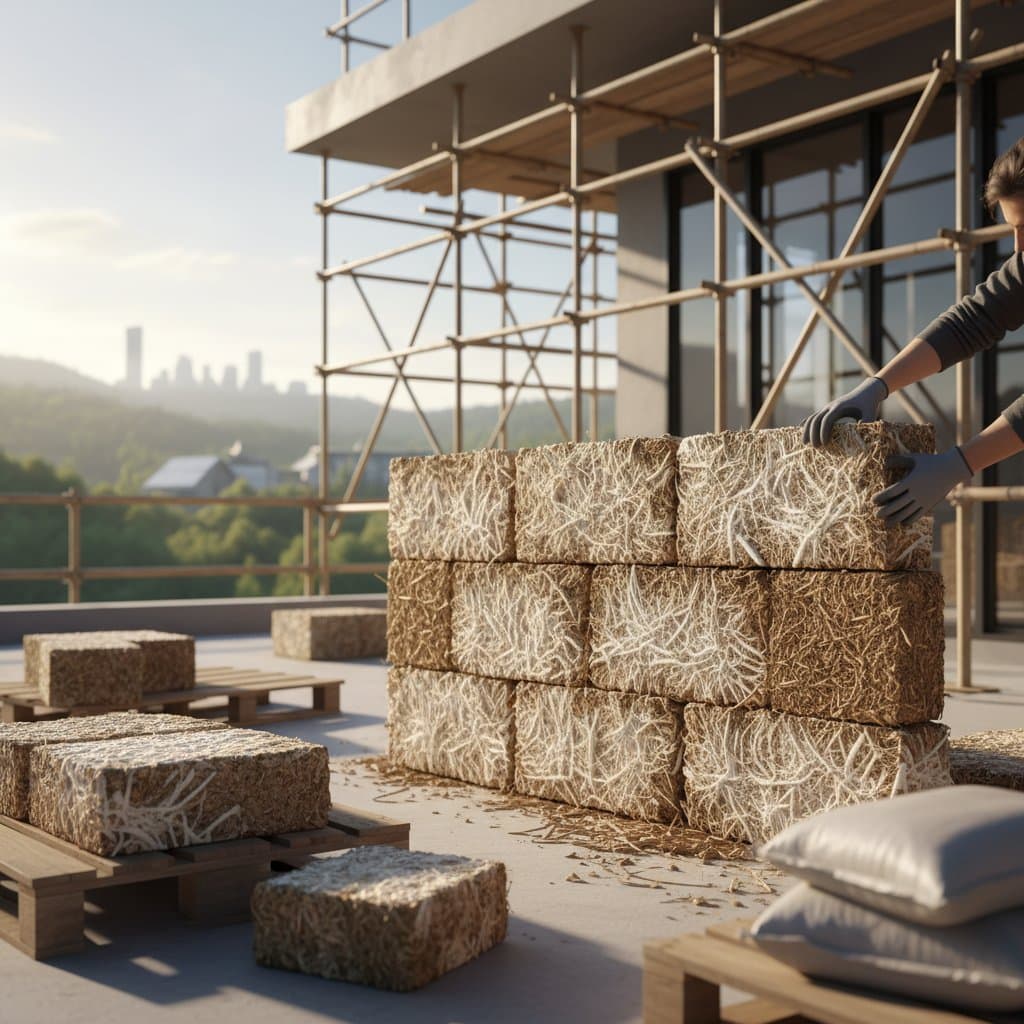
Mycelium Bricks: A Sustainable Alternative to Traditional Clay Masonry
Mycelium bricks represent an innovative bio-based material grown from the root-like networks of fungi, rather than shaped and fired from clay. These bricks prove lightweight, renewable, and fully compostable, presenting a viable option to the resource-intensive processes of conventional masonry that rely on mining and energy-heavy kilns. The growth process harnesses mycelium to bind agricultural byproducts, such as corn stalks or wood chips, into durable blocks over a period of days.
This approach attracts interest for its ability to lower the embodied carbon in buildings while transforming local waste into valuable resources. Builders and homeowners must evaluate if mycelium bricks suit their projects, considering both benefits and practical limitations in performance and application.
Understanding Production Costs
The expenses associated with mycelium bricks fluctuate based on factors like the choice of feedstock, the curing technique employed, and regional availability of materials. Raw material costs generally span 3 to 6 dollars per square foot of wall coverage for the bricks themselves. When factoring in installation, these costs rise to 10 to 18 dollars per square foot, depending on additional elements such as protective finishes and the scarcity of supply.
Key elements driving these costs include the intricacy of molds used for shaping, the duration required for growth and drying which impacts production speed, and the application of coatings to enhance resistance against moisture and ultraviolet exposure. Transportation expenses also play a role if production occurs distant from the construction site.
Compared to traditional fired clay bricks, which install at 2 to 5 dollars per square foot, mycelium options carry a higher upfront price. However, the environmental advantages, including reduced reliance on fossil fuels for firing, offset this premium over the building's lifecycle.
Essential Specifications to Evaluate
Prospective users should verify several critical specifications when selecting mycelium bricks to ensure suitability for their intended use.
- Density, expressed in pounds per cubic foot, influences both structural integrity and thermal performance.
- Compressive strength, rated in pounds per square inch, typically ranges from 70 to 200 PSI for non-load-bearing applications.
- Thermal conductivity, often between 0.03 and 0.05 watts per meter-kelvin, supports effective insulation properties.
- Water absorption, measured as a percentage of weight, requires low values for outdoor exposure to prevent degradation.
- Fire rating, which must align with local codes regarding flame spread and smoke production.
- Dimensional tolerance, accounting for natural variations in biological growth within molds.
Manufacturers should provide detailed product data sheets, ideally backed by independent testing, to confirm these metrics.
Step-by-Step Installation Guide
The installation of mycelium bricks mirrors that of other lightweight masonry but demands careful handling to preserve material integrity.
- Prepare the foundation and outline wall positions, ensuring a stable and level base.
- Perform a dry assembly to assess fit, alignment, and joint spacing.
- Select and apply a compatible bio-based mortar or adhesive, such as those formulated with low-volatile organic compounds or lime.
- Position the bricks with minimal force, avoiding impacts that could cause compression.
- Offset joints in successive courses to enhance stability and visual appeal.
- Incorporate edge supports or framing if constructing prefabricated panels.
- Finish with a sealant or coating after initial curing, opting for options like natural waxes or plant-derived resins for moisture protection.
- Permit complete drying before adding enclosures or adjacent finishes.
Overall, the timeline aligns with installing aerated concrete or lightweight clay blocks, though additional curing and sealing extend the process by several days.
Deciding Between DIY and Professional Installation
For do-it-yourself enthusiasts, mycelium bricks suit smaller-scale endeavors such as interior partitions, decorative walls, or garden features. Their reduced weight facilitates handling, and basic cutting with manual tools proves straightforward when paired with simple adhesive and sealant protocols.
Engage professionals for more demanding scenarios, including:
- Load-bearing walls that support roofs or upper levels.
- Projects surpassing 100 square feet in scope.
- Environments prone to moisture, necessitating vapor barriers and drainage systems.
- Situations requiring adherence to local building regulations or certified testing.
- Complex finishes involving custom coatings or fire-resistant configurations.
Experienced installers offer expertise in moisture management, proper flashing techniques, and ensuring long-term resilience. They also facilitate integration with broader systems, such as those pursuing green building certifications, by consulting structural and energy specialists.
Adapting to Regional Climates and Conditions
Performance of mycelium bricks varies by environment, requiring tailored strategies for optimal results.
In cold regions, maintain interior temperatures above the dew point to avert freeze-thaw cycles, potentially through exterior cladding or warm-side insulation.
Hot and humid areas demand emphasis on vapor permeability and ventilated surfaces, favoring breathable finishes over sealed paints.
Arid zones benefit from the material's stability in low moisture, though ultraviolet shielding remains essential to counter sun exposure.
Coastal settings call for robust sealing against salt-laden air and ongoing dampness, alongside fasteners resistant to corrosion.
For urban renewal projects, the bricks' lighter profile eases retrofits on aging foundations without excessive reinforcement.
Consult regional building authorities early, as approvals for bio-materials may involve engineering reviews or pilot demonstrations.
Expert Recommendations for Optimal Results
To maximize success with mycelium bricks, implement these practical strategies.
- Construct a sample panel prior to full-scale work to test bonding and aesthetics.
- Store and handle materials in dry conditions, as excess moisture compromises viability.
- Choose permeable coatings that permit vapor diffusion, avoiding synthetic barriers.
- Design with modularity in mind, allowing for straightforward section replacements over time.
- Compile and submit product documentation to inspectors at the outset to streamline permitting.
Approaching installation with the meticulous care akin to cultivation yields rewarding outcomes in bio-based construction.
Integrating Mycelium Bricks into Sustainable Projects
Mycelium bricks do not serve as a universal substitute for fired clay in every context, yet they broaden opportunities for environmentally conscious architecture. Their minimal carbon profile and end-of-life compostability align seamlessly with initiatives prioritizing ecological stewardship and innovative aesthetics.
Homeowners find value in non-structural uses like interior dividers, accent features, or auxiliary structures where thermal efficiency and ease of transport take precedence.
For architects and contractors targeting net-zero or regenerative developments, these bricks form a foundational element in closed-loop systems. As production methods advance, expect greater uniformity and affordability, accelerating widespread integration.
Familiarity with mycelium bricks equips individuals to incorporate them effectively, contributing to a built environment that consumes fewer resources, generates less refuse, and fosters biological harmony.