
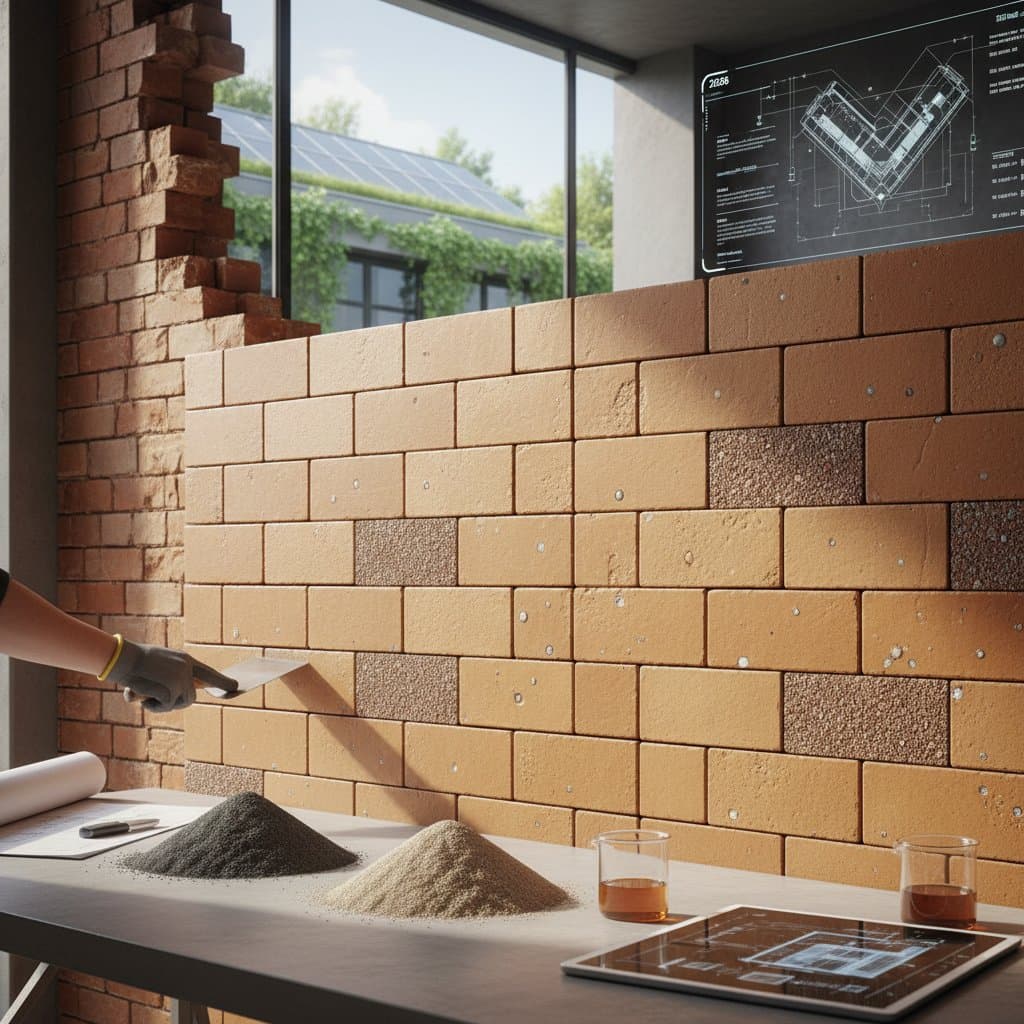
Understanding Geopolymer Bricks
Geopolymer bricks represent a significant advancement in masonry, utilizing industrial byproducts like fly ash, slag, or metakaolin instead of Portland cement. These materials, activated by alkaline solutions, create a robust binder that achieves compressive strengths often exceeding 40 megapascals, surpassing many conventional bricks at 20 to 30 megapascals. This approach not only hardens at ambient temperatures but also repurposes waste, lowering the environmental footprint of construction projects.
Traditional cement manufacturing demands high-heat kilns that release substantial carbon dioxide. Geopolymer production sidesteps this by relying on room-temperature reactions, which cut energy use by up to 80 percent and reduce overall emissions. Builders benefit from a material that aligns economic viability with ecological responsibility.
The Importance of Geopolymer Innovation
This technology tackles key industry issues, including resource scarcity and climate impact, by converting byproducts into high-performance building elements. Geopolymer bricks excel in compressive load-bearing, thermal resistance up to 1,000 degrees Celsius, and resistance to sulfates and acids, making them ideal for demanding environments. Their versatility extends to load-bearing walls, fire-resistant partitions, and durable pavements.
Dimensional stability sets geopolymers apart, as they exhibit minimal shrinkage below 0.1 percent during curing, compared to 0.5 percent or more in cement bricks. This consistency ensures precise wall construction, minimizes joint gaps, and prevents long-term cracks that compromise structural integrity. Overall, these bricks enhance project reliability and longevity.
Planning a Geopolymer Masonry Project
Transitioning to geopolymer bricks requires thorough preparation to account for their unique properties. Verify compliance with regional standards, such as ASTM C90 for structural masonry, and consult local authorities for approval in load-bearing applications. Factor in material sourcing, as availability varies by region.
Site Assessment
Begin by analyzing soil composition, drainage patterns, and exposure to elements. Geopolymers thrive on stable, well-drained bases; in wet climates, incorporate French drains or gravel layers to manage water flow. Test soil pH to ensure it supports the alkaline activation process without interference.
Material Selection
Fly Ash-Based Bricks
- Advantages: Achieve strengths over 45 megapascals at low cost, leveraging widely available coal combustion waste.
- Drawbacks: Potential for subtle color inconsistencies due to source variations; secure a reliable supplier.
- Ideal Applications: Interior and exterior load-bearing walls in standard residential builds.
Slag-Based Bricks
- Advantages: Superior resistance to chlorides and sulfates, perfect for harsh conditions.
- Drawbacks: Increased density around 2,200 kilograms per cubic meter; requires adjusted mixing ratios.
- Ideal Applications: Seawall reinforcements or industrial facility exteriors.
Metakaolin-Based Bricks
- Advantages: Uniform aesthetics with setting times under 24 hours for faster progress.
- Drawbacks: Higher material costs from processed clay sources; plan for lead times.
- Ideal Applications: Visible facades or custom architectural features.
Consider ordering 10 to 15 percent more bricks to accommodate on-site cuts and unexpected damages.
Essential Tools and Supplies
Assemble these items for efficient work:
- Brick trowel for even mortar application.
- Spirit level and plumb bob for precise alignment.
- Rubber mallet to position bricks without damage.
- Wet saw or angle grinder equipped with diamond blades for accurate cuts.
- Safety gear including gloves, dust masks, and eye protection.
Pair bricks with geopolymer-compatible mortar, typically a sodium silicate blend, to optimize adhesion and prevent efflorescence.
Installing Geopolymer Bricks Step by Step
Follow these steps to achieve a professional result.
- Foundation Preparation. Compact the base to 95 percent density using a plate compactor, and apply a damp-proof course to block moisture rise.
- First Course Layout. Mark guidelines with a chalk line and lay the initial row dry to confirm spacing, then bond with thin-set mortar.
- Mortar Application. Spread 10-millimeter beds and 8-millimeter joints, tooling them concave for water shedding.
- Brick Placement. Position each unit, tapping lightly to achieve level; verify alignment with a story pole every few courses.
- Joint Finishing. Tool joints at 50 percent hardness to seal against weather; remove excess promptly.
- Curing Process. Cover with breathable tarps and mist lightly for three days to control hydration without rapid drying.
For extended projects, prepare mortar in batches of 20 kilograms to avoid premature setting, and work in sections no wider than 1.2 meters.
Maintaining and Enhancing Geopolymer Structures
Post-construction care preserves performance. Apply silicate-based sealers annually to repel water while allowing vapor escape, and opt for lime washes over synthetic paints for breathability. Schedule inspections twice yearly, focusing on joint integrity; repoint with matching mortar using a chisel and grout bag.
Incorporate design elements like recessed LED strips or native plant borders to highlight the bricks' subtle hues. These integrations not only boost curb appeal but also support biodiversity in urban settings.
Building a Greener Future with Geopolymers
Geopolymer bricks empower constructors to deliver resilient, low-impact structures that endure environmental stresses. By prioritizing waste reuse and emission reductions, they pave the way for scalable sustainable practices in residential and commercial developments.