
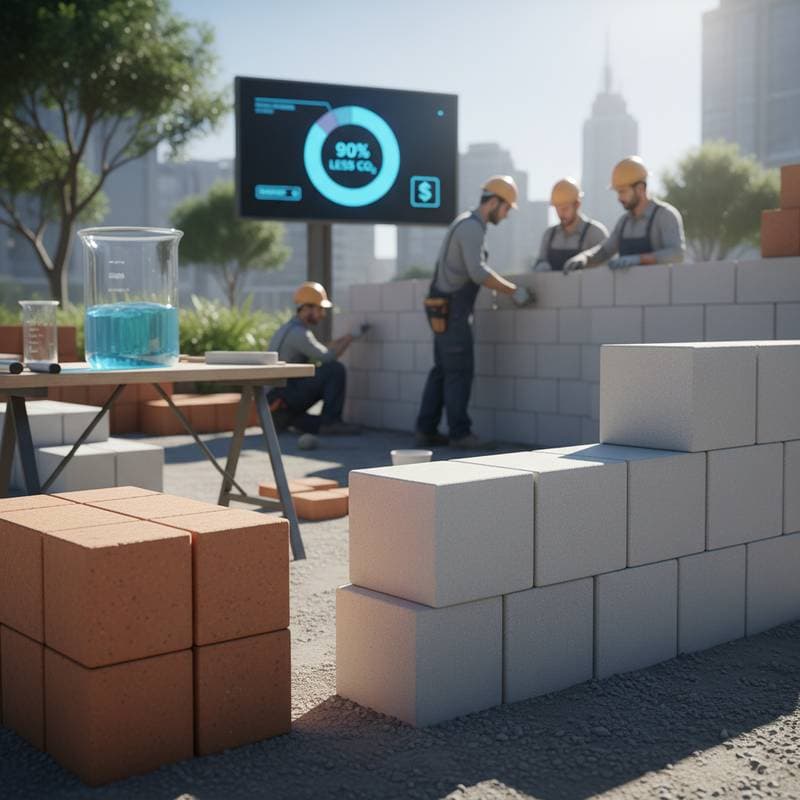
Zero-Cement Bricks Set to Transform Masonry by 2026
The masonry industry stands at the threshold of significant change with zero-cement bricks. These bricks substitute Portland cement with geopolymer binders derived from industrial byproducts like fly ash and slag. Builders gain a robust, enduring material that minimizes carbon footprints while rivaling conventional bricks in performance. As adoption grows, professionals and homeowners must weigh the benefits of this eco-friendly option against established practices.
Essential Benefits at a Glance
- Cost Savings: Expect prices 5 to 15 percent below those of fired clay or cement bricks, with materials comprising 60 percent of expenses, labor 25 percent, and equipment 15 percent.
- Strength Profile: Achieve compressive strengths of 6,000 to 8,000 PSI, surpassing standard concrete blocks for demanding applications.
- Curing Speed: Reach usability in 24 to 48 hours, far quicker than the seven-day hydration required for cement products.
- Environmental Impact: Reduce CO₂ emissions by 70 to 90 percent during production compared to traditional cement manufacturing.
- Service Life: Anticipate over 75 years of performance in typical conditions, ensuring long-term value.
The Science Behind Geopolymer Masonry
Geopolymer chemistry drives zero-cement bricks by activating aluminosilicates with alkaline activators. This reaction creates a solid, stone-like structure without the energy-heavy clinker production of Portland cement. The process yields a material that integrates seamlessly into load-bearing walls, pavements, and exterior facades.
Lower porosity enhances resistance to water ingress and freeze-thaw damage, proving advantageous in regions with harsh weather. Builders appreciate how these properties extend the material's reliability across diverse climates and uses.
Steps for Integrating into Construction Projects
Verify compliance with local building codes before specifying geopolymer bricks for structural elements. Authorities often demand proof of compressive and flexural strengths through certified tests. The permitting process mirrors that for standard masonry, though extra certification paperwork may apply.
Secure supplies from vetted manufacturers who maintain rigorous quality controls and traceability. Factor in shipping distances, as they influence final costs. Overall installation expenses align with traditional methods, yet faster curing can trim project timelines by 20 percent and cut labor needs.
Detailed Installation Process
-
Prepare the Site and Layout: Remove debris, outline wall positions, and confirm level surfaces. Employ familiar masonry tools for geopolymer bricks.
-
Choose Compatible Mortar: Select geopolymer or low-cement mixes to ensure adhesion. Maintain joint widths at 3/8 inch for stability.
-
Lay the Bricks Methodically: Start from corners and progress inward. Limit water exposure, as these bricks absorb less than clay varieties.
-
Cure and Evaluate: Permit 24 hours for initial set, with full strength in two days. Check for straight lines, even joints, and smooth finishes.
Addressing Potential Issues
Efflorescence appears infrequently but stems from residual alkalis; address it by applying a dilute acid rinse. Variations in color arise from mineral compositions, so blend batches for consistency. To avoid bonding failures, confirm mortar compatibility with brick formulations and prevent separation.
Ensuring Lasting Performance
These bricks demand little upkeep over time. Conduct yearly checks for cracks exceeding 1/16 inch or surface deterioration. In damp environments, reseal joints every five to seven years. The compact structure deters mold and algae, simplifying routine care.
Weighing DIY and Professional Approaches
Experienced DIY enthusiasts can manage non-structural tasks such as patios or low retaining walls using basic tools. Structural installations, however, call for licensed masons to meet codes and achieve peak performance. Professional involvement typically increases labor by 25 to 35 percent but safeguards quality and safety.
Advancing Sustainable Builds with Geopolymer Bricks
Geopolymer advancements position zero-cement bricks as a cornerstone of eco-friendly construction. They balance environmental responsibility with proven reliability. Homeowners and contractors who integrate them early will lead in creating resilient, low-impact structures.